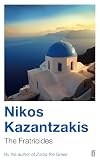
The Fratricides
by Níkos Kazantzákis
On This Page
Description
The Fratricides is about internecine strife in a village in the Epirus during the Greek civil war of the late 1940s. Many of the villagers, including Captain Drakos, son of the local priest Father Yanaros, have taken to the mountains and joined the Communist rebels. It is Holy Week and, with murder, death and destruction everywhere, Father Yanaros feels that he himself is bearing the sins of the world.Tags
Recommendations






















Member Reviews
The plot to The Fratricides is pretty simple. A small Greek town is at war with a group of communist rebels who live in the surrounding hills, constantly harassing them. There is a monk in town who advocates peace and understanding, but to no avail. Part of his credibility is undermined because it’s his own son who is leading the rebels. The monk tries to overcome the violence and ignorance all around him, all while fighting his own crises of faith.
He wonders, has God forsaken man, or has God simply given us brains and left the world’s affairs up to us? Are the communists who are trying to overthrow the government the real patriots, fighting for the common man and justice? Are they the real Christians, despite their professed show more atheism? Is either side ‘right’, or are both sides doing irreparable harm to Greece?
The monk finds himself all too alone. The men of the world are savage and violent to one another. Those who profess to be Christians act in conflict with the ideals of Christ, and it seems that “Blessed are the warmakers.” The organized men of faith are hypocritical and far from holy, a common theme in Kazantzakis’s books.
Kazantzakis uses The Fratricides to make several points: To truly be holy one must lead a life of true sacrifice and asceticism. Man needs to be free, and needs to be fierce to attain that freedom (certainly spiritually), but it’s a dilemma as to whether war should be waged. And lastly, as both sides in the conflict suffer in-fighting, one gets the impression that even if one side was victorious, that discontent and violence would continue on, for “How can you change the world when you cannot change man?”
In that sense it’s ultimately a bit pessimistic in its view, though that’s not the reason for the mediocre rating. Kazantzakis’s writing is lean and full of passion which I like, but in this case the book seems a bit one-dimensional in the analogy of the monk to Christ. It gets a bit repetitive and should have either been pared down, or had other characters or aspects of life fleshed out. show less
He wonders, has God forsaken man, or has God simply given us brains and left the world’s affairs up to us? Are the communists who are trying to overthrow the government the real patriots, fighting for the common man and justice? Are they the real Christians, despite their professed show more atheism? Is either side ‘right’, or are both sides doing irreparable harm to Greece?
The monk finds himself all too alone. The men of the world are savage and violent to one another. Those who profess to be Christians act in conflict with the ideals of Christ, and it seems that “Blessed are the warmakers.” The organized men of faith are hypocritical and far from holy, a common theme in Kazantzakis’s books.
Kazantzakis uses The Fratricides to make several points: To truly be holy one must lead a life of true sacrifice and asceticism. Man needs to be free, and needs to be fierce to attain that freedom (certainly spiritually), but it’s a dilemma as to whether war should be waged. And lastly, as both sides in the conflict suffer in-fighting, one gets the impression that even if one side was victorious, that discontent and violence would continue on, for “How can you change the world when you cannot change man?”
In that sense it’s ultimately a bit pessimistic in its view, though that’s not the reason for the mediocre rating. Kazantzakis’s writing is lean and full of passion which I like, but in this case the book seems a bit one-dimensional in the analogy of the monk to Christ. It gets a bit repetitive and should have either been pared down, or had other characters or aspects of life fleshed out. show less
Not one of his most famous works and, sadly, for good reason. Set in a small village during the Greek Civil War of the late 1940s, the story follows Father Yanaros, a 70-year-old priest who is determined to bring the sides together. It takes place during Holy Week and the story of Christ’s crucifixion and resurrection is Kazantzakis’s framework. Unfortunately, I thought he beat his theme to death. All three sides—the two warring factions (the fascists and the communists) and the priest himself—are completely intransigent; no one is willing to budge. Add to the mix, Kazantzakis’s personal devotion to Lenin (Kazantzakis became disenchanted with Communism after he watched Stalin in action) and the way he suggests that Lenin show more himself might be the second coming of Christ. I will say that he is enormously passionate and the book benefits from that, but in the end, it wasn't enough to save the book. show less
The Fratricides is set during the Greek civil war, and the title refers to Greeks killing their brother Greeks. Caught between the opposing sides - the government troops who hold his village, Castello, and the communist guerillas holding the top of the mountain - is Father Yanaros, who alone stands for peace and the brotherhood of his fellow Greeks. As the Holy Week begins Father Yanaros struggles with the villagers, and lives among their crushing poverty and overwhelming sadness as their sons are lost in battle on either side, who struggles with the ruthless captain who guards Castello, who distrusts, detests, Father Yanaros, whose son commands the communist rebels holding the mountain, and who believes the Father is in collusion with show more the enemy: with his fellow Churchmen, who he views as being corrupt and contemptable, and far from their Christian duty to, like Christ, suffer with the people - and above all with God, who seems to have turned His face from Greece...
My only real complaint is that the author at times gives details of a character's past, and the transition to these descriptions can feel unnatural, or seem out of place. Other than this the writing flows well and holds you fast.
Ultimately The Fratricides is a worthwhile, but depressing read. You cannot but feel for Father Yanaros, a pious yet simple man, standing alone, and calling to deaf ears for brotherhood among men, carrying the great Christian ideal of Love in a harsh world which is forever cold to it. show less
My only real complaint is that the author at times gives details of a character's past, and the transition to these descriptions can feel unnatural, or seem out of place. Other than this the writing flows well and holds you fast.
Ultimately The Fratricides is a worthwhile, but depressing read. You cannot but feel for Father Yanaros, a pious yet simple man, standing alone, and calling to deaf ears for brotherhood among men, carrying the great Christian ideal of Love in a harsh world which is forever cold to it. show less
A harsh and uncompromising look at war and the seeming futility of faith and the capacity for man to kill man.
Sometimes hard to read, but powerful.
Nikos Kazantzakis u lind më 18 shkurt 1883 në Iraklion, Kretë, Perandoria Osmane (tani në Greqi) ndërsa vdiq më 26 tetor 1957, në Freiburg im Breisgau, në Gjermani). Ishte shkrimtar grek, shumë produktiv, shumëllojshmëria e veprave të së cilit përfaqësojnë një kontribut të madh në letërsinë moderne greke.
Kazantzakis lindi gjatë periudhës së revoltës së Kretës kundër sundimit nga Perandoria Osmane dhe familja e tij iku për një kohë të shkurtër në ishulln grek të Naxos. Ai studioi drejtësi në Universitetin e Athinës (1902-06) dhe filozofi në henri Bergson në Paris (1907-09). Më pas ai bëri një udhëtim të gjerë në Spanjë, Angli, Rusi, Egjipt, Palestinë dhe Japoni, për t’u vendosur para show more Luftës së Dytë Botërore në ishullin Egina. Ai shërbeu si ministër në qeverinë greke (1945) dhe punoi për Organizatën e Kombeve të Bashkuara për Arsimin, Shkencën dhe Kulturën (UNESCO) në Paris (1947-48). Më pas ai u transferua në Antibes, në Francë. show less
Kazantzakis lindi gjatë periudhës së revoltës së Kretës kundër sundimit nga Perandoria Osmane dhe familja e tij iku për një kohë të shkurtër në ishulln grek të Naxos. Ai studioi drejtësi në Universitetin e Athinës (1902-06) dhe filozofi në henri Bergson në Paris (1907-09). Më pas ai bëri një udhëtim të gjerë në Spanjë, Angli, Rusi, Egjipt, Palestinë dhe Japoni, për t’u vendosur para show more Luftës së Dytë Botërore në ishullin Egina. Ai shërbeu si ministër në qeverinë greke (1945) dhe punoi për Organizatën e Kombeve të Bashkuara për Arsimin, Shkencën dhe Kulturën (UNESCO) në Paris (1947-48). Më pas ai u transferua në Antibes, në Francë. show less
Members
- Recently Added By
Lists

Jordan B. Peterson's Recommended Books
104 works; 5 members

Tammen Keltainen kirjasto
81 works; 1 member
Author Information

143+ Works 12,376 Members
This distinguished novelist, poet, and translator was born in Crete and educated in Athens, Germany, Italy, and Paris, where he studied philosophy. He found time to write some 30 novels, plays, and books on philosophy, to serve his government, and to travel widely. He ran the Greek ministry of welfare from 1919 to 1921 and was minister of state show more briefly in 1945. A political activist, he spent his last years in France and died in Germany. Kazantzakis's character Zorba has been called "one of the great characters of modern fiction," in a novel that "reflects Greek exhilaration at its best" (TLS). A film version of 1965, starring Anthony Quinn, made Kazantzakis widely known in the West. Intensely religious, he imbued his novels with the passion of his own restless spirit, "torn between the active and the contemplative, between the sensual and the aesthetic, between nihilism and commitment" (Columbia Encyclopedia). Judas, the hero of The Last Temptation of Christ (1951) is asked by Christ to betray him so that he can fulfill his mission through the crucifixion. For this book Kazantzakis was excommunicated from the Greek Orthodox Church. The Fratricides, Kazantzakis's last novel, portrays yet another religious hero, a priest caught between Communists and Royalists in the Greek Civil War. (Bowker Author Biography) show less
Some Editions
Series
Belongs to Publisher Series
Keltainen kirjasto (79)
Common Knowledge
- Canonical title*
- Veljesviha
- Original title
- Οι αδερφοφάδες. θέλει, λέει, να 'ναι λεύτερος, σκοτώστε τον!; Οι αδερφοφάδες
- Original publication date
- 1963
- People/Characters
- Father Yanaros; Leonidas; Captain Drakos; Mandras; Captain Sophocles
- Important places
- Greece
- Important events
- Greek Civil War
- First words
- The sun had risen in Castello
- Original language
- Greek
*Some information comes from Common Knowledge in other languages. Click "Edit" for more information.
Classifications
- Genres
- General Fiction, Fiction and Literature
- DDC/MDS
- 889.332 — Literature & rhetoric Classical & modern Greek literatures Modern Greek literature Fiction 20th century 1941-1944
- LCC
- PZ3 .F — Language and Literature Fiction and juvenile belles lettres Fiction and juvenile belles lettres Fiction in English
- BISAC
Statistics
- Members
- 322
- Popularity
- 99,148
- Reviews
- 10
- Rating
- (3.61)
- Languages
- 11 — Arabic, Dutch, English, Finnish, French, German, Greek, Hebrew, Norwegian (Bokmål), Portuguese, Turkish
- Media
- Paper, Ebook
- ISBNs
- 17
- ASINs
- 12