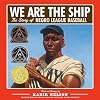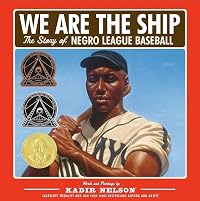
We Are the Ship: The Story of Negro League Baseball
by Kadir Nelson
On This Page
Description
Using an "Everyman" player as his narrator, Kadir Nelson tells the story of Negro League baseball from its beginnings in the 1920s through the decline after Jackie Robinson crossed over to the majors in 1947. Illustrations from oil paintings by artist Kadir Nelson.Tags
Recommendations





Member Reviews
An outstanding book, with an informative and immensely readable narrative, and gorgeous illustrations, Kadir Nelson's We Are the Ship is a work that draws the reader in, even if she (like myself) has little interest in baseball. The story of African-Americans in the sport - the title comes from a quote from Rube Foster, who founded the Negro National League - prior to the admittance of Jackie Robinson into the Major Leagues, in 1947, it is a celebration of the perseverance and independence of spirit that allowed so many athletes to continue in the face of limited opportunities, and discriminatory policies. It is also an enlightening examination of American history, exploring how racial segregation was enacted, not just in sport, but in show more everything from hotel accommodation to military service.
I learned quite a bit from this book - I'd never known, for instance, that African Americans played baseball with everyone else, until around 1887, when team owners stopped hiring them - and enjoyed it far more than I expected to. The artwork was simply breathtaking (that I did expect!), with Kadir Nelson's typically brilliant use of light, and his expressive figures. Somehow, his paintings just seem to shine! There were some references to chasing girls (and a comment about Latin women) that I could have lived without, but otherwise, I appreciated everything about We Are the Ship. It's more text-heavy than a standard picture-book, so I think it is better suited to upper elementary-school and middle school readers. All in all, a wonderful book, one I would recommend to young readers interested in baseball, or American history, and to fans of the author/artist. show less
I learned quite a bit from this book - I'd never known, for instance, that African Americans played baseball with everyone else, until around 1887, when team owners stopped hiring them - and enjoyed it far more than I expected to. The artwork was simply breathtaking (that I did expect!), with Kadir Nelson's typically brilliant use of light, and his expressive figures. Somehow, his paintings just seem to shine! There were some references to chasing girls (and a comment about Latin women) that I could have lived without, but otherwise, I appreciated everything about We Are the Ship. It's more text-heavy than a standard picture-book, so I think it is better suited to upper elementary-school and middle school readers. All in all, a wonderful book, one I would recommend to young readers interested in baseball, or American history, and to fans of the author/artist. show less
We Are The Ship: The Story of Negro League Baseball, with words and paintings by Kadir Nelson, is a unique and praiseworthy book. Nelson’s choice to make the voice of the narrator as a collective voice, the voice of we, the voice of all the players of the Negro Leagues, provides an instant immediacy for the reader. And the illustrations are simply beautiful works of art, capturing the power, pride, and dignity of the Negro League players.
We Are The Ship: The Story of Negro League Baseball is a moving and fascinating look at the history of black baseball, especially focusing on the "golden age" of the Negro League to just beyond integration of the majors. Author and illustrator Kadir Nelson supplements his artfully written text with beautiful paintings depicting the men and events in question. This chapter book features a forward by Hank Aaron, an author's note, additional information on exceptional Negro League players, a bibliography, an index, endnotes, and a filmography. The text is clear with a highly conversational tone, and could be appreciated by older elementary aged children through adults. That said, the vivid paintings are enough to draw in younger readers - show more even my infant was interested.
The book is written from the fascinating perspective of the entire cohort of all Negro League players ever, and at the risk of being redundant, I cannot emphasis enough the artfulness of Nelson's writing. The paintings and text are also deeply researched, literally down to the stitching on the uniforms. Readers learn about timeless heroes like Satchel Paige, brilliant owners like Negro League architect Rube Foster, and the cast of money men and owners (including Louis Armstrong) who made the Negro League what it was. The book assumes no background knowledge, besides perhaps a general understanding that baseball exists.
We Are The Ship also provides an unflinching and no-holds-barred look at segregation, and its impact on black and white players alike, not to mention brown players. Nelson also pulls us into the world of Latin American baseball, where African American players were paid and revered as white players were in the United States, and doesn't shy away from tackling the difficult question of why so many men nonetheless opted to primarily play in the segregated leagues back home.
The history of baseball is inextricably intertwined with the history and character of the United States, yet it often receives short shrift, if it is even discussed at all. It has been over 20 years (!) since Ken Burns' documentary came out, but the power and importance of baseball continues. This book is a wonderful examination of many subjects, from civil rights, to the history of sport, to the very nature of American consciousness. show less
The book is written from the fascinating perspective of the entire cohort of all Negro League players ever, and at the risk of being redundant, I cannot emphasis enough the artfulness of Nelson's writing. The paintings and text are also deeply researched, literally down to the stitching on the uniforms. Readers learn about timeless heroes like Satchel Paige, brilliant owners like Negro League architect Rube Foster, and the cast of money men and owners (including Louis Armstrong) who made the Negro League what it was. The book assumes no background knowledge, besides perhaps a general understanding that baseball exists.
We Are The Ship also provides an unflinching and no-holds-barred look at segregation, and its impact on black and white players alike, not to mention brown players. Nelson also pulls us into the world of Latin American baseball, where African American players were paid and revered as white players were in the United States, and doesn't shy away from tackling the difficult question of why so many men nonetheless opted to primarily play in the segregated leagues back home.
The history of baseball is inextricably intertwined with the history and character of the United States, yet it often receives short shrift, if it is even discussed at all. It has been over 20 years (!) since Ken Burns' documentary came out, but the power and importance of baseball continues. This book is a wonderful examination of many subjects, from civil rights, to the history of sport, to the very nature of American consciousness. show less
Kadir Nelson, award-winning illustrator of children’s books, takes his first crack at writing one with We are the Ship. The result is impressive. Of course, as would be expected from Nelson, the illustrations are phenomenal – beautifully depicted realistic paintings with almost three-dimensional subjects. The book is a well-researched narrative of the Negro Leagues -- baseball teams formed, owned, and populated with African-Americans who were denied access to major league baseball because of racial segregation. This narrative is divided into ten sections – nine “innings” plus a final short chapter called “extra innings.” Nelson narrates using “we,” as if he stood shoulder to shoulder with these ball players, to make show more this history feel intimate and personal. He includes interesting tidbits, such as personal details about players, to make the tale even more engaging and lively. He backs everything up with an extensive bibliography and end notes. My only caveat is that there is a lot of text in what looks a picture book, so this book isn’t appropriate for very young children with short attention spans. However, older children and even adults will enjoy this book. show less
I don't know which I enjoyed more in this book, the evocative voice, or the vivid artwork. Nelson chose to tell the story of Nego league baseball using an every-player voice, instead of a dry history you're listening to a player telling stories about the people he met and things he saw while playing with the legends of the Negro league.
But the paintings have such a sense of richness and personality - even in team portraits individuals jump off the page with liveliness.
I'd give this book to someone interested in baseball, civil rights, or art.
But the paintings have such a sense of richness and personality - even in team portraits individuals jump off the page with liveliness.
I'd give this book to someone interested in baseball, civil rights, or art.
If you have ever watched Ken Burns' landmark documentary, Baseball, then you will have heard of the Negro Leagues. In fact, it was Burns' documentary that inspired author and artist, Kadir Nelson, to create We are the Ship, to document the rise and fall of America's all-black baseball league.
The story is told, appropriately, not in chapters, but in "innings," beginning with the exclusion of blacks from major league baseball and ending with the bittersweet success of Jackie Robinson - bittersweet because while it opened baseball to other black players, it also signaled the death knell of the Negro Leagues.
The Negro League teams had more than just colorful baseball players, they had a colorful style of play - faster, looser and more show more inventive than that of MLB.
"There was a catcher, Chappy Gray, who used to catch Satchel when he was in his prime. One time they were playing in Enid, Oklahoma. By the time the game got up into late innings, it started to get kinda dark. So Chappy told Satchel, 'Hey, Satchel, you got two strikes on this hitter. Man, you throwin' the ball so hard, I can't see it too well and I don't want to break my finger. I'll tell you what you do. You wind up like you are going to throw the ball and I'll hit my fist in my mitt, make it sound like it's the ball. Man, nobody'll know the difference. ... Satchel said, 'Okay, I'll do that.' So he went back out there and he wound up and came down with that long stride, big follow-through. Chappy hit his fist in his mitt, and the umpire yelled, 'Strike three!' That hitter was so mad, he threw his bat down. He yelled at the umpire, 'You blind, Tom?! Anybody who could see knows that ball was high and outside!'"
The chapters, or "innings" are each compelling parts of the whole game, seamlessly weaving history, baseball and personalities. Although segregation is a great part of the Negro League story, We are the Ship is an uplifting book, highlighting a love of baseball and a can-do spirit.
Nelson's paintings are beautiful and lifelike depictions of a bygone era and some of baseball's greatest players. There is a double-spread foldout depicting the first Colored World Series in 1924.
The book concludes with Negro Leaguers Who Made it to the Major Leagues (count Hank Aaron among these!), Negro Leaguers in the National Baseball Hall of Fame (including Satchel Paige and Smokey Joe Williams), an Author's Note, Acknowledgments, Bibliography, Filmography, Endnotes and Index.
My only complaint with this book was the author's stated choice to write the story in the collective "we" voice. It helps to place the reader firmly inside the story, however, as a history buff and baseball fan, I spent the entire book wondering "who" was speaking. Only in the Author's Note did I discover that, although a true story, the "voice" is a fictional "we." This minor complaint will probably go unnoticed by most readers however, and certainly does not detract from the story.
This picture book for older readers is highly recommended. show less
The story is told, appropriately, not in chapters, but in "innings," beginning with the exclusion of blacks from major league baseball and ending with the bittersweet success of Jackie Robinson - bittersweet because while it opened baseball to other black players, it also signaled the death knell of the Negro Leagues.
The Negro League teams had more than just colorful baseball players, they had a colorful style of play - faster, looser and more show more inventive than that of MLB.
"There was a catcher, Chappy Gray, who used to catch Satchel when he was in his prime. One time they were playing in Enid, Oklahoma. By the time the game got up into late innings, it started to get kinda dark. So Chappy told Satchel, 'Hey, Satchel, you got two strikes on this hitter. Man, you throwin' the ball so hard, I can't see it too well and I don't want to break my finger. I'll tell you what you do. You wind up like you are going to throw the ball and I'll hit my fist in my mitt, make it sound like it's the ball. Man, nobody'll know the difference. ... Satchel said, 'Okay, I'll do that.' So he went back out there and he wound up and came down with that long stride, big follow-through. Chappy hit his fist in his mitt, and the umpire yelled, 'Strike three!' That hitter was so mad, he threw his bat down. He yelled at the umpire, 'You blind, Tom?! Anybody who could see knows that ball was high and outside!'"
The chapters, or "innings" are each compelling parts of the whole game, seamlessly weaving history, baseball and personalities. Although segregation is a great part of the Negro League story, We are the Ship is an uplifting book, highlighting a love of baseball and a can-do spirit.
Nelson's paintings are beautiful and lifelike depictions of a bygone era and some of baseball's greatest players. There is a double-spread foldout depicting the first Colored World Series in 1924.
The book concludes with Negro Leaguers Who Made it to the Major Leagues (count Hank Aaron among these!), Negro Leaguers in the National Baseball Hall of Fame (including Satchel Paige and Smokey Joe Williams), an Author's Note, Acknowledgments, Bibliography, Filmography, Endnotes and Index.
My only complaint with this book was the author's stated choice to write the story in the collective "we" voice. It helps to place the reader firmly inside the story, however, as a history buff and baseball fan, I spent the entire book wondering "who" was speaking. Only in the Author's Note did I discover that, although a true story, the "voice" is a fictional "we." This minor complaint will probably go unnoticed by most readers however, and certainly does not detract from the story.
This picture book for older readers is highly recommended. show less
Kadir Nelson's paintings are so beautiful and rich in detail, they could tell much of the story without the text. So much texture, light, and emotion is apparent in his art; it feels like gallery work. In We Are the Ship, Nelson's text is told from an unnamed ballplayer's point of view, which makes the content more accessible and far less dry than many informational books. It is almost like listening to a grandpa remember "way back when", only with more reliable research.I love this book and I learned a lot!
Members
- Recently Added By
Lists

Used books to buy next
565 works; 1 member

Mensa for Kids Excellence in Reading Award Program (Nonfiction)
54 works; 4 members

Robert F. Sibert Informational Book Medal
102 works; 1 member
Author Information

12+ Works 5,701 Members
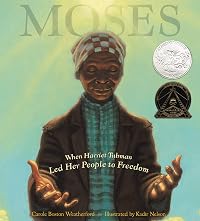
Kadir Nelson began drawing at the age of three, and painting at age ten. He won an art scholarship to study at Pratt Institute in Brooklyn, New York. After graduating with honors, he began his professional career as an artist. He has worked with numerous companies including Dreamworks, where he served as the lead conceptual artist for Amistad and show more Spirit: Stallion of the Cimarron; Sports Illustrated; Coca-Cola; The United States Postal Service; and Major League Baseball. In 1999, he started collaborating with several notable authors on a series of picture books including Dancing in the Wings by Debbie Allen; Ellington Was Not a Street by Ntozake Shange; and Salt in His Shoes by Deloris and Roslyn Jordan. He won a Coretta Scott King Illustrator Award, a Caldecott Honor and an NAACP Image Award for illustrating Carol Boston Weatherford's Moses: When Harriet Tubman Led Her People to Freedom. He is the author and illustrator of We Are the Ship: The Story of Negro League Baseball. (Bowker Author Biography) show less
All Editions
Awards and Honors
Awards
Distinctions
Notable Lists
Common Knowledge
- Canonical title
- We Are the Ship: The Story of Negro League Baseball
- Original title
- We Are the Ship: The Story of Negro League Baseball
- Original publication date
- 2008-01
- People/Characters
- Bud Fowler; Andrew "Rube" Foster; Jackie Robinson; Satchel Paige; Buck Leonard; Gus Greenlee (show all 21); Louis Armstrong; Bill "Bojangles" Robinson; Josh Gibson; Cum Posey; Abe Manley; Effa Manley; J. L. Wilkinson; Cool Papa Bell; George "Mule" Suttles; Norman "Turkey" Stearnes; Jud Wilson; Oscar Charleston; Pop Lloyd; Ray Dandridge; Judy Johnson
- Epigraph
- "We are the ship; all else the sea."
—Rube Foster, founder of the Negro National League, owner of the Chicago American Giants - Dedication
- For Buck O'Neil, an inspiration
- First words
- Foreword
From the time I can remember, baseball has been my passion.
1st Inning
Beginnings
"I ain't ever had a job, I just always played baseball."—Satchel Paige
Seems like we've been playing baseball for a mighty long time. - Quotations
- We had some white umpires from another league call our game, once. Those poor fellows didn't know what to do with themselves. They made so many mistakes, they came over and apologized after the game, said they could help it. ... (show all)They'd never seen our type of baseball. Said if they played like we did in the majors, they'd have to make the parks bigger to seat all the fans.
We played a different brand of baseball from the majors. Negro baseball as fast! Flashy! Daring! Sometimes it was even funny. But always every exciting to watch. People would come early to the ballpark just to see us practice... (show all). We would whip that ball around the infield with such precision, they'd applaud.
Pitchers threw anything and everything. Spitters, shine-balls, emery balls, cut balls—you name it. They cut that ball to pieces and had curveballs breaking about six-feet! Throw a new white ball to the pitcher, and it would... (show all) come back brown from all the tobacco juice and what-have-you. You never knew what the ball was going to do once it left the pitcher's hand.
In some places we traveled to, we couldn't get a glass of water to drink, even if we had money to pay for it—and back then, water was free!
We played on some of the worst fields you could imagine. Once in a while, we'd play in a small town where they had just made the ballfield the same day we got there. Some ol' pasture. You had to pray the ball wouldn't land in... (show all) some cow stuff. Some were so patchy—grass here, dirt there. Some didn't even have grass; and some where had as a rock, with pebbles all over the place.
Those big-league teams made good money renting their parks to us, but don't you know that after paying them all of that money to play in their ballpark, we still had to suit up down the street at the local YMCA or someplace e... (show all)lse, because they didn't let us use the locker rooms?
Makes you mad to hear players today squawk about jet lag, and all of this. Try sleeping in a car with your knees to your chest, crammed with eight other guys, only to play a game the next day. Players today just don't know how bad it could be. We look back and wonder, "How did we do all of that?" It's simple. We loved the game so much, we just looked past everything else. - Last words
- (Click to show. Warning: May contain spoilers.)9th Inning
Then Came Jackie Robinson
[...]
And most important, Jackie cleared the way for the rest of us to play in the majors, and in doing that, he helped bring the rest of the country closer to accepting Negroes as first-class citizens.
(Click to show. Warning: May contain spoilers.)Extra Innings
The End of the Negro Leagues
[...]
How can you be bitter about something like that? - Original language
- English
Classifications
- Genres
- Sports and Leisure, Nonfiction, Tween
- DDC/MDS
- 796.357 — Arts & recreation Recreation, sports, and performing arts Athletic and outdoor sports and games Ball sports Ball and stick sports Baseball
- LCC
- GV875 .A1 .N45 — Geography, Anthropology and Recreation Recreation. Leisure Recreation. Leisure Sports Ball games: Baseball, football, golf, etc.
- BISAC
Statistics
- Members
- 996
- Popularity
- 26,259
- Reviews
- 88
- Rating
- (4.48)
- Languages
- English
- Media
- Paper, Audiobook
- ISBNs
- 11
- UPCs
- 1
- ASINs
- 3