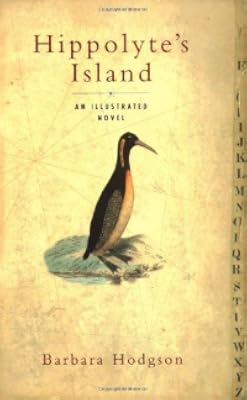
Hippolyte's Island: An Illustrated Novel
by Barbara Hodgson
On This Page
Description
In search of a new adventure, Hippolyte Webb, quixotic spirit, modern-day explorer, and natural historian, sets his sights on the Auroras, a group of tiny islands in the middle of the South Atlantic. His destination wouldn't be so unusual, except that these islands were last spotted almost two hundred years ago. Equipped with a centuries-old map, an inadequate sailboat, and an advance payment for a book about his quest, Hippolyte embarks on an unforgettable voyage, not just through show more unfamiliar seas but through the uncharted territory of his own mind and heart. This new novel by the author of The Sensualist and The Tattooed Map--lavishly illustrated with over forty illustrations and a fold-out map--is an enigmatic tale bridging the space that lies between what we believe and what we know. show lessTags
Recommendations













Member Recommendations
Atlas de Islas Remotas. Cincuenta y cinco islas en las que nunca estuve y a las que nunca iré by Judith Schalansky
Nickelini One is straight fiction, the other is mostly factual, but there is a certain air and tone about them in common, and they are likely to appeal to the same reader.
Member Reviews
Barbara Hodgson's Hippolyte's Island (Chronicle Books, 2001), is a delight. I picked it up for the illustrations (lovely maps, drawings, natural history specimens, &c.), and half-expected the text to be nothing special. But I quickly found myself drawn into the story, in which the decidedly unorthodox protagonist Hippolyte Webb decides to go in search of the Aurora Islands, a mythical[?] mini-archipelago in the South Atlantic 'discovered' in 1762 and sporadically from then until 1862, but not observed since.
Hodgson uses Webb to spin a lively and fascinating web (heh) of a tale as we see him learn to sail, make his trek, and then try to convince his New York editor (along with everyone else, including the reader) that he's not barking show more mad. Using conventional narrative along with other devices (publishing-house memos, handwritten drafts, log excerpts), the book is paced well, and designed excellently.
A bit more character development wouldn't have gone amiss - while we get to know Webb fairly well, the others he meets along the way remain a bit sketchy. Perhaps that's intended, though. Either way, a fun read, with a fascinating quest at its heart.
http://philobiblos.blogspot.com/2009/02/book-review-hippolytes-island.html show less
Hodgson uses Webb to spin a lively and fascinating web (heh) of a tale as we see him learn to sail, make his trek, and then try to convince his New York editor (along with everyone else, including the reader) that he's not barking show more mad. Using conventional narrative along with other devices (publishing-house memos, handwritten drafts, log excerpts), the book is paced well, and designed excellently.
A bit more character development wouldn't have gone amiss - while we get to know Webb fairly well, the others he meets along the way remain a bit sketchy. Perhaps that's intended, though. Either way, a fun read, with a fascinating quest at its heart.
http://philobiblos.blogspot.com/2009/02/book-review-hippolytes-island.html show less
Hippolyte Webb spends his life traveling, but only to out-of the-way, offbeat, and little-known places. He supports his lifestyle writing articles on his adventures, often in one of the numerous languages he’s picked up along the way. As the book begins, Hippolyte has been home in Vancouver only a short time but is being drawn to tales of lost islands, reported in the literature but no longer appearing on modern maps or even showing up on satellite imagery. Intrigued by the idea of rediscovering something lost, he decides to sail to the location reported to be the Auroras, three (more or less) islands halfway between the Falklands and South Georgia in the southern Atlantic. He spends weeks reading, going to museums, taking sailing show more lessons, and provisioning himself with all the necessities suggested by his treasured 1906 Royal Geographical Society "Hints to Travellers", and then he flies to the Falklands and sets off alone in a rented sailboat. What Hippolyte finds, and his difficulties making his editor believe him, form the core of the book. Hippolyte is larger than life and bowls over his editor, whom he’s never met, and his unconventional way of telling his story and presenting his evidence convinces her he’s lying. How each of them approaches this dilemma makes for a charming story.
Interspersed throughout the book are Hippolyte’s photos, drawing and watercolors, along with maps, logbook entries, and journal notes. This is definitely a keeper for my small permanent library. show less
Interspersed throughout the book are Hippolyte’s photos, drawing and watercolors, along with maps, logbook entries, and journal notes. This is definitely a keeper for my small permanent library. show less
Simply delightful story of Hippolyte, who never having sailed before, takes off from the Falkland Islands in search of the Auroras, and his subsequent battles with his down to earth editor to have the saga of his adventures published as a book.
This is billed as an illustrated novel but not in the way you might imagine. The first half of this book is the travelogue of a journey of exploration, including sketches, charts, maps, photographs and other related things.
It's difficult to summarize this book in a way that doesn't sound completely boring but to me it really wasn't. It's the story of Hippolyte Webb, a man in his late thirties who has so far in life traveled only in the Northern Hemisphere. He started a travel magazine and has written various travel articles. Now, though, he's bored. So he takes his rickety old globe whose two halves have shifted a bit and draws a line from Vancouver due south and ends up in the South Atlantic. His line goes right through three small, show more unlabeled dots between the Falkland Islands and South Georgia Island. He starts searching old maps and finds a few that name these islands -- The Auroras. Hippolyte becomes obsessed with the Auroras and decides to travel there. He takes sailing classes, secures an advance for a book about his journey and heads through South America down to the Falklands. From there he charters a boat and sets off toward what he believes are the coordinates of these mysterious islands. He records his experiences and at the end of the month-long journey returns home to write his book.
The second half of the novel is about Hippolyte's experiences with the publishing house and the editor that is assigned to him. I don't want to talk too much about this part because things that are revealed in it make you question what you were told in the first half of the book. This part is about belief, trust and emotion.
This book was interesting and different. I really enjoyed the natural history parts of the story but I know that some people might find them dull or hard to understand. There are also a decent amount of sailing terms and descriptions that I know nothing about but I took it as a chance to learn something new. If you are feeling adventurous and want to try a different sort of novel, you might want to take a trip to Hippolyte's Island.
http://webereading.com/2009/07/heavy-steps-crisscrossed-overhead.html show less
It's difficult to summarize this book in a way that doesn't sound completely boring but to me it really wasn't. It's the story of Hippolyte Webb, a man in his late thirties who has so far in life traveled only in the Northern Hemisphere. He started a travel magazine and has written various travel articles. Now, though, he's bored. So he takes his rickety old globe whose two halves have shifted a bit and draws a line from Vancouver due south and ends up in the South Atlantic. His line goes right through three small, show more unlabeled dots between the Falkland Islands and South Georgia Island. He starts searching old maps and finds a few that name these islands -- The Auroras. Hippolyte becomes obsessed with the Auroras and decides to travel there. He takes sailing classes, secures an advance for a book about his journey and heads through South America down to the Falklands. From there he charters a boat and sets off toward what he believes are the coordinates of these mysterious islands. He records his experiences and at the end of the month-long journey returns home to write his book.
The second half of the novel is about Hippolyte's experiences with the publishing house and the editor that is assigned to him. I don't want to talk too much about this part because things that are revealed in it make you question what you were told in the first half of the book. This part is about belief, trust and emotion.
This book was interesting and different. I really enjoyed the natural history parts of the story but I know that some people might find them dull or hard to understand. There are also a decent amount of sailing terms and descriptions that I know nothing about but I took it as a chance to learn something new. If you are feeling adventurous and want to try a different sort of novel, you might want to take a trip to Hippolyte's Island.
http://webereading.com/2009/07/heavy-steps-crisscrossed-overhead.html show less
I really enjoyed this book, although I felt like the concept could have been taken a lot further.
I was very taken by this book. The illustrations are beautiful and add a lot of charm to the story. Unique and a very fun read.
This is a highly imaginative book and my favourite of Hodgson's so far.
Members
- Recently Added By
Lists

BingoDOG - Scientists in Fiction
111 works; 17 members

Tall tales
25 works; 1 member
Author Information

18+ Works 2,022 Members
Barbara Hodgson is a Vancouver-based writer, photographer, and designer. She is the author of the acclaimed illustrated novels "The Sensualist" and "The Tattooed Map", "Opium", and a collaborator on "Paris Out of Hand", a fictional guidebook to Paris. (Bowker Author Biography)
Common Knowledge
- People/Characters
- Hippolyte Webb; Marie Simplon; Jeremy Gould
- Important places
- Atlantic Ocean; Vancouver, British Columbia, Canada
Classifications
Statistics
- Members
- 266
- Popularity
- 121,692
- Reviews
- 10
- Rating
- (3.65)
- Languages
- English, French
- Media
- Paper, Ebook
- ISBNs
- 6
- UPCs
- 1
- ASINs
- 3