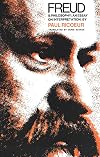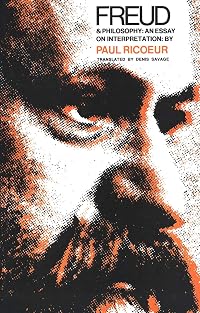
Freud and Philosophy: An Essay on Interpretation
by Paul Ricœur
On This Page
Description
"The first part of Freud and philosophy, "Problematic" presents a profound and clear theory of signification, symbol, and interpretation. The second part, "A reading of Freud," is required reading for anyone seriously interested in psychoanalysis. The third section includes a thoroughly audacious interpretation and criticism of Freud and a presentation of Ricoeur's own theory of symbol--particularly religious symbol--which places the study at the center of the debate over the sense of show more myth."--Book jacket. show lessTags
Recommendations


















Member Reviews
Without a doubt, I would have gotten much more out of this book if I had a firmer grasp of phenomenology and had read more of its main works. In that sense, whatever Ricoeur wants to use his interpretation of Freud to accomplish in his own body of work and furtherance of thought I probably missed much of. Oh well...
On the other hand, as a detailed and exhaustive summary and interpretation of much of Freud's thought I can't imagine a better source. Surely Ricoeur interprets Freud in a way biased toward what he wants to use him for. As an example, I'm not sure how useful this would be for a person looking to understand how to use Freud in clinical practice. Although again, even here, Ricoeur's explanation of the concepts of "practice" and show more "transference" do have implications in this regard.
Let's just say that if you are looking for a work that might give you an approach to Freud, a way to understand his complicated and oftentimes misunderstood concepts, there are worse places to look. Ricoeur makes me want to re-read Freud's books I've read and then read his works I haven't gotten to yet. Clarifying and confounding, but never boring.
Is it stupid to say you are proud of yourself for finishing a book? Maybe.
But I am proud that I stuck with this one to the end.
It wasn't an easy ride, but it was a fulfilling one. show less
On the other hand, as a detailed and exhaustive summary and interpretation of much of Freud's thought I can't imagine a better source. Surely Ricoeur interprets Freud in a way biased toward what he wants to use him for. As an example, I'm not sure how useful this would be for a person looking to understand how to use Freud in clinical practice. Although again, even here, Ricoeur's explanation of the concepts of "practice" and show more "transference" do have implications in this regard.
Let's just say that if you are looking for a work that might give you an approach to Freud, a way to understand his complicated and oftentimes misunderstood concepts, there are worse places to look. Ricoeur makes me want to re-read Freud's books I've read and then read his works I haven't gotten to yet. Clarifying and confounding, but never boring.
Is it stupid to say you are proud of yourself for finishing a book? Maybe.
But I am proud that I stuck with this one to the end.
It wasn't an easy ride, but it was a fulfilling one. show less
150 RIC 1
Ratings
Members
- Recently Added By
Author Information

197+ Works 6,401 Members
Professor of philosophy at the University of Paris and the University of Chicago, Paul Ricoeur has been described as "possibly the only younger philosopher in Europe whose reputation is of the magnitude of that of the old men of Existentialism---Marcel, Jaspers, Heidegger and Sartre . . . ." His work has been characterized as "the most massive show more accomplishment of any philosopher of Christian faith since the appearance of Gabriel Marcel." A practitioner of the phenomenology of Edmund Husserl mediated by a return to Immanuel Kant---in that things in themselves, though unknowable, are not excluded by bracketing existence but are acknowledged as the necessary conditions for the possibility of human experience---Ricoeur has examined those parts of experience---faulty, fallible, and susceptible to error and evil---that other phenomenologists, interested primarily in the cognitional, have neglected. In this respect he follows in the footsteps of Heidegger and Sartre, but he goes beyond them in his discovery of principles transcending human subjectivity that are amenable to spiritual interpretation. Here Ricoeur steps within the contemporary hermeneutic circle of Heidegger and Hans-Georg Gadamer, on whom he has written. Ricoeur's hermeneutical method, however, has much in common with the methods of biblical exegesis, and in this respect his works should be especially appealing to seminarians and the clergy. (Bowker Author Biography) show less
Series
Belongs to Publisher Series
Common Knowledge
- Canonical title
- Freud and Philosophy: An Essay on Interpretation
- Original title
- De l'interprétation : Essai sur Freud
- Original language
- French
Classifications
- Genres
- Philosophy, Nonfiction, Religion & Spirituality, General Nonfiction
- DDC/MDS
- 150.19 — Philosophy & psychology Psychology Emotions, Relationships, & Family Theory And Instruction Systems, schools, viewpoints
- LCC
- BF173 .F85 .R47 — Philosophy, Psychology and Religion Psychology Psychology Psychoanalysis
- BISAC
Statistics
- Members
- 302
- Popularity
- 106,414
- Reviews
- 2
- Rating
- (4.33)
- Languages
- 7 — English, French, German, Italian, Polish, Slovenian, Turkish
- Media
- Paper, Ebook
- ISBNs
- 11
- ASINs
- 7