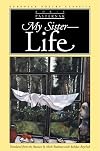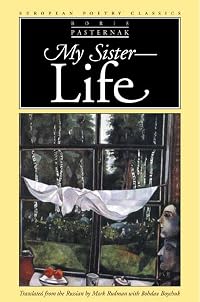
My Sister — Life
by Boris Pasternak
On This Page
Description
Boris Pasternak, the Nobel laureate and author of Doctor Zhivago, composed one of the world's great love poems in My Sister--Life. Written in the summer of 1917, the cycle of poems focuses on personal journeys and loves but is permeated by the tension and promise of the impending October Revolution. Osip Mandelstam wrote: "To read the poems of Pasternak is to get one's throat clear, to fortify one's breathing. . . . I see Pasternak's My Sister--Life as a collection of magnificent exercises show more in breathing . . . a cure for tuberculosis." This English translation, rendered with verve and intelligence by Mark Rudman, is a heady gust that matches the intensity and power of the original Russian text. show lessTags
Recommendations




















Member Reviews
Breathtaking poems of ethereal light and being inhabit this collection from Boris Pasternak. Osip Mandelstam said, "To read the poems of Pasternak is to get one's throat clear , to fortify one's breathing. . . I see Pasternak's My Sister--Life as a collection of magnificent exercises in breathing . . . a cure for tuberculosis." These poems are enchanting; the product of the early life of Pasternak. There is a clarity in the translations of Mark Rudman with Bohdan Boychuk that allow Pasternak's "breathing" which I sense as almost a sort of singing voice to pierce through the boundary between languages. The result is the poet's voice is present in its most passionate form thrilling the reader with images of love and loss; foreshadowing show more the changes that would soon engulf the world of his family, friends, and fellow citizens as the Great War would end and bring with it the upheavals in the political world of the Russian Empire. This is a beautiful collection of poems that provides a counterweight to the more familiar Pasternak of Doctor Zhivago and his other later work. show less
Ratings
Members
- Recently Added By
Author Information

Pasternak was acclaimed as a major poet some 30 years before Doctor Zhivago (1955) made him world famous. After first pursuing promising careers in music and philosophy, he started to write around 1909 and published his first collection of verse in 1914. His first genuine triumph came with the collection My Sister, Life (1917), in which a love show more affair stimulates a rapturous celebration of nature. The splendid imagery and difficult syntax of this volume are a hallmark of the early Pasternak. During the 1920s, Pasternak tried to accept the reality of the new society and moved from the lyric to the epic, taking up historical and contemporary subjects. The long poem The Year 1905 (1926) is an example. While tolerated by the literary establishment, Pasternak turned increasingly in the 1930s to translation rather than original verse. He was a prolific translator; his versions of major Shakespeare plays are the standard texts used in Soviet theaters. From the start, however, prose was an important focus for Pasternak. The most notable early work is the story "Zhenia's Childhood," written in 1918, which explored a girl's developing consciousness of her surroundings. There is also his artistic and intellectual autobiography Safe Conduct (1931). But Pasternak's greatest prose achievement came later with the novel Doctor Zhivago, written over a number of years and completed in 1955. Its hero, a physician and poet, confronts the great changes of the early twentieth century including world war, revolution, and civil war, and travels a path through life that creates a parallel between his fate and that of Christ. (The theme of preordained sacrifice is strengthened by the cycle of poems included as the last section of the book.) Doctor Zhivago was rejected for publication but appeared in 1957 in the West and won its author worldwide acclaim. A Nobel Prize followed in 1958. This led the Soviet authorities to launch a major public campaign against Pasternak and to make his personal life even more difficult. So successful were they that the poet officially turned down the award. After that, he was left in relative peace and died two years later. He was but the first of many writers in the post-Stalin period to challenge the Soviet state. During the 1970s and 1980s, Pasternak's heritage was cautiously brought into public purview in the Soviet Union. The Gorbachev period saw the removal of all restrictions on his work, and publication of Doctor Zhivago followed at long last. Several major editions of Pasternak's writings have appeared. (Bowker Author Biography) show less
Some Editions
Series
Belongs to Publisher Series
Common Knowledge
- Canonical title
- My Sister — Life
- Original title
- Сестра моя — жизнь
- Alternate titles
- Sister My Life; My Sister Life; My Sister, Life
- Original publication date
- 1922
- Original language
- Russian
Classifications
- Genres
- Poetry, Fiction and Literature
- DDC/MDS
- 891.7142 — Literature & rhetoric Literatures of other languages East Indo-European and Celtic literatures Russian and East Slavic languages Russian poetry USSR 1917–1991 Early 20th century 1917–1945
- LCC
- PG3476 .P27 .S413 — Language and Literature Slavic languages and literatures. Baltic languages. Albanian language Slavic. Baltic. Albanian Russian literature Individual authors and works 1917-1960
- BISAC
Statistics
- Members
- 89
- Popularity
- 359,905
- Reviews
- 1
- Rating
- (4.32)
- Languages
- 7 — Danish, English, Finnish, Italian, Russian, Spanish, Swedish
- Media
- Paper
- ISBNs
- 12
- ASINs
- 2