Psychogeography: Disentangling the Modern Conundrum of Psyche and Place
by Will Self
On This Page
Description
A volume of essays meditates on the complex relationship between psyche and place and evaluates the ways in which human-made geography has irrevocably shaped our emotions and behaviors while detaching people from the natural world.Tags
Recommendations



















Member Recommendations

Member Reviews
Author Will Self spends only a few pages on the Situationist origins and subsequent history of the psychogeographical enterprise in this book. He then proceeds to undertake it in something of the form developed by other recent practitioners, such as Peter Ackroyd, Cathy Turner, Nick Papadimitriou, and Iain Sinclair. The 56-page introduction "Walking to New York" seemed very similar in genre and method to Sinclair's The Last London, the principal work in this field that I've previously read, although Self's book was published a full decade earlier. (Dates on the copyright page seem to indicate that portions had been published up to four years prior to that.)
The introduction was slow reading, with its density of introspection and show more extravagant diction. It recounts Self's "walk to New York" from his home in England--interrupted by a trans-Atlantic airplane flight, of course. Throughout the book, Self boasts his status as one of a dwindling tribe to which I proudly belong. We are transport pedestrians, willing to use our feet to get to places where more conventional members of our societies would use automobiles. But there are many points in the book where he documents his use of other forms of transport. Just as the focus is not exclusively perambulatory, neither is it solely urban.
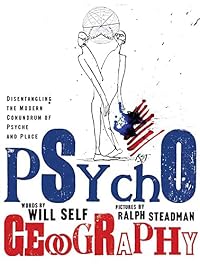
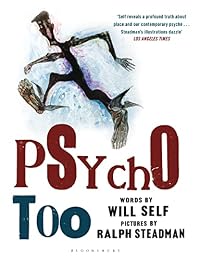
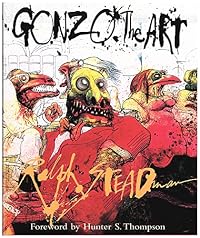
After "Walking to New York," the book's remaining two hundred pages flashed by. They entirely consist of two-page vignettes by Self, originally columns in the Independent. Each is accompanied by a full page or two of illustration by the inimitable Ralph Steadman. Steadman's contributions were in fact a chief attraction for me to borrow this book from my local public library. They are reproduced in full color. Self writes, "I wonder sometimes if, like Obelix, Ralph was dropped in a vat of some hallucinogenic potion when he was a child" (175), introducing his collaborator abruptly at the end of an essay on visiting the Netherlands. Steadman's own experiences form the basis for one essay on an encounter with an urban fox (197-9).
The fifty-odd short pieces are not arranged chronologically or geographically. They see-saw among reminiscences of frequently-intoxicated younger adulthood and musings on middle age and parenthood, all concerned with "the modern conundrum of psyche and place." Much of Self's travel has clearly been motivated by his writing, whether in a journalistic mode or researching backgrounds for his fiction "in the interests of verisimilitude" (175). The anecdotes are reliably wry and often very funny. I was especially amused by "Bouncy Metropolis" (145-8) and "Spain - The Final Frontier" (183-6). Often enough, there is an overt punchline, such as the one in "Hitler in Rio" (123-5).
Those already familiar with and agreeable toward psychogeography should enjoy this book. To the less informed reader, I might recommend starting with the Wikipedia article on the topic, followed by the short essays in this book, and then finishing with the long introduction. The contents of this volume still merit readers' attention in a world where "psyche and place" have only become more estranged in the ensuing years. show less
The introduction was slow reading, with its density of introspection and show more extravagant diction. It recounts Self's "walk to New York" from his home in England--interrupted by a trans-Atlantic airplane flight, of course. Throughout the book, Self boasts his status as one of a dwindling tribe to which I proudly belong. We are transport pedestrians, willing to use our feet to get to places where more conventional members of our societies would use automobiles. But there are many points in the book where he documents his use of other forms of transport. Just as the focus is not exclusively perambulatory, neither is it solely urban.
After "Walking to New York," the book's remaining two hundred pages flashed by. They entirely consist of two-page vignettes by Self, originally columns in the Independent. Each is accompanied by a full page or two of illustration by the inimitable Ralph Steadman. Steadman's contributions were in fact a chief attraction for me to borrow this book from my local public library. They are reproduced in full color. Self writes, "I wonder sometimes if, like Obelix, Ralph was dropped in a vat of some hallucinogenic potion when he was a child" (175), introducing his collaborator abruptly at the end of an essay on visiting the Netherlands. Steadman's own experiences form the basis for one essay on an encounter with an urban fox (197-9).
The fifty-odd short pieces are not arranged chronologically or geographically. They see-saw among reminiscences of frequently-intoxicated younger adulthood and musings on middle age and parenthood, all concerned with "the modern conundrum of psyche and place." Much of Self's travel has clearly been motivated by his writing, whether in a journalistic mode or researching backgrounds for his fiction "in the interests of verisimilitude" (175). The anecdotes are reliably wry and often very funny. I was especially amused by "Bouncy Metropolis" (145-8) and "Spain - The Final Frontier" (183-6). Often enough, there is an overt punchline, such as the one in "Hitler in Rio" (123-5).
Those already familiar with and agreeable toward psychogeography should enjoy this book. To the less informed reader, I might recommend starting with the Wikipedia article on the topic, followed by the short essays in this book, and then finishing with the long introduction. The contents of this volume still merit readers' attention in a world where "psyche and place" have only become more estranged in the ensuing years. show less
If you don't like Will Self's take on modern life, you probably won't like this. If however, like me, you do appreciate his dry wit and well crafted writing style, then you will almost certainly enjoy this collection. A seemingly random arrangement of his column in The Independent newspaper is brilliantly complemented by the always excellent Ralph Steadman's illustrations.
Self writes on all manner of subjects from the mundane to the profound. Infused with his inimitable sardonic sense of humour and mischief, these essays were for me the perfect length to get just the right flavour of whatever, or wherever, he was talking about or exploring. In places as diverse as Rio de Janeiro, The Orkney Isles, India, Iowa, and English coastal show more nuclear power stations, he takes you with him as he uncovers little nuggets of the 21st century world we live in.
The extra length introductory essay - Walking To New York - is a real treat as Self travels the usually unconsidered hinterlands of south and west London on his way to first Heathrow Airport, and then from JFK across Long Island over to Manhattan. A very unusual and enjoyable read. show less
Self writes on all manner of subjects from the mundane to the profound. Infused with his inimitable sardonic sense of humour and mischief, these essays were for me the perfect length to get just the right flavour of whatever, or wherever, he was talking about or exploring. In places as diverse as Rio de Janeiro, The Orkney Isles, India, Iowa, and English coastal show more nuclear power stations, he takes you with him as he uncovers little nuggets of the 21st century world we live in.
The extra length introductory essay - Walking To New York - is a real treat as Self travels the usually unconsidered hinterlands of south and west London on his way to first Heathrow Airport, and then from JFK across Long Island over to Manhattan. A very unusual and enjoyable read. show less
I used to take long walks through the city—all the way from the downtown core to the suburbs and beyond, some 40 km away. It’s something I couldn’t well explain. I’d get up early some morning after a big snowfall and feel the urge to see the city in the morning’s first light, still buried under the gentle cover of untrammeled snow. I’d bundle up and walk to the nearest coffee shop and, with a steaming cup of coffee in hand, I’d just keep walking. I’d walk through the dilapidated slums where young gang lookouts would eye me suspiciously. I’d walk through ethnic neighborhoods, already bustling with the signs of glum activity well before the crack of dawn: hunched figures clearing the snow from pathways and grim looking show more shopkeepers calmly smoking under a portico. I’d pass through the trendy districts, where young people gather, and through once-trendy districts that were now forgotten, with their fashionable restaurants long ago boarded-up or turned into dive bars and sex shops. For long stretches I would walk beside freeways through the unremitting desert landscape of strip malls and car dealerships. I couldn’t explain it, but there was something the cars whizzing by, busily on their way to their destination, were missing, seeing the city through their windows in a 80 km/h blur, what Self describes as "wind-screen-based realities”.
It is this difficult to describe quality of experiencing urban environments that Psychogeography seems to be all about. The term psychogeography has been around since the 1950’s, apparently, and its concern is how we experience and inhabit the physical environment. It is geography that is not so concerned with mapping physical space as mapping the inner space of public places.The book, a collection of essays by Will Self originally published for the Independent, is definitely not for everyone. Even self styled flâneurs may find Self too personal, scattered, and aimless, but the point of these essays, like the perambulations that inspired them, was never to get their destination quickly or by the straightest path. Self’s ramblings are well written and amusing and perfectly coupled with Ralph Steadman's tortured artwork. I think those who have taken long walks past the point the sidewalks end will find the work speaks to something vital about our modern urban condition. show less
It is this difficult to describe quality of experiencing urban environments that Psychogeography seems to be all about. The term psychogeography has been around since the 1950’s, apparently, and its concern is how we experience and inhabit the physical environment. It is geography that is not so concerned with mapping physical space as mapping the inner space of public places.The book, a collection of essays by Will Self originally published for the Independent, is definitely not for everyone. Even self styled flâneurs may find Self too personal, scattered, and aimless, but the point of these essays, like the perambulations that inspired them, was never to get their destination quickly or by the straightest path. Self’s ramblings are well written and amusing and perfectly coupled with Ralph Steadman's tortured artwork. I think those who have taken long walks past the point the sidewalks end will find the work speaks to something vital about our modern urban condition. show less
A collection of essays that is an entertaining farrago of travel diary, hyperbole, oddly intense extended metaphors, unnecessary vocabulary flaunting, and vituperation about everyone's national identity. The opening essay was bewildering to a non-native Londoner but began to make sense about half way through, and after that it was easier going. Ralph Steadman's illustrations are the usual entertaining nightmare.
Middle age has married itself to Will Self, but thankfully the exasperating cliche of its crisis was dealt with in his earlier incarnations. Here we have Will Self in his haughtier, more florid tones, and it is uncertain if he is having us on with the occasional gobbets of snobbish writing and tinderbox humour. The reader can expect to follow Mr Self on his "exotic" junkets, giving his own trademark perspectives in a re-imagining of travelogue writing under the thematic rubric of psychogeography (a conceptual coinage that owes at least half its due to J. G. Ballard). At times, the anecdotal bits of Self as he grapples with the usual conundrums of middle age can get a bit overbearing, but he is - in the Brit parlance - safe as houses in show more his entitlement to make his own authorial ego a direct product (rather than decanted through his fiction). The Steadman illustrations are staid offerings from that iconic gonzoid artist, and they mix between a recycling of his style with the occasional stunning piece portraying an artist in successive development. The usual post-dada cut-ups of anatomical illustrations feature, but Steadman seems to have moved more into colour - watercolour, at that. As accompanying images, at times the selection of subject seems a bit forced, and at other times Steadman's blistering hilarity comes through visually and in the captions provided. I would say: buy the book. You won't be disappointed. But it is one of those all too clever offerings that will not likely have re-read value. And, as usual fare for Steadman canvas, the pictures should horrify your more delicate relatives. show less
Started well but lapsed into random territory about half way through. Stedman's illustrations are gold, however. Still, the idea of psychogeography is important because walking with political radicalism is needed bad in an age where the screen dominates. As I see it, just *pay attention* wherever you are, every day. I like walking. Just a pity I didn't know about this when I was in New York and walked from the Bronx to the Staten Island Ferry. I did walk a lot of Manhattan, enough to raise the eyebrows of locals. You have to work harder in my home town of Sydney to keep things interesting--Maroubra to Manly in the next month.
I try to allow every author their 50 pages before I take the book to the library or give it away, but I couldn't make it that far in this one. This book is about Will Self entirely, and if you're interested in Will Self, great. He was not a sympathetic character to me.
I'm a fan of the situationists, and I approached this being someone who enjoys a long aimless stroll, as well as walking places that you're not supposed to walk because the human place has been usurped by automobiles. But while the book, tangentally, is about walking distances, it's more about Will and his drug habits and addictions, famous people he's met, etc.
I'm a fan of the situationists, and I approached this being someone who enjoys a long aimless stroll, as well as walking places that you're not supposed to walk because the human place has been usurped by automobiles. But while the book, tangentally, is about walking distances, it's more about Will and his drug habits and addictions, famous people he's met, etc.
Members
- Recently Added By
Author Information

66+ Works 10,297 Members
William Woodard "Will" Self was born on September 26, 1961. He is a British author, journalist and political commentator. He wrote ten novels, five collections of short fiction, three novellas and five collections of non-fiction writing. His novel Umbrella was shortlisted for the Man Booker Prize. His subject matter often includes mental illness, show more illegal drugs and psychiatry. Self is a regular contributor to publications including Playboy, The Guardian, Harpers, The New York Times and the London Review of Books. He also writes a column for New Statesman, and over the years he has been a columnist for The Observer, The Times and the Evening Standard. His columns for Building Design on the built environment, and for the Independent Magazine on the psychology of place brought him to prominence as a thinker concerned with the politics of urbanism. Will Self will deliver the closing address at the 2015 Melbourne Writers Festival (MWF) 2015. (Bowker Author Biography) show less
Classifications
- Genres
- Nonfiction, Travel
- DDC/MDS
- 910.019 — History & geography Geography & travel modified standard subdivisions of Geography and travel Philosophy and theory of geography and travel History, geographic treatment, biography
- LCC
- G71.5 .S464 — Geography, Anthropology and Recreation Geography (General)
- BISAC
Statistics
- Members
- 250
- Popularity
- 129,331
- Reviews
- 11
- Rating
- (3.41)
- Languages
- English
- Media
- Paper, Ebook
- ISBNs
- 4
- ASINs
- 5