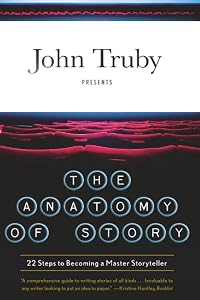
The Anatomy of Story: 22 Steps to Becoming a Master Storyteller
by John Truby
On This Page
Description
"John Truby is one of the most respected and sought-after story consultants in the film industry, and his students have gone on to pen some of Hollywood's most successful films, including Sleepless in Seattle, Scream, and Shrek. The Anatomy of Story is his long-awaited first book, and in it he shares all his secrets for writing a compelling script. Based on the lessons in his class, Great Screenwriting, The Anatomy of Story draws on a broad range of concepts and archetypes from philosophy show more and mythology, offering techniques and anecdotes alongside Truby's own unique approach to building an effective, multifaceted narrative." "Truby's method of constructing a story is at once perceptive and practical, focusing on the hero's moral and emotional growth. Writers will dig deep within and explore their own values and worldview in order to create an effective story. They will come away with a precise set of tools to employ - specific techniques to make the audience care about their characters. They will learn how to make their characters grow in meaningful ways, how to construct surprising plots that are unique to their particular concepts, and how to express a moral vision that can move an audience." "The foundations of story that Truby lays out are so fundamental that they are applicable - and essential - to all writers, from novelists and short story writers to journalists, memoirists, and writers of narrative nonfiction."--Jacket. show lessTags
Recommendations

Member Reviews
I thought this was a really insightful textbook on storytelling and what makes good stories work, but I'm going to say up front: I believe that if you use this as a writing manual and try to actually do the exercises and follow all the steps starting with a blank page, not only will you have set yourself a monumental (impossible?) task, but also you will surely sap all the fun there is to be had in writing by making it a multistep, tedious process rather than an organic, creative endeavor.
But after reading this with much interest, I have concluded that this book has two extremely valuable applications: for anyone who enjoys novels and/or movies, it will deepen your understanding of all the elements of story and broaden your enjoyment; show more and for writers, it will probably be very helpful during the revision process or if you get stuck and need to figure out what's going wrong with your story.
This book focuses on movies more than on novels, and I would recommend it primarily to readers who have seen a broad array of movies and can recognize and learn from the examples. I also think it's helpful to watch the movies shortly after reading the discussion and apply what you have learned. For instance, if you don't think Tootsie is a good movie, go back and rewatch it after reading the chapters that discuss it in this book and look for all the things Truby is talking about as you do. I guarantee you will see the movie in a different light. You may not like it any better, but you'll probably appreciate it more. show less
But after reading this with much interest, I have concluded that this book has two extremely valuable applications: for anyone who enjoys novels and/or movies, it will deepen your understanding of all the elements of story and broaden your enjoyment; show more and for writers, it will probably be very helpful during the revision process or if you get stuck and need to figure out what's going wrong with your story.
This book focuses on movies more than on novels, and I would recommend it primarily to readers who have seen a broad array of movies and can recognize and learn from the examples. I also think it's helpful to watch the movies shortly after reading the discussion and apply what you have learned. For instance, if you don't think Tootsie is a good movie, go back and rewatch it after reading the chapters that discuss it in this book and look for all the things Truby is talking about as you do. I guarantee you will see the movie in a different light. You may not like it any better, but you'll probably appreciate it more. show less
This guy has such a hard-on for Casablanca and Tootsie he should have been a film critic. The book was written in 2007 but all his examples are from way in the past (we’re talking Four Weddings and a Funeral or The Godfather). These are fine stories, it may not be what you want to write. I know I don’t. You may want to write “Iron Man” or “Nightmare Alley” or some crime thriller book. You can have a story that’s fun and still affects the reader. It doesn’t have to be about social issues or dour “message-driven” plots. This book emphasizes starting with the theme and snowballing out from there. Not about what “well wouldn’t it be fun if…”
For another thing, those works are once-in-a-blue-moon-type stories. I show more doubt Mario Puzo and Murray Burnett (the guy who wrote the play Casablanca is based on) were thinking about morals, themes, or motifs right from the get-go. They’re what Stephen King calls “geniuses” and you can’t make a genius out of a competent writer. No writing book in the world is going to do that and that is the premise this book seems to be selling. The Godfather and Casablanca were cases of the right story, right writer, and right time & place. Stephen King and Neil Gaiman say they wait until the book is finished, then examine the story to determine the theme that came out of it.
This book was much like Writing 21st Century Fiction: High Impact Techniques for Exceptional Storytelling by Donald Maass where, if I got 10% out of what I read, that would be enough. But this book is so long, and seems so counter to current stories and best-sellers, I don’t think I can recommend it. Watch another movie besides Tootsie, John. show less
For another thing, those works are once-in-a-blue-moon-type stories. I show more doubt Mario Puzo and Murray Burnett (the guy who wrote the play Casablanca is based on) were thinking about morals, themes, or motifs right from the get-go. They’re what Stephen King calls “geniuses” and you can’t make a genius out of a competent writer. No writing book in the world is going to do that and that is the premise this book seems to be selling. The Godfather and Casablanca were cases of the right story, right writer, and right time & place. Stephen King and Neil Gaiman say they wait until the book is finished, then examine the story to determine the theme that came out of it.
This book was much like Writing 21st Century Fiction: High Impact Techniques for Exceptional Storytelling by Donald Maass where, if I got 10% out of what I read, that would be enough. But this book is so long, and seems so counter to current stories and best-sellers, I don’t think I can recommend it. Watch another movie besides Tootsie, John. show less
Although a bit repetitive at some point, “The Anatomy of Story” is a great book.
I've never read anything on this subject, so I can't compare it to alternatives. But something tells me I don't need to :)
If you want clear, right to the point, technical but still passionate and beautiful guide on what makes a story work (and what doesn't), this is the book for you. But beware: it has so-o-o many spoilers...
I've never read anything on this subject, so I can't compare it to alternatives. But something tells me I don't need to :)
If you want clear, right to the point, technical but still passionate and beautiful guide on what makes a story work (and what doesn't), this is the book for you. But beware: it has so-o-o many spoilers...
It's a bedrock truth of writing that the oldest scam in the game is writing about writing. Most writing books are junk, and the reason they're junk is that they push formula, transforming art to engineering. They reduce everything to archetype and suggest logical, linear approaches to what is in fact an intuitive, iterative process. You get recipes.
No doubt the steady appetite for books pushing writing to formula motivated the misleading subtitle of The Anatomy of Story. But there is no 22 step program to become a master storyteller here. There is a 22-step plot structure, but it concerns only 38 of the book's 445 pages -- and furthermore, some of the steps are treated as disposable. This is not a recipe.
A better subtitle would have show more advertised the connection of structure and theme, for this is the point that Truby hammers at throughout. Rather than pushing the notion that you should ignore your themes, as so many writing books suggest, Truby insists that all great stories rest on a moral dilemma that is properly expressed through their plot and structure. This is where you connect with an audience: not through characters culled from some list of archetypes, but with a web of characters who all express, in some way, the protagonist's central conflict, which in the best stories is a moral problem.
And this is not simply a screenwriting book. Nothing here is applicable only to the movies. Indeed, Truby draws about half his examples from novels rather than films, considering Ulysses alongside Casablanca. As a book concerned primarily with screenwriting, it ignores the stuff of most books aimed at fiction writers: narration, description, etc., and focuses on what those books tend to gloss over: plot. Consequently, it should be of equal interest to the aspiring novelist.
There is a downside. No doubt with sales in mind, this book keeps one foot firmly in the camp of formula. You get linear steps for iterative processes. This is a particular fault of an early chapter on developing your premise. A little more emphasis on examples that flout formula would have been nice.
A valuable book on writing, worth reading carefully. show less
No doubt the steady appetite for books pushing writing to formula motivated the misleading subtitle of The Anatomy of Story. But there is no 22 step program to become a master storyteller here. There is a 22-step plot structure, but it concerns only 38 of the book's 445 pages -- and furthermore, some of the steps are treated as disposable. This is not a recipe.
A better subtitle would have show more advertised the connection of structure and theme, for this is the point that Truby hammers at throughout. Rather than pushing the notion that you should ignore your themes, as so many writing books suggest, Truby insists that all great stories rest on a moral dilemma that is properly expressed through their plot and structure. This is where you connect with an audience: not through characters culled from some list of archetypes, but with a web of characters who all express, in some way, the protagonist's central conflict, which in the best stories is a moral problem.
And this is not simply a screenwriting book. Nothing here is applicable only to the movies. Indeed, Truby draws about half his examples from novels rather than films, considering Ulysses alongside Casablanca. As a book concerned primarily with screenwriting, it ignores the stuff of most books aimed at fiction writers: narration, description, etc., and focuses on what those books tend to gloss over: plot. Consequently, it should be of equal interest to the aspiring novelist.
There is a downside. No doubt with sales in mind, this book keeps one foot firmly in the camp of formula. You get linear steps for iterative processes. This is a particular fault of an early chapter on developing your premise. A little more emphasis on examples that flout formula would have been nice.
A valuable book on writing, worth reading carefully. show less
Absolutely one of the best books on story and writing I've read. To be honest, through the first few chapters, I had to carry around a notebook, because I was constantly gaining ideas and insights on my current writing projects.
Though this seems angled toward screenwriters, it's a useful book for anyone that writes fiction. Highly recommended.
Though this seems angled toward screenwriters, it's a useful book for anyone that writes fiction. Highly recommended.
This book is a solid guide to formulaic story structure. Of course, as much as it claims to break from the "stale and formulaic" three-act structure, it also creates a whole new form of potential "stale and formulaic" structure that will help the reader create excellent stories, that all feel exactly the same.
As I was reading, there were several times where I thought the ideas Truby discusses are excellent, but a little stilting if the reader follows each and every step as if it is gospel. The real trick is to read this book, learn what it has to teach you, then use only as much as you feel you need for each story you write.
There's a textbook feel to Truby's book, especially with the writing exercises at the end of each chapter, but show more this was the first book on writing that I've read where the exercises didn't feel mandatory, or even necessary.
Definitely worth reading to help yourself improve as a writer and storyteller. show less
As I was reading, there were several times where I thought the ideas Truby discusses are excellent, but a little stilting if the reader follows each and every step as if it is gospel. The real trick is to read this book, learn what it has to teach you, then use only as much as you feel you need for each story you write.
There's a textbook feel to Truby's book, especially with the writing exercises at the end of each chapter, but show more this was the first book on writing that I've read where the exercises didn't feel mandatory, or even necessary.
Definitely worth reading to help yourself improve as a writer and storyteller. show less
I've read plenty of screenwriting books and always get something out of them but this this one is my go to guide. He cleary explains the process and the exercises at end of each chapter allow you to create a story with a strong foundation that will give your story meaning.
Members
- Recently Added By
Lists

Books Read in 2025
4,091 works; 97 members

Best Books on Writing for Writers
36 works; 19 members
Author Information
8 Works 1,341 Members
Common Knowledge
- Original publication date
- 2007 (copyright) (copyright); 2008 (first paperback edition) (first paperback edition)
- Dedication
- To Jack and Amy
- First words
- Everyone can tell a story. We do it every day. "You won't believe what happened at work." Or "Guess what I just did!" Or "A guy goes into a bar..." We see, hear, read, and tell thousands of stories in our lives.
- Last words
- (Click to show. Warning: May contain spoilers.)If you are a good reader - and I have no question that you are - you are not the same person you were when you began this book. Now that you've read it once, let me suggest... well, you know what to do.
Classifications
- DDC/MDS
- 808.543 — Literature & rhetoric Literature, rhetoric & criticism Rhetoric and collections of literary texts from more than two literatures Public Speaking, Debate Slam Poetry And Storytelling Storytelling
- LCC
- GR72.3 .T78 — Geography, Anthropology and Recreation Folklore Folklore Folk literature (General)
- BISAC
Statistics
- Members
- 1,104
- Popularity
- 22,997
- Reviews
- 16
- Rating
- (4.13)
- Languages
- 6 — Chinese, English, French, Italian, Russian, Spanish
- Media
- Paper, Audiobook, Ebook
- ISBNs
- 9
- ASINs
- 8
