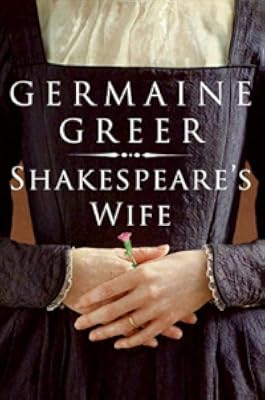
Shakespeare's Wife
by Germaine Greer
On This Page
Description
Challenges popular beliefs about the estranged nature of Shakespeare's marriage to Ann Hathaway, placing their relationship in a social and historical context that poses alternative theories about her rural upbringing and role in the bard's professional life.Tags
Recommendations


























Member Reviews
I think Greer had a lot of fun writing this book - and I had a lot of fun reading it.
I was attracted to the book by a quote from a reviewer who said something along the lines of - Greer has been as unprovocative as she could be, but the old men of academia still reacted with outrage and venom.
Well, if there were to be sides - I'd be on Greer's team.
The study of Shakespeare's life and times suffers from the lack of documentary evidence. Too many academics backfill the gap with commentary inmformed by later lives and times. Greer goes back to the basics, and gives the reader a great picture of what life was like in Stratford, and for women in particular. Life was different, but the reader comes away with a sense of what life may have show more been likely for Ann Hathaway.
The other interesting aspect of the book, for me, was the picture of the aging Shakespeare who retired back to Avon as a man of some wealth. There's a hint here of some sort of serious decline in abilities - dementia? It's only an aside in this book, but I would love to see if others have considered the issue. Just because he was a genius at his prime doesn't mean he waasn't mortally fragile as he aged. show less
I was attracted to the book by a quote from a reviewer who said something along the lines of - Greer has been as unprovocative as she could be, but the old men of academia still reacted with outrage and venom.
Well, if there were to be sides - I'd be on Greer's team.
The study of Shakespeare's life and times suffers from the lack of documentary evidence. Too many academics backfill the gap with commentary inmformed by later lives and times. Greer goes back to the basics, and gives the reader a great picture of what life was like in Stratford, and for women in particular. Life was different, but the reader comes away with a sense of what life may have show more been likely for Ann Hathaway.
The other interesting aspect of the book, for me, was the picture of the aging Shakespeare who retired back to Avon as a man of some wealth. There's a hint here of some sort of serious decline in abilities - dementia? It's only an aside in this book, but I would love to see if others have considered the issue. Just because he was a genius at his prime doesn't mean he waasn't mortally fragile as he aged. show less
http://nhw.livejournal.com/1150833.html
Ann Shakespeare, née Hathaway, died in 1623, seven years after her husband, and was probably born in 1556, eight years before him. As Germaine Greer rightly points out, she tends to get short shrift from her husband's admirers, most of whom see her as an inconvenient detail of the Bard's early life, operating in a different universe to the London theatre world. Greer pulls apart this casual sexism, using the documentary evidence combined with her own instincts, and tells rather a good story firmly moored in the social history of Stratford-upon-Avon - the decaying Shakespeares and the more prosperous Hathaway clan; the struggles between the local council and the psychopathic landlord; the show more destruction of most of the town several times over by accidental fire. She points out that the oddest thing about the Shakespeares' marriage is the fact that William was so young (not Ann's pregnancy, which was par for the course), and then goes on to point out several romantic heroes in Shakespeare's works who are explicitly younger than the women they love. She makes a good case that several of the sonnets (beyond 145, which is fairly obvious) are addressed to Ann - and asks, why should that be such an outrageous idea?
Of course, there isn't a lot of documentary evidence to go on, but on the whole Greer resists the temptation of straying too far into fantasy, apart from one chapter on Ann's totally fictional career making clothes, and a half chapter on her husband's equally unproven slow lingering death from syphilis. She also casts, to my mind, unnecessary doubts on the authenticity of the most concrete single object relating to Shakespeare which survives, namely his monument. But the whole thing is done with Greer's characteristic verve - her academic background, after all, is as a Shakespeare scholar, and in this book she combines passion and profundity. show less
Ann Shakespeare, née Hathaway, died in 1623, seven years after her husband, and was probably born in 1556, eight years before him. As Germaine Greer rightly points out, she tends to get short shrift from her husband's admirers, most of whom see her as an inconvenient detail of the Bard's early life, operating in a different universe to the London theatre world. Greer pulls apart this casual sexism, using the documentary evidence combined with her own instincts, and tells rather a good story firmly moored in the social history of Stratford-upon-Avon - the decaying Shakespeares and the more prosperous Hathaway clan; the struggles between the local council and the psychopathic landlord; the show more destruction of most of the town several times over by accidental fire. She points out that the oddest thing about the Shakespeares' marriage is the fact that William was so young (not Ann's pregnancy, which was par for the course), and then goes on to point out several romantic heroes in Shakespeare's works who are explicitly younger than the women they love. She makes a good case that several of the sonnets (beyond 145, which is fairly obvious) are addressed to Ann - and asks, why should that be such an outrageous idea?
Of course, there isn't a lot of documentary evidence to go on, but on the whole Greer resists the temptation of straying too far into fantasy, apart from one chapter on Ann's totally fictional career making clothes, and a half chapter on her husband's equally unproven slow lingering death from syphilis. She also casts, to my mind, unnecessary doubts on the authenticity of the most concrete single object relating to Shakespeare which survives, namely his monument. But the whole thing is done with Greer's characteristic verve - her academic background, after all, is as a Shakespeare scholar, and in this book she combines passion and profundity. show less
"Shakespeare's Wife" by Australian feminist Germaine Greer is a valuable addition to the groaning corpus of Shakespeariana. It's assertive, well-researched, and bracing. Greer argues that Ann Hathaway Shakespeare badly needs to be rescued from the neglect and condescension of the Shakespearians, who have refused to give her her due. They've subscribed too easily to the myth that Mrs. Shakespeare was a kind of harpy whom Will was only too glad to escape by making a career for himself on and through the London stage. Ann is generally portrayed as a cypher - a nothing - or worse, as a Shrew who badly needed to be Tamed. Greer alters that perception by painting her as competent, devoted, and assured. I recommend the book to those seeking a show more better understanding of Shakespeare and his time.
"Ann Shakespeare cannot sensibly be written out of her husband's life if only because he himself was so aware of marriage as a challenging way of life, a 'world-without-end bargain.' The Shakespeare wallahs have succeeded in creating a Bard in their own likeness, that is to say, incapable of relating to women, and have then vilified the one woman who remained true to him all his life, in order to exonerate him. There can be no doubt that Shakespeare neglected his wife, embarrassed her and even humiliated her, but attempting to justify his behavior by vilifying her is puerile. The defenders of Ann Hathaway are usually derided as sentimental when they are simply trying to be fair. It is a more insiduous variety of sentimentality that wants to believe that women who are ill-treated must have brought it upon themselves." show less
"Ann Shakespeare cannot sensibly be written out of her husband's life if only because he himself was so aware of marriage as a challenging way of life, a 'world-without-end bargain.' The Shakespeare wallahs have succeeded in creating a Bard in their own likeness, that is to say, incapable of relating to women, and have then vilified the one woman who remained true to him all his life, in order to exonerate him. There can be no doubt that Shakespeare neglected his wife, embarrassed her and even humiliated her, but attempting to justify his behavior by vilifying her is puerile. The defenders of Ann Hathaway are usually derided as sentimental when they are simply trying to be fair. It is a more insiduous variety of sentimentality that wants to believe that women who are ill-treated must have brought it upon themselves." show less
Germaine Greer has always made me think about things in a different way. I like her iconoclastic style, and I like her dry, witty humour.
I like Shakespeare too. I love the Sonnets. My favourite plays are all the well-known ones, the ones I’ve seen performed: Hamlet, King Lear, Macbeth, The Tempest, Midsummer Night’s Dream, The Merchant of Venice, Julius Caesar, Henry IV Part 2, and The Taming of the Shrew (I’ve only seen that one on screen). But I’ve never been much interested in all the speculation about authorship and whatnot, so I wasn’t too sure that I would enjoy Greer’s analysis of the representation of Ann Hathaway in Shakespeare’s Wife.
I needn’t have worried. Greer systematically unpacks what purports to be show more scholarly argument in favour of Ann-as-Shrew and tears the claims to shreds. Not a shred of evidence for that, she says, demolishing some hapless scholar’s magnum opus. Nonsense, no way in the world that could have happened at that time and in that society, she says. Foolhardy in his certainty, she announces. Greer doesn’t shilly-shally – she is refreshingly decisive and provocative. She even suggests that Shakespeare would have had it out with one Anthony Burgess, if he’d known how Burgess (writing in 1970) stigmatised Ann as promiscuous and Shakespeare as being bullied into the marriage with bitter resignation:
We may wonder how flattering Shakespeare would have found Burgess’s estimate of his character. If any of this had been said in his hearing, he would have been obliged to challenge Burgess in defence of his own honour, to say nothing of his wife’s. (p. 86)
I can imagine students of Shakespeare, tasked with a 2000 word essay about The Bard, struggling to suppress their laughter as they hunch over the book in the Baillieu…
To read the rest of my review please visit https://anzlitlovers.com/2014/06/18/shakespeares-wife-by-germaine-greer/ show less
I like Shakespeare too. I love the Sonnets. My favourite plays are all the well-known ones, the ones I’ve seen performed: Hamlet, King Lear, Macbeth, The Tempest, Midsummer Night’s Dream, The Merchant of Venice, Julius Caesar, Henry IV Part 2, and The Taming of the Shrew (I’ve only seen that one on screen). But I’ve never been much interested in all the speculation about authorship and whatnot, so I wasn’t too sure that I would enjoy Greer’s analysis of the representation of Ann Hathaway in Shakespeare’s Wife.
I needn’t have worried. Greer systematically unpacks what purports to be show more scholarly argument in favour of Ann-as-Shrew and tears the claims to shreds. Not a shred of evidence for that, she says, demolishing some hapless scholar’s magnum opus. Nonsense, no way in the world that could have happened at that time and in that society, she says. Foolhardy in his certainty, she announces. Greer doesn’t shilly-shally – she is refreshingly decisive and provocative. She even suggests that Shakespeare would have had it out with one Anthony Burgess, if he’d known how Burgess (writing in 1970) stigmatised Ann as promiscuous and Shakespeare as being bullied into the marriage with bitter resignation:
We may wonder how flattering Shakespeare would have found Burgess’s estimate of his character. If any of this had been said in his hearing, he would have been obliged to challenge Burgess in defence of his own honour, to say nothing of his wife’s. (p. 86)
I can imagine students of Shakespeare, tasked with a 2000 word essay about The Bard, struggling to suppress their laughter as they hunch over the book in the Baillieu…
To read the rest of my review please visit https://anzlitlovers.com/2014/06/18/shakespeares-wife-by-germaine-greer/ show less
Germaine Greer has little time for the generations of scholars who have derided Shakespeare's wife. Her research demonstrates that there's precious little documentary evidence of Ann Hathaway's life - no one can say with any certainty that she was a shrew and a drain on the Bard's genius, so why not consider the possibility that she was instead an intelligent, resourceful and independent woman?
Greer has provided a well researched book that looks at the much aligned Ann Hathaway.
Through looking at family history and social conditions at the time she unpacks and brings Ann Hathaway into a more balanced historical context.
An interesting read.
Through looking at family history and social conditions at the time she unpacks and brings Ann Hathaway into a more balanced historical context.
An interesting read.
A fascintating read for the detail and research that brings to life Stratford and London during the transition to the 17th Century. However, I think only someone with a graduate degree in Shakespeare's lit or English life of the times could read every paragraph without doing additonal research or at least looking up some words like "peascod" or "drabbing". Somme footnotes could have helped.
This is en enlightening read mainly about the independence and strength of English women during this tme, but this is not for the faint of heart. It was given to me when the previous reader couldn't finish it. I say dive in and use context like water-wings.
This is en enlightening read mainly about the independence and strength of English women during this tme, but this is not for the faint of heart. It was given to me when the previous reader couldn't finish it. I say dive in and use context like water-wings.
Members
- Recently Added By
Lists

John Carey's Sunday Best
82 works; 3 members

Club Read's Recommended Nonfiction Written by Women
618 works; 30 members
Author Information

34+ Works 6,217 Members
Germaine Greer is an author and noted Feminist. She is the author of The Female Eunuch, Daddy, We Hardly Knew You, The Change: Women, Ageing and the Menopause, The Beautiful Boy, Shakespeare's Wife and White Beech: The Rainforest Years, among others (Bowker Author Biography)
Awards and Honors
Awards
Distinctions
Common Knowledge
- People/Characters
- Anne Hathaway; William Shakespeare
- First words
- Anyone steeped in western literary culture must wonder why any woman of spirit would want to be a wife.
- Blurbers
- Shapiro, James
Classifications
- Genres
- Literature Studies and Criticism, Biography & Memoir, Nonfiction, Poetry, Fiction and Literature
- DDC/MDS
- 822.33 — Literature & rhetoric English & Old English literatures English drama 1558-1625 Elizabethan period William Shakespeare
- LCC
- PR2906 .G74 — Language and Literature English English Literature English renaissance (1500-1640)
- BISAC
Statistics
- Members
- 647
- Popularity
- 44,866
- Reviews
- 21
- Rating
- (3.45)
- Languages
- Dutch, English, Greek
- Media
- Paper, Ebook
- ISBNs
- 14
- ASINs
- 7