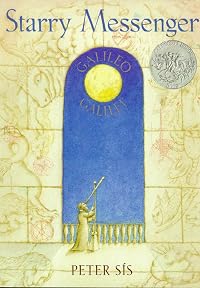
Starry Messenger: Galileo Galilei
by Peter Sís
On This Page
Description
Describes the life and work of the courageous man who changed the way people saw the galaxy, by offering objective evidence that the earth was not the fixed center of the universe.Tags
Recommendations

















Member Reviews
Like Peter Sis's other book I recently read, The Tree of Life: Charles Darwin, the artwork and small details are lush. I like the way Sis does not skimp on showing dates and details in the life of Galileo. These are not generalized, glossed-over biographies, they are rich in information about their subjects.
Text is wrapped around round objects so that the reader is forced to turn the book on it's side to see the text...and no doubt the pictures...from a different perspective. Something, unfortunately, the Catholic Church was unable to do in it's condemnation of Galileo Galilei and his novel idea that the earth goes around the sun.
It is always amazing the human capacity for denial of reality and how much it hasn't changed in almost 500 show more years. show less
Text is wrapped around round objects so that the reader is forced to turn the book on it's side to see the text...and no doubt the pictures...from a different perspective. Something, unfortunately, the Catholic Church was unable to do in it's condemnation of Galileo Galilei and his novel idea that the earth goes around the sun.
It is always amazing the human capacity for denial of reality and how much it hasn't changed in almost 500 show more years. show less
This book by one of my favorite children's authors is a visual feast of intricate drawings and details on the life of Galileo Galilei. Sis incorporates primary and secondary sources in sharing sometimes very difficult to understand knowledge on the life of Galilei with fluid and detailed drawings. My personal favorite part of the book was incorporating the physical layout of the book into a visceral learning experience by moving the book in a circle to read the inscriptions, hunting for key characters in pictures, and the symbolism in his unique drawing elements. The author does an amazing job of incorporating Galileo's real writings into a fun and interactive book that can engage children's imaginations while also teaching them a good show more bit of science! show less
Top 100 Pick because:
Although I feel this book is almost more suited for adults to appreciate, hopefully younger children will find inspiration and beauty in this picture book. I find the illustrations and cultural and historical influences upon the story absolutely compelling and breathtaking. From the front cover to the back, each page is filled with details, many of them alluding to Galileo's life and the sprinkling actual samples of his writing throughout (which I think an adult would find more interesting than a young child). I cannot give the book anything other than 5 stars, however, because I love the way Galileo's life is told, the captivating illustrations, and how it all ties together. I do also love that Galileo stuck to not show more only what he believed (which is more faith based), but what he knew & could prove. STEM inspiration right there. show less
Although I feel this book is almost more suited for adults to appreciate, hopefully younger children will find inspiration and beauty in this picture book. I find the illustrations and cultural and historical influences upon the story absolutely compelling and breathtaking. From the front cover to the back, each page is filled with details, many of them alluding to Galileo's life and the sprinkling actual samples of his writing throughout (which I think an adult would find more interesting than a young child). I cannot give the book anything other than 5 stars, however, because I love the way Galileo's life is told, the captivating illustrations, and how it all ties together. I do also love that Galileo stuck to not show more only what he believed (which is more faith based), but what he knew & could prove. STEM inspiration right there. show less
Peter Sís, children’s book author/illustrator, is known for his picture books that aren’t really just for children. In this tribute to Galileo Galilei, he celebrates the paradigm shift precipitated by Galileo, who was born in Pisa, Italy on February 15, 1564.
In a number of carefully reasoned treatises, Galileo provided evidence that the earth was not in fact the center of the universe. He overturned conventional thinking in epistemology, theology, history, and science, paving the way for modern astronomy.
Much of the evidence provided by Galileo came from his use of the telescope. Galileo did not invent this instrument himself; a Dutch eyeglass maker, Hans Libbershey, was at least the first person to apply for a patent in 1608. But show more Galileo saw its potential, and was quick to find new uses for the telescope and also to make critical improvements to it.
At the end of 1609, Galileo began turning his enhanced telescope to the sky. After he had made lunar observations, he shifted his attention to Jupiter. On January 7, 1610, he observed the planet and saw what he thought were three fixed stars near it, strung out in a line. The next night, he saw all three stars to the west of Jupiter. Over the next week he returned to the formation every night. He discovered that not only did the little stars never leave the planet, but they seemed to be carried along with it, and moreover, kept changing their position with respect to each other and to Jupiter. Also, a fourth companion entered the grouping that apparently had been around the other side of the planet during his initial observations.
By January 15th Galileo figured out that the moving bodies were not stars but four moons that were revolving around Jupiter. This proved that not everything in space circled the Earth. Therefore, to Galileo, our planet might not the absolute center of the universe, as the Catholic Church maintained (based on its understanding of the Bible).
In March of 1610 he published a small book, Sidereus Nuncius (The Starry Messenger), revealing some discoveries that had not been dreamed of in the philosophy of the time: mountains on the Moon, lesser moons in orbit around Jupiter, and the resolution of what had been thought cloudy masses in the sky (nebulae) into collections of stars too faint to see individually. Other observations followed, including the phases of Venus and the existence of sunspots.
These revelations and Galileo’s theory that the earth went around the sun had a major impact on cosmology and Galileo became famous. But the Catholic Church “began to worry”:
“Galileo had become too popular. By upholding the idea that the earth was not the center of the universe, he had gone against the Bible and everything the ancient philosophers had taught. He had gone against the Church . . .”
Galileo was tried in the Pope’s court and ordered not to express his beliefs. He was also condemned to spend the rest of his life under house arrest.
Finally, the author reports:
". . . more than three hundred years later, the leaders of the very Church that had punished Galileo Galilei pardoned him, and they admitted he was probably - in fact, surely and absolutely - right.”
[The phrasing of this statement by Sís is a little odd - the Church's 1992 statement, as reported by "The New York Times," was quite definitive: "We today know that Galileo was right in adopting the Copernican astronomical theory," Paul Cardinal Poupard, the head of the current investigation, said in an interview . . ."]
The illustrations by Sís are the real “stars” of the story; they are detailed evocations of historical documents from Galileo’s time and and truly wonder-inspiring. He also incorporates excerpts of handwritten passages from The Starry Messenger.
Evaluation: This book with its mesmerizing pictures (the book was a 1997 Caldecott Honor Book) teaches some important lessons about truth, courage, and persistence even when those in power may act unjustly. show less
In a number of carefully reasoned treatises, Galileo provided evidence that the earth was not in fact the center of the universe. He overturned conventional thinking in epistemology, theology, history, and science, paving the way for modern astronomy.
Much of the evidence provided by Galileo came from his use of the telescope. Galileo did not invent this instrument himself; a Dutch eyeglass maker, Hans Libbershey, was at least the first person to apply for a patent in 1608. But show more Galileo saw its potential, and was quick to find new uses for the telescope and also to make critical improvements to it.
At the end of 1609, Galileo began turning his enhanced telescope to the sky. After he had made lunar observations, he shifted his attention to Jupiter. On January 7, 1610, he observed the planet and saw what he thought were three fixed stars near it, strung out in a line. The next night, he saw all three stars to the west of Jupiter. Over the next week he returned to the formation every night. He discovered that not only did the little stars never leave the planet, but they seemed to be carried along with it, and moreover, kept changing their position with respect to each other and to Jupiter. Also, a fourth companion entered the grouping that apparently had been around the other side of the planet during his initial observations.
By January 15th Galileo figured out that the moving bodies were not stars but four moons that were revolving around Jupiter. This proved that not everything in space circled the Earth. Therefore, to Galileo, our planet might not the absolute center of the universe, as the Catholic Church maintained (based on its understanding of the Bible).
In March of 1610 he published a small book, Sidereus Nuncius (The Starry Messenger), revealing some discoveries that had not been dreamed of in the philosophy of the time: mountains on the Moon, lesser moons in orbit around Jupiter, and the resolution of what had been thought cloudy masses in the sky (nebulae) into collections of stars too faint to see individually. Other observations followed, including the phases of Venus and the existence of sunspots.
These revelations and Galileo’s theory that the earth went around the sun had a major impact on cosmology and Galileo became famous. But the Catholic Church “began to worry”:
“Galileo had become too popular. By upholding the idea that the earth was not the center of the universe, he had gone against the Bible and everything the ancient philosophers had taught. He had gone against the Church . . .”
Galileo was tried in the Pope’s court and ordered not to express his beliefs. He was also condemned to spend the rest of his life under house arrest.
Finally, the author reports:
". . . more than three hundred years later, the leaders of the very Church that had punished Galileo Galilei pardoned him, and they admitted he was probably - in fact, surely and absolutely - right.”
[The phrasing of this statement by Sís is a little odd - the Church's 1992 statement, as reported by "The New York Times," was quite definitive: "We today know that Galileo was right in adopting the Copernican astronomical theory," Paul Cardinal Poupard, the head of the current investigation, said in an interview . . ."]
The illustrations by Sís are the real “stars” of the story; they are detailed evocations of historical documents from Galileo’s time and and truly wonder-inspiring. He also incorporates excerpts of handwritten passages from The Starry Messenger.
Evaluation: This book with its mesmerizing pictures (the book was a 1997 Caldecott Honor Book) teaches some important lessons about truth, courage, and persistence even when those in power may act unjustly. show less
See full review @ The Indigo Quill: http://theindigoquill.blogspot.com/2014/04/review-starry-messenger-galileo-galil...
This is an educational book about one of the world's first astronomer's, Galileo Galilei. It can easily be used as a tool to teach your child (or children) and be interactive with little extras and things. There is also a Teacher's Guide available HERE.
I'll note that this is the Caldecott Winner for the year 1997. That being said, I didn't particularly enjoy this Children's book compared to others I've reviewed. I did not feel like the artwork and the text complimented each other very well, and the illustrations weren't fitting for the audience this book is intended for.
Although the artwork itself is beautiful and show more innovative, the scripting was extremely difficult to read and the pages are almost so busy that it's distracting and the eye cannot locate the focal point.
There were some parts where the text generally did not make sense (Particularly the final page). The wording was off and the illustrations were difficult to interpret.
I don't think this would be my first choice in teaching my child about Galileo. I think there are better picture books out there that I could find much more suited and well-rounded for a young audience. The idea of this book is nice, I just think it's unsuitable. show less
This is an educational book about one of the world's first astronomer's, Galileo Galilei. It can easily be used as a tool to teach your child (or children) and be interactive with little extras and things. There is also a Teacher's Guide available HERE.
I'll note that this is the Caldecott Winner for the year 1997. That being said, I didn't particularly enjoy this Children's book compared to others I've reviewed. I did not feel like the artwork and the text complimented each other very well, and the illustrations weren't fitting for the audience this book is intended for.
Although the artwork itself is beautiful and show more innovative, the scripting was extremely difficult to read and the pages are almost so busy that it's distracting and the eye cannot locate the focal point.
There were some parts where the text generally did not make sense (Particularly the final page). The wording was off and the illustrations were difficult to interpret.
I don't think this would be my first choice in teaching my child about Galileo. I think there are better picture books out there that I could find much more suited and well-rounded for a young audience. The idea of this book is nice, I just think it's unsuitable. show less
Another beautiful book by Sís, this time profiling physicist, mathematician, astronomer, and philosopher Galileo, who dared defy the long-held belief that the earth was the centre of the universe, and basing himself on observations through a telescope he had build and improved upon himself, proved that the earth actually orbited the sun. Filled with details about his life and times, from his birth in 1564 (the same year as Shakespeare's own birth and Michelangelo's death), with notes from his journals and his famous treatise from 1610, The Starry Messenger (Sidereus Nuncius), the first scientific treatise to be published based on observations made through a telescope, until his final days, which he spent under house arrest following an show more church inquisition which found him "vehemently suspect of heresy". Fans of Sís will love this, and it's a good starting point for those not yet familiar with his work. show less
A wonderful tale of Galileo. Filled with beautiful illustrations and various side notes, we learn about the life of Galileo and his struggles to gain a knowledge beyond him. We learn what a huge impact Galileo had on astronomy, even with his limitations. He pursued his passion, and although it imprisoned him, he always kept his love for stars alive. As the book states, no one can take away your thoughts or keep you from thinking about something. It's a powerful lesson for students to learn.
Members
- Recently Added By
Lists

Best children's picture books
377 works; 85 members

A Child's Book Tour of Italy
88 works; 3 members

al.vick-wishlist-Children's
462 works; 3 members

Caldecott Honor Books
296 works; 23 members

Books Read in 2023
5,638 works; 147 members

The Story of the World: History for the Classical Child: Activity Book Two
415 works; 2 members
Author Information

Peter Sis was born in Brno, Czechoslovakia, in 1949 and attended the Academy of Applied Arts in Prague and the Royal College of Art in London. He began his career as a filmmaker and won the Golden Bear Award at the 1980 West Berlin Film Festival for an animated short. He has also won the Grand Prix Toronto and the Cine Golden Eagle Award, and in show more 1983 collaborated with Bob Dylan on You Got to Serve Somebody. His film work is in the permanent collection of the Museum of Modern Art, New York. In 1982 Sis was sent to Los Angeles to produce a film for the 1984 Winter Olympics. But the film project was canceled when Czechoslovakia and the entire Eastern bloc decided to boycott the Olympics. Ordered by his government to return home, Sis decided to stay in the United States and was granted asylum. Sis then met Maurice Sendak who introduced him to children's books, and he moved to New York City in 1984 to begin a career in children's literature. Sís earned quick acclaim with the publication of the 1986 Newbery Medal Winner, The Whipping Boy by Sid Fleishman, for which he did the illustrations. Sis is a five-time winner of The New York Times Book Review Best Illustrated Book of the Year.. Komodo! and A Small Tall Tale from the Far Far North were each named a Boston Globe-Horn Book Award Honor Book, and he has won a Society of Illustrators Gold Medal for Komodo! and a Silver Medal for The Three Golden Keys. Starry Messenger: Galileo Galilei was a 1997 Caldecott Honor Book, as was Tibet Through the Red Box. Sis has also received a MacArthur Fellowship Sis' editorial illustrations have appeared in Time, Newsweek, Esquire, The Atlantic Monthly, and many other magazines in the United States and abroad. He has published nearly 1,000 drawings in The New York Times Book Review. He has designed many book jackets and posters, including, in 1984, the famous poster for Milos Forman's Academy Award-winning motion picture Amadeus. He has also completed a mural for the Washington/Baltimore Airport, a poster for the New York City subway system, and a stage set for the Joffrey Ballet. His work has been exhibited in Prague, London, Zurich, Hamburg, Los Angeles, and New York in both group and one-man shows. (Bowker Author Biography) show less
Some Editions
Awards and Honors
Awards
Distinctions
Common Knowledge
- Canonical title*
- Le messager des étoiles. Galiléo Galiléi
- Original publication date
- 1996
- People/Characters
- Galileo Galilei
- Epigraph
- "God fixed the Earth upon its foundation, not to be moved for ever." --- PSALMS
"Be not afraid of greatness: some are born great, some achieve greatness, and some have greatness thrust upon them." --- William Shakespeare, Twelfth Night (II.v.159) - Dedication
- For Frances
- First words
- For hundreds of years, most people thought the earth was the center of the universe, and the sun and the moon and all the other planets revolved around it.
- Last words
- (Click to show. Warning: May contain spoilers.)Finally, more than three hundred years later, the leaders of the very Church that had punished Galileo Galilei pardoned him, and they admitted that he was probably -- in fact, surely and absolutely -- right.
- Original language*
- Anglais (Etats-Unis) (Etats-Unis)
*Some information comes from Common Knowledge in other languages. Click "Edit" for more information.
Classifications
Statistics
- Members
- 1,479
- Popularity
- 15,771
- Reviews
- 31
- Rating
- (4.09)
- Languages
- 7 — Czech, English, French, German, Korean, Spanish, Portuguese (Portugal)
- Media
- Paper, Audiobook, Ebook
- ISBNs
- 24
- ASINs
- 2