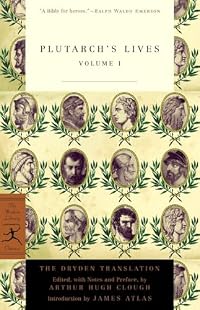
Plutarch's Lives, Volume 1 of 2
by Plutarch
Plutarch's Lives, Dryden translation, edited by Clough (1)
On This Page
Description
"Lives" is a series of biographies of famous Greeks and Romans by the ancient Greek historian Plutarch who lived during the first and second century AD. "Lives" consists of twenty-three paired biographies, one Greek and one Roman, and four unpaired, which explore the influence of character on the lives and destinies of the subjects. Rather than providing strictly historical accounts, Plutarch was most concerned with capturing this issue of character. This volume, volume 1 of 2, contains the show more first half of this classic history in which you will find the biographies of the following persons: "Theseus," "Romulus," "Lycurgus," "Numa Pompilius," "Solon," "Poplicola," "Themistocles," "Camillus," "Pericles," "Fabius," "Alcibiades," "Coriolanus," "Timoleon," "Æmilius Paulus," "Pelopidas," "Marcellus," "Aristides," "Marcus Cato," "Philopœmen," "Flamininus," "Pyrrhus," "Caius Marius," "Lysander," "Sylla," "Cimon," "Lucullus," "Nicias," and "Crassus.". show lessTags
Recommendations




Member Reviews
"Now himselfe confesseth in some place, that when he began this worke, at the first it was but to profit others; but that afterwards it was to profit himselfe, looking upon those histories, as if he had looked in a glasse, and seeking to reform his life in some sort, and to forme it in the mould of the vertues of these great men; taking this fashion of searching their manners, and writing the Lives of these noble men, to be a familiar haunting and frequenting of them. Also he thought, [said he himselfe] that he lodged these men one after another in his house, entering into consideration of their qualities, and that which was great in either of them, choosing and principally taking that which was to be noted, and most worthy to be knowne show more in their sayings and deeds." - This quote is from Sir Thomas North’s Life of Plutarch in his 1631 translation of Plutarch, and in many ways it sums up this reading experience really well for me.
After checking out two different translations, I ended up choosing the one by Aubrey Stewart and George Long. (The other was the so-called 'Dryden Translations', which, because it was done by several different people, is of a somewhat uneven quality. The language in that version is also relatively archaic. I may return to it though.) While I can’t say anything about the quality of the translations from Greek, the language in the Stewart/Long version flows smoothly, their respective introductions were interesting and the notes to the text were useful. As for Plutarch himself, his Parallel Lives is an incomparable work, and his insights and profound understanding of human nature, makes it, in addition to its obvious historical value, something far more than simply a collection of short biographies. Plutarch has an ethical as well as historical interest in his pairing of Lives of the famous Greeks and Romans, and in the adjoined Comparisons (those that are still extant), just as often contrasts the achievements and characters of his subjects as much as he aims to show their resemblances.
I had already read the Life of Lycurgus (in the Penguin Classics series of Plutarch translations), so I read the Life of Numa and the Comparison of Numa with Lycurgus first. Because of this, I ended up reading about Theseus and Romulus last, and that proved a good choice, since they somehow stand apart anyway because of their distinct mythological character. The Stewart/Long translation is just as readable as the more modern translations (found in e.g. the Penguin Classics), so if you want the entire series of Plutarch’s Parallel Lives, for which there are many good reasons, this is a very good choice. And it’s no drawback that it’s available for free download for Kindle (and in other formats).
I’ll end this by letting Plutarch speak for himself: "I do not write Histories, but Lives; nor do the most conspicuous acts of necessity exhibit a man's virtue or his vice, but oftentimes some slight circumstance, a word, or a jest, shows a man's character better than battles with the slaughter of tens of thousands, and the greatest arrays of armies and sieges of cities. Now, as painters produce a likeness by a representation of the countenance and the expression of the eyes, without troubling themselves about the other parts of the body, so I must be allowed to look rather into the signs of a man's character, and thus give a portrait of his life, leaving others to describe great events and battles." - (From the introduction to the Life of Alexander.)
This work is licensed under a Creative Commons Attribution-NonCommercial-ShareAlike 3.0 Unported License. show less
After checking out two different translations, I ended up choosing the one by Aubrey Stewart and George Long. (The other was the so-called 'Dryden Translations', which, because it was done by several different people, is of a somewhat uneven quality. The language in that version is also relatively archaic. I may return to it though.) While I can’t say anything about the quality of the translations from Greek, the language in the Stewart/Long version flows smoothly, their respective introductions were interesting and the notes to the text were useful. As for Plutarch himself, his Parallel Lives is an incomparable work, and his insights and profound understanding of human nature, makes it, in addition to its obvious historical value, something far more than simply a collection of short biographies. Plutarch has an ethical as well as historical interest in his pairing of Lives of the famous Greeks and Romans, and in the adjoined Comparisons (those that are still extant), just as often contrasts the achievements and characters of his subjects as much as he aims to show their resemblances.
I had already read the Life of Lycurgus (in the Penguin Classics series of Plutarch translations), so I read the Life of Numa and the Comparison of Numa with Lycurgus first. Because of this, I ended up reading about Theseus and Romulus last, and that proved a good choice, since they somehow stand apart anyway because of their distinct mythological character. The Stewart/Long translation is just as readable as the more modern translations (found in e.g. the Penguin Classics), so if you want the entire series of Plutarch’s Parallel Lives, for which there are many good reasons, this is a very good choice. And it’s no drawback that it’s available for free download for Kindle (and in other formats).
I’ll end this by letting Plutarch speak for himself: "I do not write Histories, but Lives; nor do the most conspicuous acts of necessity exhibit a man's virtue or his vice, but oftentimes some slight circumstance, a word, or a jest, shows a man's character better than battles with the slaughter of tens of thousands, and the greatest arrays of armies and sieges of cities. Now, as painters produce a likeness by a representation of the countenance and the expression of the eyes, without troubling themselves about the other parts of the body, so I must be allowed to look rather into the signs of a man's character, and thus give a portrait of his life, leaving others to describe great events and battles." - (From the introduction to the Life of Alexander.)
This work is licensed under a Creative Commons Attribution-NonCommercial-ShareAlike 3.0 Unported License. show less
Plutarch wrote his lives to educate the reader. In doing so he used a combination of history and myth while assessing the politics and religion of the "Noble" Greeks and Romans whose lives he included in his writings. What was originally a series of books have been compiled into two volumes that span the lives from ancient Greece through the centuries until the Roman Empire flourished. I found that in creating his histories Plutarch admitted time and again to uncertainty about some of the specific events that he portrayed. In addition, he would sometimes note that there were those who held differing opinions about some of his characterizations of events.
One theme of his lives is the identification of key characteristics of success of show more the particular life depicted; in fact, he points out that success does not depend on one particular style of leadership or rule. However, that did not stop Plutarch for identifying some lives that were better than others. One of the most successful lives depicted was that of Pericles. Near the beginning of his life of Pericles, Plutarch observes "that it becomes a man's duty to pursue and make after the best and choicest of everything, that he may not only employ his contemplation, but may also be improved by it." (p 201)
Not only does he highlight the importance of contemplation (an activity that Aristotle considered the highest virtue in which a man might engage himself [Nichomachean Ethics]) for improvement of one's life, but also the application of his intellect to objects such as acts of virtue. All of this is merely introductory to a life that includes just such actions and provides some of the reasons why Athens under the leadership of Pericles was so successful. All of this is done, in part, to educate the reader and encourage an "admiration of the things done and desire to imitate the doers of them."(p 202)
Pericles led a life that did not leave any writings, not unlike that of Socrates, although we have some of his orations thanks to Thucydides' History of the Peloponnesian War. What he did leave were public and sacred buildings, and evidence of a policy that encouraged great public shows, banquets, and processions to further the pleasure of the people of Athens. At one point, Plutarch compares him to a skillful physician who balances the pleasures with "keen pains and drug" when necessary to cure what ailments might exist among the citizenry. He maintained his rule through attention to the soul of the people. Plutarch adds, "The source of this predominance was not barely the power of language, but, as Thucydides assures us, the reputation of his life, and the confidence of his character; his manifest freedom from every kind of corruption, and superiority to all considerations of money." Would that we had leaders like that in America today.
Pericles may sound like the proverbial person that is too good to be true, however in his conclusion Plutarch reinforces his judgement with these words, "He was indeed a character deserving our high admiration not only for his equitable and mild temper . . .", but that he had not "gratified his envy or his passion". (p 234) It is such a character that made Pericles one of Plutarch's favorites among the many noble lives that he chronicled. Each of the lives in this volume receives what appears to be an objective study of the details of their character, actions, and relations with others. The result is a compendium that provides the reader with instruction in how to live as well as a magnificent narrative of how many of the noblest of Greeks and Romans actually lived their lives. show less
One theme of his lives is the identification of key characteristics of success of show more the particular life depicted; in fact, he points out that success does not depend on one particular style of leadership or rule. However, that did not stop Plutarch for identifying some lives that were better than others. One of the most successful lives depicted was that of Pericles. Near the beginning of his life of Pericles, Plutarch observes "that it becomes a man's duty to pursue and make after the best and choicest of everything, that he may not only employ his contemplation, but may also be improved by it." (p 201)
Not only does he highlight the importance of contemplation (an activity that Aristotle considered the highest virtue in which a man might engage himself [Nichomachean Ethics]) for improvement of one's life, but also the application of his intellect to objects such as acts of virtue. All of this is merely introductory to a life that includes just such actions and provides some of the reasons why Athens under the leadership of Pericles was so successful. All of this is done, in part, to educate the reader and encourage an "admiration of the things done and desire to imitate the doers of them."(p 202)
Pericles led a life that did not leave any writings, not unlike that of Socrates, although we have some of his orations thanks to Thucydides' History of the Peloponnesian War. What he did leave were public and sacred buildings, and evidence of a policy that encouraged great public shows, banquets, and processions to further the pleasure of the people of Athens. At one point, Plutarch compares him to a skillful physician who balances the pleasures with "keen pains and drug" when necessary to cure what ailments might exist among the citizenry. He maintained his rule through attention to the soul of the people. Plutarch adds, "The source of this predominance was not barely the power of language, but, as Thucydides assures us, the reputation of his life, and the confidence of his character; his manifest freedom from every kind of corruption, and superiority to all considerations of money." Would that we had leaders like that in America today.
Pericles may sound like the proverbial person that is too good to be true, however in his conclusion Plutarch reinforces his judgement with these words, "He was indeed a character deserving our high admiration not only for his equitable and mild temper . . .", but that he had not "gratified his envy or his passion". (p 234) It is such a character that made Pericles one of Plutarch's favorites among the many noble lives that he chronicled. Each of the lives in this volume receives what appears to be an objective study of the details of their character, actions, and relations with others. The result is a compendium that provides the reader with instruction in how to live as well as a magnificent narrative of how many of the noblest of Greeks and Romans actually lived their lives. show less
Read this book slowing through over about three months in 2020. The book swings back and forth between interesting assessments of Roman and Greek leaders and less interesting parts. Somehow reading accounts of ancient battles tends to get tiresome. The overall theme through the biographies lies in the tremendous challenge of succeeding as a leader in politics and war. Almost every person portrayed had some sort of critical failing.
War War War War War. Once I got used to the translator's style (a bit like Charles Dickens) I was able to proceed with some speed. This is not for the timid or for people who like short sentences. I like the one best where the general, upon being rebuked, took out his sword and killed himself. That's the way to take responsibility for ones actions.
This book was a massive undertaking, but worth it. Fifty Greek and Roman leaders are described in mini-biographies by Plutarch. It was enlightening to me to see the difference between societies at that time, and our modern world. The similarities were also striking, given the current world violence we now try to tell ourselves is so unnatural and immoral.
It's becoming clear to me that the reason Greek and Roman history is so prevalent in our history classes, and in our way of thinking, is simply because the Greeks were the first to have a true alphabet. The first to record their history, at least in a way that has mostly survived. I can't help but think what a pity it is that other societies histories, of the Trojans, or of the show more "barbarians" of Northern Europe, or even the Aztec's or the Maya are lost. show less
It's becoming clear to me that the reason Greek and Roman history is so prevalent in our history classes, and in our way of thinking, is simply because the Greeks were the first to have a true alphabet. The first to record their history, at least in a way that has mostly survived. I can't help but think what a pity it is that other societies histories, of the Trojans, or of the show more "barbarians" of Northern Europe, or even the Aztec's or the Maya are lost. show less
A very beautifully written translation. Be warned, however, that you will want to consult another source for any serious study, as Clough has taken some serious liberties with the text.
Leather cowhide, Castalia Library, limited edition of 750
Members
- Recently Added By
Lists

CCE 100 Great Books List
145 works; 8 members
Author Information

1,619+ Works 25,898 Members
PLUTARCH. c.46--c.125 Considered by many to be the most important Greek writer of the early Roman period, Plutarch was a member of a well-to-do Greek family, a chief magistrate, a priest at Delphi, and an exceptionally well-read individual. His philosophical views were based on those of Plato and, although a Greek, he esteemed the achievements and show more attributes of the Romans. By the time Plutarch's works were published for the first time in the eleventh century, some had already been lost. He wrote innumerable essays on philosophical, historical, political, religious, and literary subjects, 78 of which survive today and are known collectively as the "Moralia." He is known primarily, however, for his Parallel Lives of Greeks and Romans, which consists of 50 biographies---23 of prominent Greeks, 23 of Roman leaders, and 4 separate lives---accompanied at intervals by short comparative essays. Although historical information is included in the work, Plutarch wrote it originally to inspire emulation in youth, so the emphasis is on character, moral choice, and anecdote. Sir Thomas North's 1579 translation into English of Parallel Lives became an important source for William Shakespeare which he used for three plays, Julius Caesar, Antony and Cleopatra, and Coriolanus. (Bowker Author Biography) show less
All Editions
Some Editions
Series

Belongs to Publisher Series
Common Knowledge
- Canonical title
- Plutarch's Lives, Volume 1 of 2
- Disambiguation notice
- Do not combine with complete editions or with editions that have more than two volumes. The Everyman edition is in three volumes and other reprints are in usually in four or five volumes.
Classifications
- Genres
- History, Nonfiction, Biography & Memoir, General Nonfiction
- DDC/MDS
- 920.038 — History & geography Biographies, Genealogy, Healdry Biographies General and collective by localities Ancient
- LCC
- DE7 .P513 — History of Europe, Asia, Africa and Oceania Greco-Roman World History of the Greco-Roman world General
- BISAC
Statistics
- Members
- 1,684
- Popularity
- 13,185
- Reviews
- 7
- Rating
- (4.13)
- Languages
- Chinese, English
- Media
- Paper, Audiobook, Ebook
- ISBNs
- 46
- ASINs
- 12