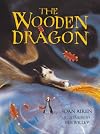
The Wooden Dragon
by Joan Aiken
On This Page
Description
Joan Aiken tells the story of Window and her sailor brother, Handle, who live in a small house in a wooded hollow. Each autumn, Handle must sweep the huge piles of leaves away. But one day, he breaks the news that he must go away on an extra long trip and leaves Window a little wooden dragon that will help look after her. And so the little dragon sits on a corner shelf, growing dusty, and waits for the time when he can come to Window's aid.Tags
Recommendations















Member Reviews
Celebrated children's writer Joan Aiken, author of the classic The Wolves of Willoughby Chase, spins an original fairy-tale in this brightly-illustrated picture-book. The story of siblings Window and Handle - the former a homebound knitter and storyteller, unable to get very far because of a lame leg; the latter an energetic sailor who periodically leaves home on long sea voyages - it centers around the gift of a wooden dragon, from brother to sister. Ignoring the hand-carved memento, Windows instead pines for her absent brother, and worries about her own fate, if autumn leaves should bury their house. When the dragon, now dusty and pining himself, comes to her in a dream, WIndow manages to snap out of her malaise, cleaning the dragon show more and setting him loose on the aforementioned leaves. Returning to his "secret magic island,' he leaves Window in a much more hopeful state...
Although a great fan of Aiken's work, I confess to being a tad disappointed in The Wooden Dragon, which I had to track down through inter-library loan. Unlike her retelling of Snow White and the Seven Dwarfs, or her original fairy-tale, The Moon's Revenge, which were both published here in the states, this one was only ever published in London (at least in English), and is therefore more difficult to obtain in the USA. Leaving such issues aside, I found that the story here, although engaging enough, did not live up to the author's better work. The names of the two main characters - Aiken has a penchant for idiosyncratic names - were distracting, and the dilemma of the leaf-buried house somehow felt so obviously contrived, rather than organically magical. There's nothing really wrong here (although I would have preferred Handle to return at the end), so perhaps my lukewarm response was the result of overly high expectations. The accompanying illustrations by Bee Willey were quite lovely, with a gorgeous color scheme, and a leaf motif throughout that was sometimes subtle, sometimes obvious. I found her human faces a little creepy, but perhaps they were meant to have a sort of eldritch enchantment.
All in all, despite my qualifications, this is still a book worth seeking out, if one is a Joan Aiken fan, or enjoys picture-books featuring fantastic tales. show less
Although a great fan of Aiken's work, I confess to being a tad disappointed in The Wooden Dragon, which I had to track down through inter-library loan. Unlike her retelling of Snow White and the Seven Dwarfs, or her original fairy-tale, The Moon's Revenge, which were both published here in the states, this one was only ever published in London (at least in English), and is therefore more difficult to obtain in the USA. Leaving such issues aside, I found that the story here, although engaging enough, did not live up to the author's better work. The names of the two main characters - Aiken has a penchant for idiosyncratic names - were distracting, and the dilemma of the leaf-buried house somehow felt so obviously contrived, rather than organically magical. There's nothing really wrong here (although I would have preferred Handle to return at the end), so perhaps my lukewarm response was the result of overly high expectations. The accompanying illustrations by Bee Willey were quite lovely, with a gorgeous color scheme, and a leaf motif throughout that was sometimes subtle, sometimes obvious. I found her human faces a little creepy, but perhaps they were meant to have a sort of eldritch enchantment.
All in all, despite my qualifications, this is still a book worth seeking out, if one is a Joan Aiken fan, or enjoys picture-books featuring fantastic tales. show less
Ratings
Members
- Recently Added By
Author Information

216+ Works 19,819 Members
Joan Delano Aiken was born in Rye, Sussex, England, on September 4, 1924, the daughter of the Pulitzer Prize winner, writer Conrad Aiken. She was raised in a rural area and home schooled by her mother until the age 12. She then attended Wychwood School, a boarding school in Oxford. Her work first appeared in 1941 when the British Broadcasting show more Corporation, where she worked as a librarian, broadcast some of her short stories on their Children's Hour program. Aiken also worked at St. Thomas's Hospital, and in 1943 she moved to the reference department of the London office of the United Nations, where she collected information about resistance movements. She worked for the UN until 1949, all the while continuing to write stories. In 1953 a collection of short fiction called All You've Ever Wanted and Other Stories was published. While writing The Wolves of Willoughby Chase, begun in 1952, her husband became ill and died of lung cancer in 1955. After working for five years as a copy editor at Argosy Magazine, and at the J. Walter Thompson Advertising Firm, she returned and finished the book in 1963. The Wolves of Willoughby Chase won the Lewis Carroll Shelf Award and was made into a successful film in 1988. In 1969 The Whispering Mountain won the Guardian Children's Book Award, and in 1972, Night Fall won America's Edgar Allen Poe Award for juvenile mystery. Aiken is best known for her adult "fantasy" stories. She has received awards for children's fiction and for mystery fiction, and has also written ''sequels'' to Jane Austen books. She collaborated with her daughter to write many episodes of her Arabel and Mortimer the raven series for the BBC. In all, Aiken wrote 92 novels - including 27 for adults - as well as plays, poems and short stories, although she was best known as a writer of children's stories. Joan Aiken died in January of 2004 at the age of 79. (Bowker Author Biography) show less
All Editions
Awards and Honors
Awards
Classifications
Statistics
- Members
- 20
- Popularity
- 1,280,085
- Reviews
- 1
- Rating
- (2.75)
- Languages
- English, Spanish
- Media
- Paper
- ISBNs
- 3