Toads and Diamonds
by Charlotte S. Huck
On This Page
Description
Two step-sisters receive appropriate gifts for their actions: one's words are accompanied by flowers and jewels, the other's by toads and snakes.Tags
Recommendations








Member Reviews
In this French variant of the classic "good sister/bad sister" story - tale-type 480 in the Aarne-Thompson folklore classification system - two step-sisters find very different rewards for their different behavior. Goodhearted Renée, much put-upon by her unkind stepmother and stepsister, is rewarded with flowers and gemstones every time she speaks, after showing kindness to a bird and rabbit, on her way to the spring, and fetching a cool drink of water for an old woman. Selfish Francine, on the other hand, discovers that toads and snakes fall from her mouth when she speaks, after refusing to aid the same two creatures, and a beautiful lady (all the old woman in disguise) on her own trip to the spring.
Included by celebrated show more fairy-tale-salon author Charles Perrault in his 1697 collection, Histoires ou contes du temps passé: Les Contes de ma Mère l'Oie ("Stories or Fairy Tales from Bygone Eras: Tales of Mother Goose"), in which it was known simply as Les Fées ("The Fairies"), this story reminds me of any number of other variants, particularly the Grimm fairy-tale of Mother Holly. Charlotte Huck's retelling is engaging, and Anita Lobel's accompanying watercolor and gouache illustrations, although at first glance not really to my taste, won me over by the end. Recommended to young fairy-tale enthusiasts, and to fans of Anita Lobel's artwork. show less
Included by celebrated show more fairy-tale-salon author Charles Perrault in his 1697 collection, Histoires ou contes du temps passé: Les Contes de ma Mère l'Oie ("Stories or Fairy Tales from Bygone Eras: Tales of Mother Goose"), in which it was known simply as Les Fées ("The Fairies"), this story reminds me of any number of other variants, particularly the Grimm fairy-tale of Mother Holly. Charlotte Huck's retelling is engaging, and Anita Lobel's accompanying watercolor and gouache illustrations, although at first glance not really to my taste, won me over by the end. Recommended to young fairy-tale enthusiasts, and to fans of Anita Lobel's artwork. show less
I really enjoyed this story which closely resembled the Cinderella story. It appeared to be just another version of the classic plot of the kind and unkind sisters. The theme of the story revolves around a kind stepsister whose kindness to others rewarded her with a gift of diamond and roses that would fall from her lips every time she spoke. When her step mother found out about the gift, she forced her real daughter to act like her gifted sister in order to receive the same gift. But as they say “old habits die hard”, the daughter could not escape her bad attitude and unkindness to others. As a result, instead of receiving a gift she was cursed with toads and snakes that would fall from her lips every time she spoke. Of course, the show more kind sister was blamed for her sister’s misfortune and was kicked out of the house. Despite the great injustice the kind sister experienced, she eventually married a prince and ceased possessing her gift of diamond and roses, because as a princess she no longer needed such a gift. On the other hand, her stepsister got banished into a cave where she continued to have toads and snakes fall from her lips whenever she spoke.
The story’s theme is simple and clear, it carries the message that good behavior and kindness to others come with its own reward, while unkindness has negative consequences. I particularly liked how the author portrayed the good sister as a strong and resourceful character; breaking away from the traditional stereotype of a helpless female portrayed in many fairy tales. Another area where the author seemed to have deviated from the traditional tale is by placing a limitation/end upon the gifts, which totally acknowledges that to forever speak flowers and diamonds would actually be a curse and not a gift. Additionally, by placing that limit on the gift, the author highlighted the importance that the main character be accepted and admired for her own true self rather than for her gift.
In brief, I believe the story was well written and delivered a well-articulated moral lesson. The story seemed appropriate for children between the age of 7 and 9 years old. show less
The story’s theme is simple and clear, it carries the message that good behavior and kindness to others come with its own reward, while unkindness has negative consequences. I particularly liked how the author portrayed the good sister as a strong and resourceful character; breaking away from the traditional stereotype of a helpless female portrayed in many fairy tales. Another area where the author seemed to have deviated from the traditional tale is by placing a limitation/end upon the gifts, which totally acknowledges that to forever speak flowers and diamonds would actually be a curse and not a gift. Additionally, by placing that limit on the gift, the author highlighted the importance that the main character be accepted and admired for her own true self rather than for her gift.
In brief, I believe the story was well written and delivered a well-articulated moral lesson. The story seemed appropriate for children between the age of 7 and 9 years old. show less
While the story is typical of some fairy tales, and it did hold my interest, the illustrations were not as engaging as Lobel's usual artistry.
There are two daughters of a nasty mother. One is kind, generous and loving, the other, the biological child, is nasty, self centered and vile. When Renee, the step daughter, comes upon an elderly woman, she is asked to fetch some water. While getting the water, she befriends a bird and a rabbit. Her reward from the old woman is that whenever she opens her mouth, diamonds and jewels will flow forth.
When the biological daughter is told to find the old lady and get her reward, She does not meet an elderly lady, but rather meets a lovely woman who requests water. Rude, nasty and begrudging, she is show more ugly to the critters along the way. Her reward from the lovely lady is that when she opens her mouth, snakes and toads will spew forth.
The mother tires of snakes and toads and sends her daughter away. Renee happens upon, a prince who uses the jewels as a dowry. They live ..... happily ever after. show less
There are two daughters of a nasty mother. One is kind, generous and loving, the other, the biological child, is nasty, self centered and vile. When Renee, the step daughter, comes upon an elderly woman, she is asked to fetch some water. While getting the water, she befriends a bird and a rabbit. Her reward from the old woman is that whenever she opens her mouth, diamonds and jewels will flow forth.
When the biological daughter is told to find the old lady and get her reward, She does not meet an elderly lady, but rather meets a lovely woman who requests water. Rude, nasty and begrudging, she is show more ugly to the critters along the way. Her reward from the lovely lady is that when she opens her mouth, snakes and toads will spew forth.
The mother tires of snakes and toads and sends her daughter away. Renee happens upon, a prince who uses the jewels as a dowry. They live ..... happily ever after. show less
Toads and Diamonds is a different tale that still gives you everything you could ask for in a fairytale. A beautiful and kind protagonist, a wicked step mother, and a even more wicked step sister are the stars of a hilarious and magical journey. The illustrations were decent, it depicted expressions well and I really enjoyed the page where the witch turned into a part human, half bird, and half rabbit creature.
This is a retelling of the fairy tale "The Kind and Unkind Sisters". A kind daughter is nice to a stranger, and every time she talks roses and diamonds fall from her mouth. The bad mother makes the bad sister do the same thing, except she isn't nice and so the stranger curses her so that snakes and toads fall from her mouth.
Because I have read an un-child-ized version before, this version sort of rubbed raw on my nerves. It is a good story though.
The illustrations show the evil mother and evil sister as both being fat with blonde curls while the good sister is thin. I feel that is sterotypical.
Because I have read an un-child-ized version before, this version sort of rubbed raw on my nerves. It is a good story though.
The illustrations show the evil mother and evil sister as both being fat with blonde curls while the good sister is thin. I feel that is sterotypical.
(Included in the Blue Fairy Book)
I remember reading several variations of this tale, including a young adult novelization years back when I was a kid. The illustrations in this book are pleasing to read, the illustrations were done by the same woman who did the pictures for Princess Furball. Definitely recommended as part of a fairy tale/illustrations collection.
I remember reading several variations of this tale, including a young adult novelization years back when I was a kid. The illustrations in this book are pleasing to read, the illustrations were done by the same woman who did the pictures for Princess Furball. Definitely recommended as part of a fairy tale/illustrations collection.
Library Thing Part C # 10 Traditional Literature
Huck, Charlotte, and Anita Lobel. Toads and Diamonds. New York: Greenwillow, 1996. Print.
On the Author’s Note page, the last page of the book, Charlotte Huck has shared her research knowledge and endeavors for this work. It is fascinating that she decided to retell Perrault’s version of this folktale. As she stated in her Author’s Note, there are over nine hundred versions of this story type, “The Kind and Unkind Sisters” that have been recorded. Two stepsisters at different times wander into the forest to collect water at a spring; when the first stepsister, the younger one, sets out to the spring, she meets an old woman who asks for a drink of water. This younger mistreated show more sister shows the old woman kindness and offers water to the woman, who in turn, gives her a gift of flowers and jewels. Every time the young girl speaks, flowers and jewels fall from her mouth. Returning home with her new gift, her stepsister and mother become envious throw her out into the street. The mother sends her daughter in search of the old woman by the spring, in hopes of gaining the same gift. The stepsister is not as lucky and runs into a bird landing on her shoulder and scaring her. She then runs into a peaceful rabbit and tries to catch it for a stew, and then meets a beautiful young woman limping and who asks her for a drink of water. The folktale pattern of three is seen here and with all three visits, the older stepsister does not show kindness but instead shows a hostile proud full attitude. The old woman reveals all three of her transformations and then bestows the gift of toads and snakes on the stepsister. Every time she speaks, toads and snakes will fall out of her mouth.
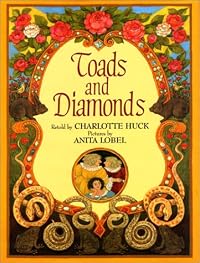
It is a treasure to be able to read a folktale from the 1600’s and especially to enjoy it in a big book format with Anita Lobel’s superb expressionistic/ folkart style. Her color palette are rich primary colors that surround the text , almost giving the feeling of one peeking around a curtain to look outside one’s window at an impossible scene from a fairy tale world unfolding on the street. A must buy for the library folktale collection. Curriculum connection is prek-middle school -language arts, great read aloud, readers theatre. Appropriate age 0-10+ show less
Huck, Charlotte, and Anita Lobel. Toads and Diamonds. New York: Greenwillow, 1996. Print.
On the Author’s Note page, the last page of the book, Charlotte Huck has shared her research knowledge and endeavors for this work. It is fascinating that she decided to retell Perrault’s version of this folktale. As she stated in her Author’s Note, there are over nine hundred versions of this story type, “The Kind and Unkind Sisters” that have been recorded. Two stepsisters at different times wander into the forest to collect water at a spring; when the first stepsister, the younger one, sets out to the spring, she meets an old woman who asks for a drink of water. This younger mistreated show more sister shows the old woman kindness and offers water to the woman, who in turn, gives her a gift of flowers and jewels. Every time the young girl speaks, flowers and jewels fall from her mouth. Returning home with her new gift, her stepsister and mother become envious throw her out into the street. The mother sends her daughter in search of the old woman by the spring, in hopes of gaining the same gift. The stepsister is not as lucky and runs into a bird landing on her shoulder and scaring her. She then runs into a peaceful rabbit and tries to catch it for a stew, and then meets a beautiful young woman limping and who asks her for a drink of water. The folktale pattern of three is seen here and with all three visits, the older stepsister does not show kindness but instead shows a hostile proud full attitude. The old woman reveals all three of her transformations and then bestows the gift of toads and snakes on the stepsister. Every time she speaks, toads and snakes will fall out of her mouth.
It is a treasure to be able to read a folktale from the 1600’s and especially to enjoy it in a big book format with Anita Lobel’s superb expressionistic/ folkart style. Her color palette are rich primary colors that surround the text , almost giving the feeling of one peeking around a curtain to look outside one’s window at an impossible scene from a fairy tale world unfolding on the street. A must buy for the library folktale collection. Curriculum connection is prek-middle school -language arts, great read aloud, readers theatre. Appropriate age 0-10+ show less
Members
- Recently Added By
Author Information

37+ Works 1,830 Members
All Editions
Common Knowledge
- Original publication date
- 1996; 1695, Perrault's first manuscript version of five tales...this tale was titled "The Fairies"
- People/Characters
- In Perrault's published version, Histoires ou contes du temps passe (1697)altered the relationship and made them sisters, the elder was called Franchon and the younger had no name. (1697)
- First words
- There once was a widow who had a daughter, Francine and a stepdaughter, Renee.
Classifications
Statistics
- Members
- 82
- Popularity
- 374,243
- Reviews
- 7
- Rating
- (4.00)
- Languages
- English
- Media
- Paper
- ISBNs
- 2
- ASINs
- 1