Explaining Hitler: The Search for the Origins of His Evil
by Ron Rosenbaum
On This Page
Description
When Hitler's war ended in 1945, the war over Hitler--who he really was, what gave birth to his unique evil--had just begun. Hitler did not escape the bunker in Berlin but, half a century later, he has managed to escape explanation in ways both frightening and profound. Explaining Hitler is an extraordinary quest, an expedition into the war zone of Hitler theories. This is a passionate, enthralling book that illuminates what Hitler explainers tell us about Hitler, about the explainers, and show more about ourselves. show lessTags
Recommendations


















Member Reviews
Years ago, at a flat-warming party, I was taken to task for having a biography of the religious fundamentalist Ian Paisley - the false assumption being that having a biography of someone means sharing/validating their beliefs or actions. No fan of Paisley, I was interested to know more about him to understand how so many people on the small island of Ireland could support his bizarre ideology (he is on record declaring that the Pope is the Anti-Christ - a popular belief in the 17th Century, but slightly less so in the 21st).
Having a book about Hitler on your bookshelf is, in the same vein, problematic and so much more so given the growth of neo-fascism and holocaust denial Worldwide. Rosenbaum's book, though is worth any embarassment show more its presence on your bookshelf may cause.
The reality is that this book is far more about the historians who have written about Hitler than it is about the dictator. It's more about the philosophical questions that history writing raises than it is about the chronology of fascism.
Particularly fascinating are his interviews with Holocaust-denial poster boy David Irving, and that with George Steiner where they discuss his controversial novel [book:The Portage of A.H to San Cristobal], but the whole book is brilliantly conceived and executed. show less
Having a book about Hitler on your bookshelf is, in the same vein, problematic and so much more so given the growth of neo-fascism and holocaust denial Worldwide. Rosenbaum's book, though is worth any embarassment show more its presence on your bookshelf may cause.
The reality is that this book is far more about the historians who have written about Hitler than it is about the dictator. It's more about the philosophical questions that history writing raises than it is about the chronology of fascism.
Particularly fascinating are his interviews with Holocaust-denial poster boy David Irving, and that with George Steiner where they discuss his controversial novel [book:The Portage of A.H to San Cristobal], but the whole book is brilliantly conceived and executed. show less
Debates concerning the historical and moral significance of Adolf Hitler have gone on since the beginning of his rise to power in Germany. In the decades after his bunker suicide, those debates elevated to arguments over the very nature and existence of evil. An integral part of the arguments has been the ongoing attempt to understand the why of Hitler. In this engaging work of literary journalism, Ron Rosenbaum travels the world to converse with some of the historians, philosophers, filmmakers, and others who have attempted to make sense of Hitler's actions, to find a root cause for the Holocaust.
Rosenbaum methodically examines the evidence for and against all the major hypotheses concerning the origin of Hitler's character. He sifts show more through all the rumors--including his alleged Jewish ancestry and what biographer Alan Bullock refers to as "the one-ball business"--and the attempts to derive some psychological cause from them. Various Hitlers emerge: Hitler as con man and brutal gangster, Hitler the unspeakable pervert, Hitler the ladies' man, Hitler as modernist artist working in the medium of evil....
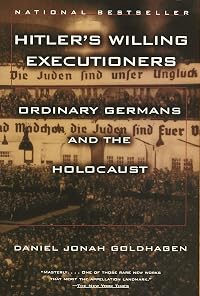
But Rosenbaum's portrayals of those who would define Hitler are as fascinating as the shifting perspectives on the fÜhrer. Here we see the brave journalists of the Munich Post who attempted to reveal Hitler's evil to the world as early as the 1920s. We witness Shoah director Claude Lanzmann's imperious attempts to stifle analysis of Hitler and the Holocaust, branding such historical inquiries as "obscene." We see the effects, on a frazzled Daniel Jonah Goldhagen, of the controversy surrounding the publication of his Hitler's Willing Executioners. We see the interior crises of Hitler apologist David Irving and philosopher-novelist George Steiner, among others, as they struggle with the ramifications of their work and thought. And, best of all, we have Rosenbaum to serve as an informed, intimate, and on occasion witty guide. In White Noise, Don DeLillo depicted the satirical academic discipline of "Hitler studies;" Ron Rosenbaum breathes a life into the field that no fiction can match. --Ron Hogan
Seeking explanations for Hitler's monumental evil and the Holocaust, Rosenbaum traveled from Vienna and Munich to London, Paris and Jerusalem, interviewing leading historians, biographers, philosophers, psychologists and theologians. While this convoluted, selective survey of Hitler scholarship will frustrate readers looking for hard answers, it offers groundbreaking insights into the enigma of Hitler's psyche.
When Hitler's war ended in 1945, the war over Hitler--who he really was, what gave birth to his unique evil--had just begun. Hitler did not escape the bunker in Berlin but, half a century later, he has managed to escape explanation in ways both frightening and profound. Explaining Hitler is an extraordinary quest, an expedition into the war zone of Hitler theories. This is a passionate, enthralling book that illuminates what Hitler explainers tell us about Hitler, about the explainers, and about ourselves. show less
Rosenbaum methodically examines the evidence for and against all the major hypotheses concerning the origin of Hitler's character. He sifts show more through all the rumors--including his alleged Jewish ancestry and what biographer Alan Bullock refers to as "the one-ball business"--and the attempts to derive some psychological cause from them. Various Hitlers emerge: Hitler as con man and brutal gangster, Hitler the unspeakable pervert, Hitler the ladies' man, Hitler as modernist artist working in the medium of evil....
But Rosenbaum's portrayals of those who would define Hitler are as fascinating as the shifting perspectives on the fÜhrer. Here we see the brave journalists of the Munich Post who attempted to reveal Hitler's evil to the world as early as the 1920s. We witness Shoah director Claude Lanzmann's imperious attempts to stifle analysis of Hitler and the Holocaust, branding such historical inquiries as "obscene." We see the effects, on a frazzled Daniel Jonah Goldhagen, of the controversy surrounding the publication of his Hitler's Willing Executioners. We see the interior crises of Hitler apologist David Irving and philosopher-novelist George Steiner, among others, as they struggle with the ramifications of their work and thought. And, best of all, we have Rosenbaum to serve as an informed, intimate, and on occasion witty guide. In White Noise, Don DeLillo depicted the satirical academic discipline of "Hitler studies;" Ron Rosenbaum breathes a life into the field that no fiction can match. --Ron Hogan
Seeking explanations for Hitler's monumental evil and the Holocaust, Rosenbaum traveled from Vienna and Munich to London, Paris and Jerusalem, interviewing leading historians, biographers, philosophers, psychologists and theologians. While this convoluted, selective survey of Hitler scholarship will frustrate readers looking for hard answers, it offers groundbreaking insights into the enigma of Hitler's psyche.
When Hitler's war ended in 1945, the war over Hitler--who he really was, what gave birth to his unique evil--had just begun. Hitler did not escape the bunker in Berlin but, half a century later, he has managed to escape explanation in ways both frightening and profound. Explaining Hitler is an extraordinary quest, an expedition into the war zone of Hitler theories. This is a passionate, enthralling book that illuminates what Hitler explainers tell us about Hitler, about the explainers, and about ourselves. show less
Kind of long-winded but it goes through various theories about who was most responsible for the Holocaust, Hitler or his underlings or German people, and how evil was he really? Skimmed the last third of it since it was a hard slog to get through. Author could have abridged it, I think ! One controversy is interesting : either Hitler felt he was doing the right thing and felt no shame, or he was delighting in his evil, knowing it for what it was.
Reviewed by Mr. Overeem (Language Arts)
The title is deceptive: Rosenbaum's book explores the world of "Hitler Explainers," distinguished scholars across the globe who have tried to "unpack" one of history's most ominous mysteries. If one thinks about it long enough, one realizes that the questions these men spent (and are still spending) time answering are often essential ones about the human race. I have seldom been as absorbed in a book or as enthusiastic about making someone listen to me talk about it for 30 interrupted minutes.
The title is deceptive: Rosenbaum's book explores the world of "Hitler Explainers," distinguished scholars across the globe who have tried to "unpack" one of history's most ominous mysteries. If one thinks about it long enough, one realizes that the questions these men spent (and are still spending) time answering are often essential ones about the human race. I have seldom been as absorbed in a book or as enthusiastic about making someone listen to me talk about it for 30 interrupted minutes.
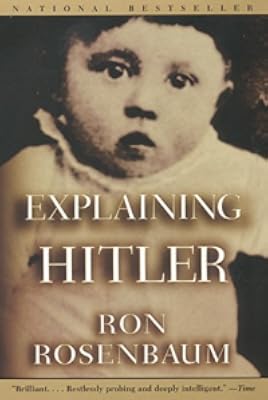
The book sold itself to me due to the title and the cover. The title because this question has fascinated me since I was a little girl and read The Diary of Anne Frank and The Rise and Fall of the Third Reich. Hitler and his regime seem so the embodiment of evil, surely to examine the question of Hitler is to examine the question of evil itself. So this was a topic that definitely called to me.
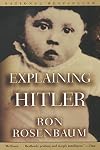
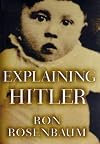
Then there's that cover. And it's not condemning the book (much) to say I found it the most powerful and haunting part of the book. Hitler's baby picture. The picture of innocence. A reminder of his humanity and that one isn't born a Hitler surely? The contents of the book though made a lighter impression and left me feeling a bit frustrated. The show more various sections give an overview of various theorists on the subject and explanations, but never left me feeling I'd plumed anything very deep. And since I've heard criticisms of those theorists that leave me wondering about the use of this book.
As mentioned in a LibraryThing review, a Holocaust denier David Irving gets an entire chapter as does Trevor-Roper--who "authenticated" the Hitler diaries. The chapter about Claude Lanzmann was all about how we shouldn't even ask the question. I don't rate it lower because I did like being exposed to various theorists and theories about Hitler, but ultimately felt this book never lived up to the promise made by the title--which admittingly seems the author's point--this seems to be more about the attempts than trying to work towards a resolution. show less
Then there's that cover. And it's not condemning the book (much) to say I found it the most powerful and haunting part of the book. Hitler's baby picture. The picture of innocence. A reminder of his humanity and that one isn't born a Hitler surely? The contents of the book though made a lighter impression and left me feeling a bit frustrated. The show more various sections give an overview of various theorists on the subject and explanations, but never left me feeling I'd plumed anything very deep. And since I've heard criticisms of those theorists that leave me wondering about the use of this book.
As mentioned in a LibraryThing review, a Holocaust denier David Irving gets an entire chapter as does Trevor-Roper--who "authenticated" the Hitler diaries. The chapter about Claude Lanzmann was all about how we shouldn't even ask the question. I don't rate it lower because I did like being exposed to various theorists and theories about Hitler, but ultimately felt this book never lived up to the promise made by the title--which admittingly seems the author's point--this seems to be more about the attempts than trying to work towards a resolution. show less
This is an extremely interesting book. It's basic theme is that a lack of historical evidence leaves us with no way of validating various explanations of Hitler. So, ultimately, these explanations say more about us, than they do about Hitler. This book requires a close and thorough reading to uncover the implications of Hitler explaining for historiography and Western moral philosophy. I came away with a much better appreciation of Hitler literature as well as a lot of questions about whether current Western thought is robust enough to deal with the 20th century, let alone the 21st.
Since the chapters are divided by the major Hitler explainers, you can also use this book as a guide to literature on Hitler and his role in the Holocaust. show more However, Rosenbaum's critiques of the various positions make little sense outside the context of the entire work.
Caveat: there is no bibliography, so retrospective review of his sources must be ferreted out of the footnotes. show less
Since the chapters are divided by the major Hitler explainers, you can also use this book as a guide to literature on Hitler and his role in the Holocaust. show more However, Rosenbaum's critiques of the various positions make little sense outside the context of the entire work.
Caveat: there is no bibliography, so retrospective review of his sources must be ferreted out of the footnotes. show less
3116 Explaining Hitler: The Search for the Origins of His Evil, by Ron Rosenbaum (read 1 Oct 1998) This is a most extraordinary book. It is full of investigative detail, though it is not written like an investigative reporter's book. It delves into the many rumors and hidden things of Hitler's life, spending a lot of time on his half-niece, Geli Raubal, who shot herself in Hitler's apartment on Sept 18, 1931, and also on the possibility that Hitler was one-fourth Jewish. And on many other things related to Hitler and those who have written about him. This is a heavy, excellent book, provoking one to serious thought.
Members
- Recently Added By
Published Reviews
ThingScore 100
If you thought the one historical figure people could reach a consensus on was Adolf Hitler, you'd be very wrong. Given the growing relativization of history writing and the constant intramural infighting in academia, given the growing preference of scholars for seeing history as a product of abstract social forces rather than the acts of individual men, historians have left us not with one show more Hitler, but a multitude of Hitlers.
With "Explaining Hitler," he has written a book that does for Hitler studies what David Lehman's superb book "Signs of the Times" did for deconstruction: he has written an exciting, lucid book informed by two qualities in increasingly short supply in academic circles: old-fashioned moral rigor and plain old common sense. show less
With "Explaining Hitler," he has written a book that does for Hitler studies what David Lehman's superb book "Signs of the Times" did for deconstruction: he has written an exciting, lucid book informed by two qualities in increasingly short supply in academic circles: old-fashioned moral rigor and plain old common sense. show less
added by danielx
Lists

Books About World War II
102 works; 29 members

Ten books that most shaped your view of history
91 works; 12 members

Books Set in Germany
74 works; 12 members

Books about World War II
241 works; 22 members

Best books read in the first half of 2012
38 works; 6 members
Top Five Books of 2012
55 works; 10 members

5 Best 5 Years
71 works; 4 members

Five star books
1,767 works; 110 members

Mustich's 1000 Books to Read Before You Die: A Life Changing List
1,001 works; 20 members
Author Information

18+ Works 1,693 Members
Ron Rosenbaum's books include The Shakespeare Wars, How the End Begins, and The Secret Parts Fortune, a collection of his nonfiction writing which has appeared in Harper's, the New Yorker, and the New York Times Magazine, among other periodicals. He has also edited an anthology about contemporary anti-Semitism, Those Who Forget the Past.
Some Editions
Awards and Honors
Distinctions
Notable Lists
Series
Belongs to Publisher Series
Common Knowledge
- Canonical title
- Explaining Hitler: The Search for the Origins of His Evil
- Original title
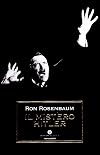
- Il mistero Hitler
- Original publication date
- 1998
- People/Characters
- Adolf Hitler
- Important events
- World War I; World War II; Holocaust
- Epigraph
- The more I learn about Hitler, the harder I find it to explain. — Alan Bullock
There will never be an adequate explanation. . . . The closer one gets to explicability the more one realizes nothing can make Hitler explicable. — Emil Fackenheim
Hitler is explicable in principle, but that does not mean that he has been explained. — Yehuda Bauer
He [God] owes me answers to many questions. — Holocaust survivor at Auschwitz, 1985 - Dedication
- To those who survived, and to those who did not
- First words
- In the realm of Hitler explanations, it's come to be called "the survival myth," and though no one believes it now, it struck a chord in the post-war popular imagination.
- Last words
- (Click to show. Warning: May contain spoilers.)To resist making the kind of explanatory excuses for Hitler that permit him to escape, that grant him the posthumous victory of a last laugh.
- Publisher's editor
- Karp, Jonathan
- Blurbers
- Conquest, Robert; Mee, Charles L., Jr.; Posner, Gerald; Tanenhaus, Sam; Remnick, David
- Original language
- English
Classifications
- Genres
- History, Nonfiction, General Nonfiction, Biography & Memoir
- DDC/MDS
- 943.086092 — History & geography History of Europe Central Europe: Germany, Austria, Switzerland, Czech, Poland, Hungary Historical periods of Germany Germany 1866- Third Reich 1933-1945 History, geographic treatment, biography Biographies, Diaries And Journals
- LCC
- DD247 .H5 .R67 — History of Europe, Asia, Africa and Oceania Germany History of Germany History By period Modern, 1519- 19th-20th centuries Revolution and Republic, 1918-
- BISAC
Statistics
- Members
- 775
- Popularity
- 36,191
- Reviews
- 15
- Rating
- (3.96)
- Languages
- 7 — Dutch, English, French, Italian, Polish, Portuguese, Spanish
- Media
- Paper, Audiobook, Ebook
- ISBNs
- 22
- ASINs
- 9