First the Egg
by Laura Vaccaro Seeger
On This Page
Description
A picture book about transformations.Tags
Recommendations

Member Reviews
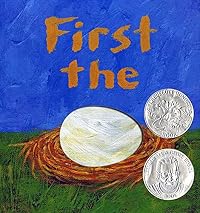
First the Egg is a beautiful, early childhood, book that illustrated the cause and effect relationship. Seeger starts the book with "First the egg, then the chicken." The illustration of the egg includes a cut-out in the page, with the white feathers of the chicken making the shape of the egg. Each pair of pages following contains the same layout. "First the tadpole, then the frog" and so on. As I read, I could hear my Kindergarten students jumping with excitement to tell me what comes after each "first". Seeger uses tangible relationships for young readers including seed/plant, word/story, and paint/picture. She ends the book in the opposite way she began the book, truly leaving young readers to ponder the common saying. "What comes show more first? The chicken or the egg?" I would totally use this book with my kindergarten students. In whole group we could have a great discussion based on this book, but I also would like to have my gifted students read it to me individually and discuss their thoughts with them. Love this book! show less
Can I say I love cut out holes in picture books? Can I say I'm not really sure what cut-out holes are technically called? Die-cut? I must have missed that day in my Children's Materials class.
The point is this book is great and it has cut out holes. It's informational, but instead of just a bunch of discrete facts, Seeger cleverly brings things full circle and, whoah, this picture book just got deep, man!
The point is this book is great and it has cut out holes. It's informational, but instead of just a bunch of discrete facts, Seeger cleverly brings things full circle and, whoah, this picture book just got deep, man!
A deceptively simple, decidedly playful sequence of statements invites readers to ponder, what comes first: the chicken or the egg? Carefully choreographed page turns and die-cuts focus on the process of change and becoming, so “First” sits alone on a yellow background, facing “the EGG”—an egg-shaped die-cut revealing a white egg against an orange-and-brown background. Turn the page, and “then” appears, the egg-shaped die-cut now forming the yellow body of a chick emerging from the shell, facing “the CHICKEN”—the white hen whose body gave color to the previous spread’s egg. Tadpole and frog, seed and flower, caterpillar and butterfly all receive the same treatment, then word and story, paint and picture bring all show more the disparate elements together, nature being the catalyst for art. Seeger’s vibrant, textured oil-on-canvas illustrations contain a wealth of subtlety, allowing the die-cuts to reveal cunning surprises with each turn of the page. Children and adults alike will delight in flipping the sturdy pages back and forth to recreate the transformations over and over again. Another perfectly pitched triumph from an emerging master of the concept book. (Picture book. 2-6) show less
Beginning with the die cut on the cover, which completes the title and hides a secret underneath, this delivers a string of delightful surprises as Seeger crisply explores the stages of development in the natural world and, then, how a story grows. Thickly textured backgrounds provide visual energy for minimalist images that cleverly incorporate additional die cuts. “First the EGG,” reads the text on the opening spread, which pictures the egg through an appropriately shaped hole. When children flip the page, they’ll find a fuzzy chick and its adult counterpart—“then the CHICKEN.” So it goes through the life stages of frog, flower, and butterfly. Suddenly, Seeger turns away from nature. “First the WORD,” she writes, show more “then the STORY.” “First the PAINT . . . then the PICTURE,” accompanied by a painting that pulls the book together, showing chicken, flower, frog, and butterfly enjoying a beautiful day together. A funny finale sets up the book’s beginning. Pages are sturdy enough to support poking fingers and repeated viewings, both of which are guaranteed show less
Clever die-cut illustrations elevate this concept book about transformations and sequences into a work of art. As the book opens, an egg-shaped cutout over white paper creates an illustration of an egg, but turning the page transforms that egg-shaped cutout into the body of a yellow chick and the white background is revealed to be part of a white-feathered chicken. Simple text, “First the EGG / then the CHICKEN,” accompanies these pages, and the sparse wording only works to highlight the ingenious, vibrant, oil-on-canvas illustrations. Subsequent pages portray a tadpole then frog, seed then flower, caterpillar then butterfly before moving toward more abstract sequences, word then story, paint and picture. It ends full-circle by show more returning to the egg, hinting that the story and picture mentioned in the book were, in fact, part of the very book the child is holding. There are some discrepancy between the book’s simple text and its complex illustrations and concepts, so while it may seem like a book for very young children, it is probably better suited for a slightly older audience. Librarians should note that as the illustrations invite young readers to put their fingers in the cutouts, pages will likely be damaged and need to be repaired. Nevertheless, the cost of repair or replacement should not deter librarians from including this fine, Caldecott Honor winning title in their collection. Recommended for readers age 4 to 8. show less
The strength of this book is in the beautiful illustrations and repetitive text to show the birth and development of plants, animals, and even ideas. The primary weakness is sadly part of what makes it great – the die cut pages decreasing its durability for regular library use - but still worth the risk!
A simple, clever book shows the development of impressive things from humble sources. Using cutouts and bold, thick paint strokes, Laura Vaccaro Seeger transforms an egg into a chicken, a tadpole into a frog, even a words and paint into a story and picture about these natural wonders. Part of the cleverness of this book is the fact that the cutouts form pictures on both the front and back of the page. The oval egg, for example, forms the body of a chick when the page is turned and reveals a full-grown hen. This intermediate step helps bridge the gap between beginning and end, showing the development in more detail. The repetitive sentence structure (First the ___, then the ___) makes this a book even very young children will be able to show more master reading by themselves. The end comes full circle as we see "first the chicken, then the egg!" This is an original book which addresses big concepts in a fresh way and is highly recommended for libraries which serve preschoolers and kindergartners. show less
Members
- Recently Added By
Lists

Caldecott Honor Books
296 works; 23 members

Storytime
145 works; 2 members

Children's Books About Science and Math
461 works; 12 members

Books Read in 2023
5,547 works; 144 members
Author Information

25 Works 5,189 Members
Laura Vaccaro Seeger is a New York Times best-selling author and illustrator. Laura is also a 2-time Caldecott Honor Award winner as well as a winner of the New York Times Best Illustrated Book Award, the Boston Globe/Horn Book Award for Best Picture Book, and a 2-time winner of the Theodor Seuss Geisel Honor Award. She is also the recipient of show more the Empire State Award for Body of Work and Contribution to Children's Literature. Laura's paintings have been exhibited in many museums and galleries including the Art Institute of Chicago and the New York Public Library. Laura earned her BFA degree at the School of Fine Art and Design at the State University of New York at Purchase. She moved to Manhattan to begin a career as an animator, artist, designer, and editor in the network television business. She created show openings and special segments for NBC and ABC for many years and won an Emmy Award for an NBC Special opening animation. Laura is the author of the Dog and Bear Series, First the Egg, Green, I Had a Rooster, Lemons are Not Red, One Boy, The Hidden Alphabet, Walter was Worried, and What If? (Bowker Author Biography) show less
Awards and Honors
Awards
Distinctions
Notable Lists
Common Knowledge
- Canonical title
- First the Egg
- Original publication date
- 2007
- Dedication
- for Chris
- First words
- First the EGG
- Last words
- (Click to show. Warning: May contain spoilers.)then the EGG!
- Original language
- English
Classifications
Statistics
- Members
- 1,424
- Popularity
- 16,441
- Reviews
- 119
- Rating
- (4.12)
- Languages
- Chinese, English, Spanish
- Media
- Paper, Audiobook, Ebook
- ISBNs
- 15
- ASINs
- 4