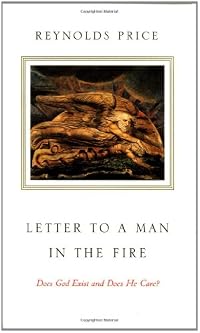
Letter To A Man In The Fire: Does God Exist And Does He Care
by Reynolds Price
On This Page
Description
Does God Exist and Does He Care? In April 1997 Reynolds Price received an eloquent letter from a reader of his cancer memoir, A Whole New Life. The correspondent, a young medical student diagnosed with cancer himself and facing his own mortality, asked these difficultQuestions. The two began a long-distance correspondence, culminating in Price's thoughtful response, originally delivered as the Jack and Lewis Rudin Lecture at Auburn Theological Seminary, and now expanded onto the printed page show more as Letter to a Man in the Fire. Harvesting a variety of sources -- diverse religious traditions, classical and modern texts, and a lifetime of personal experiences, interactions, and spiritual encounters -- Price meditates on God's participation in our fate. With candor and sympathy, he offers the reader such a rich variety of tools to explore these questions as to place this work in the company of other great tetsaments of faith from St. Augustine to C. S. Lewis. Letter to a Man in the Fire moves as much as it educates. It is a rare combination of deep erudition, vivid prose, and profound humanity. show lessTags
Recommendations








Member Reviews
There is much to be learned from Reynolds Price’s short volume, Letter to a Man in the Fire: Does God Exist and Does He Care? Not only readers, but also authors and editors should—like the peppered imperative of a Charles Stanley sermon—“Listen!”
From the dust jacket blurb:
Letter is permeated by a humility and reverence for its topic. There is no ne plus ultra, implicit or explicit, that is prevalent in much of today’s theological and religious writing (Brian McLaren’s audaciously titled A New Kind of Christianity comes to mind, which implies an exhaustive knowledge of 2000 years of Christian theology that is sorely lacking in his work). Price maintains “…you must know from the start that I have no further potent claim to make on your time or credulity. I’m no trained theologian, no regular churchgoer, no mathematical cosmologist, no theoretical physicist, and no statistician with an eye for your chances or anyone else’s” (24). Later, he asserts “Even a fool as hardened as I won’t hope to urge a substantial revision at this late date in our Western sense of the nature and purposes of God, especially the God who is both our omnipotent Creator and the mute witness of so much agony in humankind and among our fellow creatures” (76). He even admits, “If you think I’m mumbling in soft-brained error, I might not deny you” (86).
Popular and “public” theologians: “Listen!”
Price’s deep-rooted prose acknowledges and respects the work of those who preceded him. There are (meaningful) references to other poets, musicians, and authors, ranging across millennia from Auden to Bach to Tertullian. He frames his views in a wider context grounded in years of diligent scholarship, and disdains those who fail to give the same respect to their topic (witness his view of the “immensely self-assured, sometimes piercing, and often baldly unsubstantiated books and television appearances of [the Jesus Seminar’s] John Dominic Crossan” (95)). This critique could be equally applied to books like Reza Aslan’s Zealot or the vacuous, twitterized cotton candy of Rob Bell’s What Is the Bible? But I digress.
Writers of history, or any topic that exists in a historical continuum: “Listen!”
Like a Pauline epistle, Price has managed to pack a lot of thought into a short letter (a letter is in fact what this book is: it begins with the salutation “Dear Jim”, and concludes with the valediction, “All hope from Reynolds”). Despite the nonacademic form, there is a very helpful “Further Reading, Listening, and Looking” section which, unlike a standard bibliography, provides an often detailed assessment on resources in other religions (Hinduism’s Bhagavad Gita), as well as poetry (Milton’s Paradise Lost), fiction (Dostoyevsky’s The Brothers Karamazov and The Idiot), history (Meier’s A Marginal Jew), and the author’s own work (A Palpable God), among many others. This section adds another 25% to the book’s pagination, which testifies to both the foregoing letter’s brevity and the scope and helpfulness of the concluding guidance. It is this sort of afterword that correctly blurs the lines between popular and academic titles; there is no reason why popular works cannot be supported and referenced in an academic (or quasi-academic) manner. Poor examples of this sort include Aslan’s Zealot, whose “Notes” section is willfully obfuscatory and bastardizes the usage of the term, and Bell’s Bible, which devotes an entire “Part” (“Part 5”) to “Endnotes”, which itself has (many) sections, including one for thank-yous and another titled “Books About the Bible That Will Blow Your Mind.” It’s a complete, unorganized mess.
Authors and editors and publishers: “Listen!”
Finally, we must address the two questions asked in the book’s subtitle: does God exist and does He care? Price is unambiguous on both. Ultimately he states that “I know I believe that God loves his creation” (84), which asserts not only the existence of God but His care as well. But don’t trust me; just read the letter. It is time well spent. show less
From the dust jacket blurb:
In April 1997 Reynolds Price received an eloquent letter from a reader of his cancer memoir A Whole New Life. The correspondent, a young medical student diagnosed with cancer himself and facing his own mortality, asked the difficult questions above [the book’s subtitle]. The two began a long-distance correspondence, culminating in Price’s thoughtful response, originally delivered as the Jack and Lewis Rudin Lecture at Auburn Theological Seminary, and nowshow more
expanded onto the printed page as Letter to a Man in the Fire.
Letter is permeated by a humility and reverence for its topic. There is no ne plus ultra, implicit or explicit, that is prevalent in much of today’s theological and religious writing (Brian McLaren’s audaciously titled A New Kind of Christianity comes to mind, which implies an exhaustive knowledge of 2000 years of Christian theology that is sorely lacking in his work). Price maintains “…you must know from the start that I have no further potent claim to make on your time or credulity. I’m no trained theologian, no regular churchgoer, no mathematical cosmologist, no theoretical physicist, and no statistician with an eye for your chances or anyone else’s” (24). Later, he asserts “Even a fool as hardened as I won’t hope to urge a substantial revision at this late date in our Western sense of the nature and purposes of God, especially the God who is both our omnipotent Creator and the mute witness of so much agony in humankind and among our fellow creatures” (76). He even admits, “If you think I’m mumbling in soft-brained error, I might not deny you” (86).
Popular and “public” theologians: “Listen!”
Price’s deep-rooted prose acknowledges and respects the work of those who preceded him. There are (meaningful) references to other poets, musicians, and authors, ranging across millennia from Auden to Bach to Tertullian. He frames his views in a wider context grounded in years of diligent scholarship, and disdains those who fail to give the same respect to their topic (witness his view of the “immensely self-assured, sometimes piercing, and often baldly unsubstantiated books and television appearances of [the Jesus Seminar’s] John Dominic Crossan” (95)). This critique could be equally applied to books like Reza Aslan’s Zealot or the vacuous, twitterized cotton candy of Rob Bell’s What Is the Bible? But I digress.
Writers of history, or any topic that exists in a historical continuum: “Listen!”
Like a Pauline epistle, Price has managed to pack a lot of thought into a short letter (a letter is in fact what this book is: it begins with the salutation “Dear Jim”, and concludes with the valediction, “All hope from Reynolds”). Despite the nonacademic form, there is a very helpful “Further Reading, Listening, and Looking” section which, unlike a standard bibliography, provides an often detailed assessment on resources in other religions (Hinduism’s Bhagavad Gita), as well as poetry (Milton’s Paradise Lost), fiction (Dostoyevsky’s The Brothers Karamazov and The Idiot), history (Meier’s A Marginal Jew), and the author’s own work (A Palpable God), among many others. This section adds another 25% to the book’s pagination, which testifies to both the foregoing letter’s brevity and the scope and helpfulness of the concluding guidance. It is this sort of afterword that correctly blurs the lines between popular and academic titles; there is no reason why popular works cannot be supported and referenced in an academic (or quasi-academic) manner. Poor examples of this sort include Aslan’s Zealot, whose “Notes” section is willfully obfuscatory and bastardizes the usage of the term, and Bell’s Bible, which devotes an entire “Part” (“Part 5”) to “Endnotes”, which itself has (many) sections, including one for thank-yous and another titled “Books About the Bible That Will Blow Your Mind.” It’s a complete, unorganized mess.
Authors and editors and publishers: “Listen!”
Finally, we must address the two questions asked in the book’s subtitle: does God exist and does He care? Price is unambiguous on both. Ultimately he states that “I know I believe that God loves his creation” (84), which asserts not only the existence of God but His care as well. But don’t trust me; just read the letter. It is time well spent. show less
If a turgid prose style, patriarchal concern-trolling, and trite commentary on the Book of Job = your thing, this is the book for you. For others, this verbose bit of paternalistic bullshit may suffice:
"And here I wonder briefly if women who are understandably concerned to mitigate the oppressively masculine qualities of God in our creeds might want to consider whether the human female gender is not fortunate to have avoided those painful ambiguities which have flowed...from our thinking of God as father. Do we wish to cloud our fullest sense of woman and mother by adding those further human qualities to the ineffable--a mother who brings us the whole of history with all its maniacs, wars, and plagues?"
"And here I wonder briefly if women who are understandably concerned to mitigate the oppressively masculine qualities of God in our creeds might want to consider whether the human female gender is not fortunate to have avoided those painful ambiguities which have flowed...from our thinking of God as father. Do we wish to cloud our fullest sense of woman and mother by adding those further human qualities to the ineffable--a mother who brings us the whole of history with all its maniacs, wars, and plagues?"
Man in the Fire is author Reynold Price’s response to a letter he received from a young medical student facing terminal cancer who wants to know the answer to the question put forth in the title of this book.
Price, who freely admits that he is not a theologian or even a regular church goer, draws on his life experiences, including his struggle with a life-threatening spinal cancer, to answer the young man with heartfelt honesty.
Man in the Fire is a thoughtful and intelligent testament Price’s faith.
Price, who freely admits that he is not a theologian or even a regular church goer, draws on his life experiences, including his struggle with a life-threatening spinal cancer, to answer the young man with heartfelt honesty.
Man in the Fire is a thoughtful and intelligent testament Price’s faith.
Ratings
Members
- Recently Added By
Author Information

67+ Works 4,552 Members
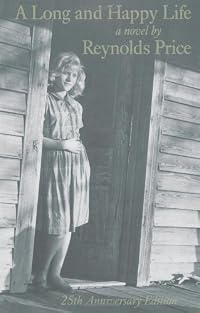
Reynolds Price (February 1, 1933 - January 20, 2011), born Edward Reynolds Price in Macon, North Carolina, was an American poet, novelist, dramatist, essayist and James B. Duke Professor of English at Duke University. After graduating from Duke University in 1955, he won a Rhodes scholarship to study at Oxford University. Despite being living as a show more paraplegic after receiving radiation treatment for a spinal tumor since the mid-1980s, he produced approximately one book a year. His first novel, A Long and Happy Life (1962) won the William Faulkner Award. His other works include The Names and Faces of Heroes, Clear Pictures: First Loves, First Guides, A Whole New Life, and The Good Priest's Son. Kate Vaiden won the National Books Critics Circle Award. His plays have been produced on stage and on PBS's American Playhouse. He died due to complications of a heart attack on January 20, 2011 at the age of 77. (Bowker Author Biography) Reynolds Price, the author of numerous volumes of fiction, poetry, memoir, plays, essays, & translation, has won the National Book Critics Circle Award, the William Faulkner Award, & the Levinson, Blumenthal, & Tietjans poetry awards. A member of the American Academy of Arts & Letters & a regular commentator on National Public Radio's "All Things Considered", he lives in Durham, North Carolina. (Publisher Provided) show less
Awards and Honors
Notable Lists
Classifications
Statistics
- Members
- 164
- Popularity
- 199,026
- Reviews
- 3
- Rating
- (3.75)
- Languages
- English
- Media
- Paper, Ebook
- ISBNs
- 4
- UPCs
- 1
- ASINs
- 1