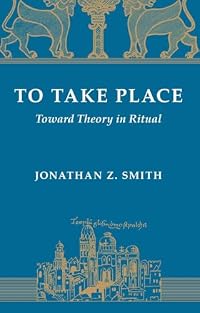
To Take Place: Toward Theory in Ritual
by Jonathan Z. Smith
Chicago Studies in the History of Judaism (1987)
On This Page
Description
In this broad-ranging inquiry into ritual and its relation to place, Jonathan Z. Smith prepares the way for a new approach to the comparative study of religion. Smith stresses the importance of place--in particular, constructed ritual environments--to a proper understanding of the ways in which "empty" actions become rituals. He structures his argument around the territories of the Tjilpa aborigines in Australia and two sites in Jerusalem--the temple envisioned by Ezekiel and the Church of show more the Holy Sepulchre. The first of these locales--the focus of one of the more important contemporary theories of religious ritual--allows Smith to raise questions concerning the enterprise of comparison. His close examination of Eliade's influential interpretation of the Tjilpa tradition leads to a powerful critique of the approach to religion, myth, and ritual that begins with cosmology and the category of "The Sacred." In substance and in method, To Take Place represents a significant advance toward a theory of ritual. It is of great value not only to historians of religion and students of ritual, but to all, whether social scientists or humanists, who are concerned with the nature of place. "This book is extraordinarily stimulating in prompting one to think about the ways in which space, or place, is perceived, marked, and utilized religiously. . . . A provocative example of the application of humanistic geography to our understanding of what takes place in religion."--Dale Goldsmith, Interpretation show lessTags
Recommendations








Member Reviews
The "place" of the title and of Smith's theory is not merely location, but also the "place" in sequence and the "place" in rank or value. He theorizes ritual as a "mode of paying attention," which creates and affirms distinctions and differences, rather than contents or essences. He thus draws comparisons between the "places" established by Tjilpa dreamtime narratives, ancient near eastern temple architecture, the system of the Mishnah, and the Christian liturgical year.
As always, Smith is rigorous and thorough in his treatment of his illustrative cases, and he applies a critical sensibility to the history of the scholarship of religion. Not only does he take Eliade to task over the universality of the "sacred axis," he dissects and show more addresses the abiding legacy of Protestant anti-Catholic polemics underlying the conception of "ritual" in academic discourse. show less
As always, Smith is rigorous and thorough in his treatment of his illustrative cases, and he applies a critical sensibility to the history of the scholarship of religion. Not only does he take Eliade to task over the universality of the "sacred axis," he dissects and show more addresses the abiding legacy of Protestant anti-Catholic polemics underlying the conception of "ritual" in academic discourse. show less
Smith stresses the importance of place—in particular, constructed ritual environments—to a proper understanding of the ways in which "empty" actions become rituals. He structures his argument around the territories of the Tjilpa aborigines in Australia and two sites in Jerusalem—the temple envisioned by Ezekiel and the Church of the Holy Sepulchre. The first of these locales—the focus of one of the more important contemporary theories of religious ritual—allows Smith to raise questions concerning the enterprise of comparison. His close examination of Eliade's influential interpretation of the Tjilpa tradition leads to a powerful critique of the approach to religion, myth, and ritual that begins with cosmology and the category show more of "The Sacred." show less
There was too much dense academia for me. Dry and inaccessible.
Ratings
Members
- Recently Added By
Author Information

10+ Works 537 Members
Jonathan Z. Smith is perhaps the leading theorist working in the study of religions today; he is also a scholar who specializes in Hellenistic and late Antique religions. Trained at Yale University, where he wrote a thesis examining the methods employed in James G. Frazer's mammoth classic, The Golden Bough, Smith has been particularly interested show more in using the ideas and methods of sociology and anthropology to study religions. Through unrelenting criticism and detailed historical investigations, he has called into question many of the conclusions that an older generation of scholars had reached. His acumen has been directed particularly at the work of Mircea Eliade, who was for years Smith's colleague at the University of Chicago. His recent book, Drudgery Divine, aims to expose the sectarian purposes that led Protestant historians to isolate "primitive Christianity" from its contexts in ancient religions, an expose that Smith's own background in Judaism makes him ideally suited to carry out. As a theorist, Smith emphasizes the active role of intellection in all scholarly enterprises. He insists that the aim of religious studies is distinct from that of religions ("map is not territory"), that "religion" is a category "imagined" by Western scholars to accomplish certain academic purposes, and that theoretical questions and purposes should explicitly guide all investigations. For example, Smith states that when scholars compare religions, their immediate concern should not be with finding similarities that pervade a large body of data (cp. Eliade), nor should it be to determine who borrowed what from whom (historical diffusion). Instead, the purpose of comparison is to identify individual differences that assume significance because they elucidate specific theoretical issues. Smith's distinction between locative religions---religions that pertain to specific places---and utopian ones---religions that have broken their bonds with place---is especially helpful in considering the history of religions in the Hellenistic and late Antique periods. Smith's work is itself too recent to have been the subject of a scholarly monograph, but readers will find Smith's influence extending widely through the study of ancient religions. Those who want critical assessments may wish to consult book review indexes. (Bowker Author Biography) show less
Series

Common Knowledge
- Canonical title
- To Take Place: Toward Theory in Ritual
- Original publication date
- 1987
- Important places
- Australia; Temple of Ezekiel, Jerusalem; Church of the Holy Sepulchre, Jerusalem; Israel; Jerusalem
- Disambiguation notice
- Full title (1987): To take place : toward theory in ritual / Jonathan Z. Smith
Classifications
- Genres
- Nonfiction, Religion & Spirituality, Anthropology
- DDC/MDS
- 291.3 — Religion Other religions [Formerly: General Religious Topics] [formerly: Public worship and other practices. Relocated to 203]
- LCC
- BL580 .S64 — Philosophy, Psychology and Religion Religions. Mythology. Rationalism Religions. Mythology. Rationalism Worship. Cultus
- BISAC
Statistics
- Members
- 101
- Popularity
- 318,381
- Reviews
- 3
- Rating
- (3.50)
- Languages
- English, Norwegian (Bokmål), Norwegian
- Media
- Paper
- ISBNs
- 3