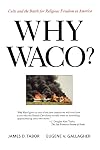
Why Waco?: Cults and the Battle for Religious Freedom in America
by James D. Tabor
On This Page
Description
In the first balanced, authoritative account of the siege, James Tabor and Eugene Gallagher explore the powerful drama in Waco and the motivations of all the players, including the government, the media, the cultbusters, the Branch Davidians, and David Koresh himself. Tabor and Gallagher unflinchingly confront the most controversial accusations concerning the group's possession of illegal firearms, unconventional sexual practices, and child abuse. Without attempting to excuse Koresh's show more actions, they argue that the public has never been given the complete story. Tabor and Gallagher explain what really happened in Waco: Who were the Branch Davidians and what originally brought them to Mount Carmel? What led the government to attack? What role did the media play? And what lessons must we learn to avoid repeating this American tragedy? Using the events at Mount Carmel as a cautionary tale, the authors challenge Americans government officials, parents, the media, all of us - to rethink our stereotypes about unconventional religious groups. show lessTags
Recommendations

























Member Reviews
Tabor's perspective in this book is truly unique, as someone who both studies religions academically, and a negotiator during the actual crisis. However, this book fell a little flatter compared to what I was hoping for it. Tabor brings his ability to deeply analyze hermeneutics and religious convictions, but doesn't really discuss the validity of them. I understand that that may have lay outside the scope of the book, but it would have been a great opportunity.
This is not just my criticism, but one from the book itself. Tabor posits that what makes cults "dangerous" to American society beyond the harm to a few insiders is that it compels outsiders to have to examine their own convictions and lives, and determine whether or not it is show more as meaningful or fulfilling as they think they are, concluding that it is easier to denounce the messenger, rather than confront the message. Tabor, ironically, does just that. He talks about Koresh's history and describes his sincere convictions, but stays his hand at quantifying their actual validity, which he could have certainly done given his academic prowess and other works. show less
This is not just my criticism, but one from the book itself. Tabor posits that what makes cults "dangerous" to American society beyond the harm to a few insiders is that it compels outsiders to have to examine their own convictions and lives, and determine whether or not it is show more as meaningful or fulfilling as they think they are, concluding that it is easier to denounce the messenger, rather than confront the message. Tabor, ironically, does just that. He talks about Koresh's history and describes his sincere convictions, but stays his hand at quantifying their actual validity, which he could have certainly done given his academic prowess and other works. show less
Ratings
Members
- Recently Added By
Author Information

19+ Works 1,052 Members
James D. Tabor is chair of the Department of Religious Studies at the University of North Carolina, Charlotte. He is the author of several books, among them Paul and Jesus and The Jesus Dynasty. Visit him at www.jamestabor.com. Simcha Jocobovici is a filmmaker (The Lost Tomb of Jesus), author (The Jesus Family Tomb), and adjunct professor in the show more Department of Religion at Huntington University. He is the host of the television series The Naked Archaeologist and winner of three Emmy Awards. Visit him at www.apltd.ca, and www.simchajtv.com. show less
Common Knowledge
- People/Characters*
- David Koresh
- Important events
- Waco Branch Davidian Siege (1993)
*Some information comes from Common Knowledge in other languages. Click "Edit" for more information.
Classifications
- Genres
- Nonfiction, Religion & Spirituality, History, Politics and Government, General Nonfiction
- DDC/MDS
- 299.93 — Religion Other religions Shintoism/Taoism/Other Mythologies Religions of other origin Religions of eclectic and syncretistic origin
- LCC
- BP605 .B72 .T33 — Philosophy, Psychology and Religion Islam. Bahaism. Theosophy, etc. Islam. Bahai Faith. Theosophy, etc. Other beliefs and movements
- BISAC
Statistics
- Members
- 83
- Popularity
- 377,578
- Reviews
- 1
- Rating
- (3.30)
- Languages
- English
- Media
- Paper, Ebook
- ISBNs
- 4
- ASINs
- 1