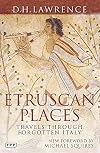
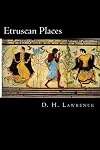
Etruscan Places
by D. H. Lawrence
On This Page
Description
The Etruscan civilisation, which flourished from the 8th until the 5th century BC in what is now Tuscany, is one of the most fascinating and mysterious in history. An uninhibited, elemental people, the Etruscans enthralled D.H. Lawrence, who craved their 'old wisdom', the secret of their vivacity and love of life. To him they represented the antithesis of everything he despised in the modern world, perhaps because their spontaneity and naturalness struck a chord with his own quest for show more personal and artistic freedom - so often censured or repressed. Lawrence approaches the enigmatic Etruscans as a poet, passionately and searchingly, and so the reader is swept up in his luminous descriptions of a utopian world where dancing and feasting, art and music were everything. The exhilaration of Lawrence in his Etruscan adventures stands in stark contrast to his intimations of the darkness of Mussolini's Italy - at a time when Europe was beginning its inexorable drift towards tragedy. The last of Lawrence's travel books, 'Etruscan Places' is an ephemeral and vivid account, replete with hauntingly evocative descriptions of the way of life of this once great civilisation. show lessTags
Recommendations






















Member Reviews
OK, so it's not the normal DH Lawrence - but then you wouldn't think it was. This is a 1930s travelogue. Some good description of Etruscan tombs, as seen then, but the book only really comes to life when Lawrence is adding his own views, whether on the difference between the Etruscans and the Romans, or life in Mussolini's Italy. If it is a subject which already interests you, then it is worth a read.
A short travel book written in 1930's which explores Etruscan life through visiting tombs in the old Italian (Etruscian) towns of Tarquinia, Vulci, volterra. While most of tombs have been ransacked of artifacts, several murals remain and Lawrence provides an interesting comentary of what these mean and how the Etrucian people may have lived their lives.
> D. H. Lawrence, Promenades étrusques, traduit de l’anglais par Thérèse Aubray (Paris, Gallimard, [1949]), 237 pp. in-8°, 8 pli.
Se reporter au compte rendu de Charles DELVOYE
In: Latomus, T. 9, Fasc. 1 (Janvier-Mars 1950), p. 129… ; (en ligne),
URL : https://drive.google.com/file/d/1ePeTY61dYpXoa2Oyv9ZVammdt0znWqim/view?usp=shari...
Se reporter au compte rendu de Charles DELVOYE
In: Latomus, T. 9, Fasc. 1 (Janvier-Mars 1950), p. 129… ; (en ligne),
URL : https://drive.google.com/file/d/1ePeTY61dYpXoa2Oyv9ZVammdt0znWqim/view?usp=shari...
Oct 13, 2020 (Edited)French
Ratings
Members
- Recently Added By
Author Information

895+ Works 60,614 Members
D(avid) H(erbert) Lawrence was born on September 11, 1885. His father was a coal miner and Lawrence grew up in a mining town in England. He always hated the mines, however, and frequently used them in his writing to represent both darkness and industrialism, which he despised because he felt it was scarring the English countryside. Lawrence show more attended high school and college in Nottingham and, after graduation, became a school teacher in Croyden in 1908. Although his first two novels had been unsuccessful, he turned to writing full time when a serious illness forced him to stop teaching. Lawrence spent much of his adult life abroad in Europe, particularly Italy, where he wrote some of his most significant and most controversial novels, including Sons and Lovers and Lady Chatterly's Lover. Lawrence and his wife, Frieda, who had left her first husband and her children to live with him, spent several years touring Europe and also lived in New Mexico for a time. Lawrence had been a frail child, and he suffered much of his life from tuberculosis. Eventually, he retired to a sanitorium in Nice, France. He died in France in 1930, at age 44. In his relatively short life, he produced more than 50 volumes of short stories, poems, plays, essays, travel journals, and letters, in addition to the novels for which he is best known. (Bowker Author Biography) show less
Some Editions
Awards and Honors
Series
Belongs to Publisher Series
Penguin Books (756)
Work Relationships
Common Knowledge
- Canonical title
- Etruscan Places
- Original publication date
- 1932
- Important places
- Tuscany, Italy; Volterra, Tuscany, Italy; Etruria
- First words
- The Etruscans, as everyone knows, were the people who occupied the middle of Italy in early Roman days, and whom the Romans, in their usual neighbourly fashion, wiped out entirely in order to make room for Rome with a very bi... (show all)g R.
- Last words
- (Click to show. Warning: May contain spoilers.)He should have been rewarded, for having such clever children, sculptors in bread.
Classifications
- Genres
- Travel, Nonfiction, General Nonfiction, Art & Design
- DDC/MDS
- 914.504 — History & geography Geography & travel Geography of and travel in Europe Italy, San Marino, Vatican City, Malta subdivisions and modified standard subdivisions Travel; guidebooks
- LCC
- DG223 .L37 — History of Europe, Asia, Africa and Oceania City History of Italy Ancient Italy. Rome to 476 History By period Pre-Roman Italy. Etruria. Etruscans
- BISAC
Statistics
- Members
- 351
- Popularity
- 89,852
- Reviews
- 3
- Rating
- (3.52)
- Languages
- 8 — Danish, Dutch, English, French, German, Italian, Spanish, Swedish
- Media
- Paper, Ebook
- ISBNs
- 25
- ASINs
- 24