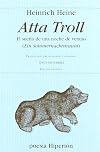
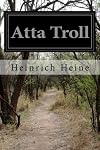
Atta Troll
by Heinrich Heine
On This Page
Description
Publisher: B.W. Huebsch Publication date: 1914 Subjects: History / General Language ArtsTags
Recommendations
































Member Reviews
Recenzoj
Citaĵo
„ Peni redoni en Esperanto la esencon de la spriteco kaj lerteco de la aŭtoro, estas kvazaŭ elekti plej armitajn malamikojn, por ke la venko estu pli triumfa. La tradukinto laboris sukcese. ”
— 1925, Georges Stroele, Esperanto, paĝo 170
Citaĵo
„ Heine estas majstro en humoro kaj versfarado. Estas tre malfacile redoni en Esperanto la esencon de lia sprito kaj lerto. Zanoni sukcesis kiel Kalocsay por Johano la Brava fari versajn rekreaĵojn anstataŭ simplajn tradukojn. Zanoni meritas altan rangon en nia Esperanta verkaro. ”
— 1925, Historio de Esperanto II, paĝoj 585-586
Citaĵo
„ Peni redoni en Esperanto la esencon de la spriteco kaj lerteco de la aŭtoro, estas kvazaŭ elekti plej armitajn malamikojn, por ke la venko estu pli triumfa. La tradukinto laboris sukcese. ”
— 1925, Georges Stroele, Esperanto, paĝo 170
Citaĵo
„ Heine estas majstro en humoro kaj versfarado. Estas tre malfacile redoni en Esperanto la esencon de lia sprito kaj lerto. Zanoni sukcesis kiel Kalocsay por Johano la Brava fari versajn rekreaĵojn anstataŭ simplajn tradukojn. Zanoni meritas altan rangon en nia Esperanta verkaro. ”
— 1925, Historio de Esperanto II, paĝoj 585-586
Mar 24, 2023Esperanto
Ratings
Members
- Recently Added By
Author Information

Heinrich Heine, 1797-1856 Born Christian Johann Heinrich Heine in Dusseldorf, Germany, on December 13, 1797, Heine's parents were Samson Heine, a commercial tradesman, and Elisabeth van Geldern. The eldest of four, Heine studied law at the universities of Bonn, Berlin, and Gottingen. Although Heine showed more of an interest in literature than show more law, he continued to study about the government, and earned a degree in that field in 1825. Even with his degree, Heine never practiced or held a position in government service. Eventually, Heine decided to follow his heart, and in 1821 he made his debut as a poet with the work Gedichte, translated as Poems. The release of Heine's third volume of poetry, The Town of Lucca, caused quite a stir. In this volume of poetry, Heine satirized the poet August von Platen for his attacks on Heine's Jewish origins. This act discredited Heine, and in 1831 he fled to Paris. There he became a journalist, reporting on French cultural and political affairs. He also wrote travel books and worked on German literature and philosophy, as well as poetry. Heine's best-known works include Atta Troll: A Midsummer Night's Dream, a romantic and humorous narrative poem that satirizes many targets, including German political poets; and Germany: A Winter's Tale, a fictionalized account of Heine's visit to Germany in 1843. Debilitated with a paralyzing illness since 1848, it wasn't until eight years later, on February 17, 1856, that Heine passed away. He was buried at the Montmartre Cemetery in France. (Bowker Author Biography) show less
Series
Belongs to Publisher Series
dtv weltliteratur (2082)
Reclams Universal-Bibliothek (2261)
Work Relationships
Is contained in
Has as a study
Common Knowledge
Classifications
- Genres
- Fiction and Literature, Poetry
- DDC/MDS
- 830 — Literature & rhetoric German & related literatures German literature and literatures of related languages
- LCC
- PT2309 — Language and Literature German, Dutch and Scandinavian literatures German literature Individual authors or works 1700-ca. 1860/70
- BISAC
Statistics
- Members
- 42
- Popularity
- 685,939
- Reviews
- 1
- Rating
- (3.50)
- Languages
- 5 — English, Esperanto, French, German, Spanish
- Media
- Paper, Ebook
- ISBNs
- 11
- ASINs
- 5