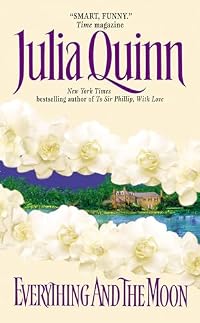
On This Page
Description
It was indisputably love at first sight. But Victoria Lyndon was merely the teenaged daughter of a vicar. . .while Robert Kemble was the dashing young earl of Macclesfield. Surely what their meddlesome fathers insisted must have been true-that he was a reckless seducer determined to destroy her innocence. . . and she was a shameless fortune hunter. So it most certainly was for the best when their plans to elope went hopelessly awry. Even after a seven-year separation, Victoria-now a show more governess-still leaves Robert breathless. But how could he ever again trust the raven-haired deceiver who had shattered his soul? And Victoria could never give her heart a second time to the cad who so callously trampled on it the first. But a passion fated will not be denied, and vows of love yearn to be kept. . . even when one promises the moon. show lessTags
Recommendations












Member Reviews
I've read worse romance novels, but this is the first one that I've ever actually thrown across the room in rage. The other books I'd read by Julia Quinn made me really trust her as someone with a feminist understanding about female autonomy and male-female power dynamics. Everything and the Moon betrayed that trust throughout its plot, summarized below.
-*-SPOILERS-*-
The book goes wrong from the first. In the 'Dear Reader' author's note, Quinn says that in this book she tries something she normally doesn't believe in: having the hero fall in love with the heroine at first sight. I wish she'd never tried this at all, because the result was an immature young man with a great deal of power (social and financial--he's an earl) suddenly show more developing an obsession with a naive young woman who has none (her father is a clergyman). He's used to getting everything he wants, so when he decides he wants to spend the rest of his life with her, he doesn't believe anything could stand in his way. He convinces her that they are fated for each other, then when their fathers unwittingly conspire to break them up, believes that she's intentionally jilted him and goes off to London to live a cynical, worldly life.
Her heart is broken, she no longer trusts her father, and in order to escape from her old life she finds a series of miserable jobs as a governess. Seven years later, he discovers her again at a garden party he's attending at her employer's home. She wants nothing to do with him, but, still driven by obsession and anger, he forces her to pay attention to him on multiple occasions. When she makes it clear to him that his association with her is placing her job, and therefore her entire welfare, in jeopardy, his first thought is that she can always put herself in his protection.
When she is fired, through something that is, in fact, indirectly his fault (his attentions to her made another party guest sexually interested in her; when he attempts to rape her the hero rescues her and beats up her attacker, who later slanders her to her employer), she finally finds employment that makes her happy: work in a dress shop where she makes friends and feels that she is in control of her life at last. However, the hero can't believe that she's happy without him, and when he discovers that she is living in a "dangerous part of town" he begins stalking her. No, really. He stands outside her window, he "escorts" her to and from her job, he constantly sends her presents that she never asked for, and he continually berates her about her choices.
Finally, when someone is killed in her neighborhood, he kidnaps her--he persuades her to ride home from work in his carriage, she falls asleep, and when she wakes up they're halfway to his cottage by the sea. She's horrified and tries to explain to him (again) why her autonomy is important to her, but she only sounds pathetic and he doesn't get it.
They stop at an inn for the night. She attempts to escape, but doesn't get far before she's attacked by two men in the street. He rescues her, then blames her for endangering herself and tells her she's sleeping in his bed for the rest of the night. [This is when I threw the book against the wall. I wasn't even going to finish reading it, but I ended up too curious not to.]
It turns out he doesn't actually rape her then--how nice of him! They continue to his cottage, where he makes her feel guilty because she turns him on so much that he's in pain. So eventually she does have sex with him.
Let me go over that again. She's been abducted and taken to the middle of nowhere from where she has no ability whatsoever to return. If she did return, she would probably have no job because she's been missing from it without excuse for several days. She feels morally obliged to him for saving her from being violently raped twice. She is sexually attracted to him and can't help feeling some nostalgic affection for him (despite her better judgment). Her position is hopeless, unless, as he makes absolutely clear, she marries him. At this point she has sex with him.
Of course, it's great sex and she doesn't feel bad at all about it in the morning, because they after all were destined for each other. They go back to London and get married and live happily ever after.
Heroine: "I just worry sometimes that you won't let me have my way."
Hero: "But I love you and I want to protect you FOREVER!"
Heroine: "Oh, okay."
If I were trying to write a book that sympathetically spells out the twisted psychology of a stalker, it would come out very much like this one. The more I think about it the more it blows my mind that Quinn wrote it herself, given her statements about being a feminist, and her understanding, demonstrated clearly in other books, of why men in the social situations she writes about have inherently more power than women, why that isn't fair, and why it's important that romantic heroines retain a whole lot of personal autonomy. My only guess is that her feminism developed a whole lot after she wrote this book, as it's one of her earliest. show less
-*-SPOILERS-*-
The book goes wrong from the first. In the 'Dear Reader' author's note, Quinn says that in this book she tries something she normally doesn't believe in: having the hero fall in love with the heroine at first sight. I wish she'd never tried this at all, because the result was an immature young man with a great deal of power (social and financial--he's an earl) suddenly show more developing an obsession with a naive young woman who has none (her father is a clergyman). He's used to getting everything he wants, so when he decides he wants to spend the rest of his life with her, he doesn't believe anything could stand in his way. He convinces her that they are fated for each other, then when their fathers unwittingly conspire to break them up, believes that she's intentionally jilted him and goes off to London to live a cynical, worldly life.
Her heart is broken, she no longer trusts her father, and in order to escape from her old life she finds a series of miserable jobs as a governess. Seven years later, he discovers her again at a garden party he's attending at her employer's home. She wants nothing to do with him, but, still driven by obsession and anger, he forces her to pay attention to him on multiple occasions. When she makes it clear to him that his association with her is placing her job, and therefore her entire welfare, in jeopardy, his first thought is that she can always put herself in his protection.
When she is fired, through something that is, in fact, indirectly his fault (his attentions to her made another party guest sexually interested in her; when he attempts to rape her the hero rescues her and beats up her attacker, who later slanders her to her employer), she finally finds employment that makes her happy: work in a dress shop where she makes friends and feels that she is in control of her life at last. However, the hero can't believe that she's happy without him, and when he discovers that she is living in a "dangerous part of town" he begins stalking her. No, really. He stands outside her window, he "escorts" her to and from her job, he constantly sends her presents that she never asked for, and he continually berates her about her choices.
Finally, when someone is killed in her neighborhood, he kidnaps her--he persuades her to ride home from work in his carriage, she falls asleep, and when she wakes up they're halfway to his cottage by the sea. She's horrified and tries to explain to him (again) why her autonomy is important to her, but she only sounds pathetic and he doesn't get it.
They stop at an inn for the night. She attempts to escape, but doesn't get far before she's attacked by two men in the street. He rescues her, then blames her for endangering herself and tells her she's sleeping in his bed for the rest of the night. [This is when I threw the book against the wall. I wasn't even going to finish reading it, but I ended up too curious not to.]
It turns out he doesn't actually rape her then--how nice of him! They continue to his cottage, where he makes her feel guilty because she turns him on so much that he's in pain. So eventually she does have sex with him.
Let me go over that again. She's been abducted and taken to the middle of nowhere from where she has no ability whatsoever to return. If she did return, she would probably have no job because she's been missing from it without excuse for several days. She feels morally obliged to him for saving her from being violently raped twice. She is sexually attracted to him and can't help feeling some nostalgic affection for him (despite her better judgment). Her position is hopeless, unless, as he makes absolutely clear, she marries him. At this point she has sex with him.
Of course, it's great sex and she doesn't feel bad at all about it in the morning, because they after all were destined for each other. They go back to London and get married and live happily ever after.
Heroine: "I just worry sometimes that you won't let me have my way."
Hero: "But I love you and I want to protect you FOREVER!"
Heroine: "Oh, okay."
If I were trying to write a book that sympathetically spells out the twisted psychology of a stalker, it would come out very much like this one. The more I think about it the more it blows my mind that Quinn wrote it herself, given her statements about being a feminist, and her understanding, demonstrated clearly in other books, of why men in the social situations she writes about have inherently more power than women, why that isn't fair, and why it's important that romantic heroines retain a whole lot of personal autonomy. My only guess is that her feminism developed a whole lot after she wrote this book, as it's one of her earliest. show less
Dear Robert, you kidnapped her, of course she's upset. Apologise lots and start to understand that you're entering a partnership and she's quite an independent person, you have got to treat her better or she's going to be miserable.
Dear Victoria, he means well, you're going to have to keep fighting for some independence. He's a bit of an idiot and you will have to keep him on his toes or he's going to start taking your for granted.
It's not a bad read, two people fall in love and enjoy a summer, however both fathers are against the match which causes them to fall out and get caught up in a huge misunderstanding. The two of them meet again seven years later when Victoria is working as a governess and hating her work. They have to work show more through several layers of misunderstanding before they can have their happy ever after.
Light, I did have some issues with some of the kidnapping and the certainty the hero had that he was right all the time. show less
Dear Victoria, he means well, you're going to have to keep fighting for some independence. He's a bit of an idiot and you will have to keep him on his toes or he's going to start taking your for granted.
It's not a bad read, two people fall in love and enjoy a summer, however both fathers are against the match which causes them to fall out and get caught up in a huge misunderstanding. The two of them meet again seven years later when Victoria is working as a governess and hating her work. They have to work show more through several layers of misunderstanding before they can have their happy ever after.
Light, I did have some issues with some of the kidnapping and the certainty the hero had that he was right all the time. show less
♥ Everything and the Moon:
I truly love Julia's style of writing!!
And this book is just so romantic and lovely!!
Robert and Victoria's love endured a lot and still they are on fire after 7 years of not seeing each other!! The “Hens” chapters made me laugh a lot!! I am so glad Robert knew what really happened 7 years ago quickly!! The story reminds me a lot of Persuasion by Jane Austen, giving second chances and all that.
One of my favorite parts, is the sea scene, It's been awhile since I read the book but somehow this scene is still with me, I still think of it. It's a cold, angry scene filled with pain, remorse and regret and above all love and comedy.
What made me drop a star however is Victoria! She just made the book drag when show more they could have gotten their happy ending a while ago, beside that the book is good. show less
I truly love Julia's style of writing!!
And this book is just so romantic and lovely!!
Robert and Victoria's love endured a lot and still they are on fire after 7 years of not seeing each other!! The “Hens” chapters made me laugh a lot!! I am so glad Robert knew what really happened 7 years ago quickly!! The story reminds me a lot of Persuasion by Jane Austen, giving second chances and all that.
One of my favorite parts, is the sea scene, It's been awhile since I read the book but somehow this scene is still with me, I still think of it. It's a cold, angry scene filled with pain, remorse and regret and above all love and comedy.
What made me drop a star however is Victoria! She just made the book drag when show more they could have gotten their happy ending a while ago, beside that the book is good. show less
I enjoyed this book. It required considerable suspension of disbelief, but once my disbelief was dangling just below the ceiling I did get quite intrigued by it. The heroine is bordering on TSTL - but you can see why she does some of the things she does, even when (a) said action is practically suicidal or (b) she probably ought to have got over those hangups by now. The hero can be overbearing, annoying and far from stupidity-free himself - although he can also be charming. Their main Big Misunderstanding is understandable (sorry) but it takes them far too long to fix it and stop being unreasonably suspicious of one another and to stop behaving like idiots. That said, it's entertaining and fun, and has some very sweet moments. Some of show more the secondary characters are wonderfully silly and very likeable. The book is well structured and well paced, and although there are a couple of mistakes they are not significant. I think this now completes my reading of Quinn's back-list; this wasn't one of my favourites, but I did enjoy reading it. show less
Everything and the Moon
3 Stars
As a huge fan of Quinn's Bridgertons series, it always amazes me that the same writer is responsible for her ridiculously plotted early works.
Everything and the Moon has potential as a story of lovers reunited after a huge misunderstanding. Let me preface the rest of this review by saying that this theme is one I detest with a vengeance. That said, it is actually well-written here and the first half of the book is engaging, particularly due to Robert and Victoria's witty sniping and bickering (Quinn is very skilled at this type of dialogue).
Unfortunately, the second half of the book is drawn out and tedious. The huge misunderstanding is quickly resolved and the rest of the story revolves around Robert's show more obsessive determination to force Victoria into marriage (supposedly for her own good) and her playing hard to get - running hot one minute and cold the next. At this point, I lost interest in the characters and their romance despite their early chemistry.
All in all, the book is well-written (despite the repetitions of some scenes that act more as filler), the dialogue is snappy and there are several endearing moments that make it all worthwhile. show less
3 Stars
As a huge fan of Quinn's Bridgertons series, it always amazes me that the same writer is responsible for her ridiculously plotted early works.
Everything and the Moon has potential as a story of lovers reunited after a huge misunderstanding. Let me preface the rest of this review by saying that this theme is one I detest with a vengeance. That said, it is actually well-written here and the first half of the book is engaging, particularly due to Robert and Victoria's witty sniping and bickering (Quinn is very skilled at this type of dialogue).
Unfortunately, the second half of the book is drawn out and tedious. The huge misunderstanding is quickly resolved and the rest of the story revolves around Robert's show more obsessive determination to force Victoria into marriage (supposedly for her own good) and her playing hard to get - running hot one minute and cold the next. At this point, I lost interest in the characters and their romance despite their early chemistry.
All in all, the book is well-written (despite the repetitions of some scenes that act more as filler), the dialogue is snappy and there are several endearing moments that make it all worthwhile. show less
This has not aged well. We now talk about the importance of consent all the time, so I don't find it super romantic to kidnap somebody because you're in love with them. Not cool.
This is a cute book. Although early in Julia Quinn's career (published in 1997), she is getting her distinctive witty, fun voice in this book. Robert is a loveable character - much more convincing lovable than he is rakish. Victoria is a stubborn character who greatly annoys me in places - she seems to put herself in danger just to go contrary to Robert's wishes. While this book is fun, it does have some problems. First, Victoria holds long grudges. After they've both realized that the problem with elopement was a misunderstanding, shouldn't some of her anger and distrust towards him evaporate? It doesn't seem to. In fact, she seems almost more annoyed with him than ever. Secondly, when it seems like it would be pushing it just too far show more for her to be annoyed with him anymore for what happened years ago and has been shown to just be a misunderstanding, she introduces the idea that Victoria treasures her "independence" too much to marry him. Er...if I were living in a hovel and working for a dressmaker - not a fantastic job - I would think it would be rather ridiculous not to marry a man I loved who could get me out of a rather miserable situation. Someone really needs to knock some sense into her head. Despite these problems, however, this is a great book, and I really enjoyed it. show less
Members
- Recently Added By
Author Information

106+ Works 77,591 Members
Julia Quinn is the pseudonym used by Julie Pottinger (born Julie Cotler in 1970), a best-selling American historical romance author. Pottinger grew up in the New England and California. She has appeared on the New York Times Bestseller List nine times. Pottinger went to Harvard and majored in Art History. After getting this degree, she decided show more that she wanted to be a doctor, so she had to complete two more years of college to fulfill her science credits. While studying science, she drafted two romance novels. A few weeks after she was accepted to medical school, she discovered that her first two novels, Splendid and Dancing At Midnight, had been sold at auction, so she postponed medical school for two years while she wrote two more novels. By the time Pottinger finally entered Yale medical school, three of her books had been published. After only a few short months of studying medicine, however, she left medical school and devoted herself full-time to her writing. Pottinger lives in the Pacific Northwest with her husband, Paul Pottinger. She was the recipient of the Romance Writers of America RITA Award in 2007 for "On the Way to the Wedding" and in 2008 for "The Secret Diaries of Miss Miranda Cheever". In 2015 her novel, The Secrets of Sir Richard Kenworthy made the New York Times bestseller list. Julia's title, Because of Miss Bridgerton, is a April 2016 New York Times bestseller. (Bowker Author Biography) show less
Series

Work Relationships
Is contained in
Common Knowledge
- Canonical title
- Everything and the Moon
- Original title
- Everything and the Moon
- Original publication date
- 1997-03
- People/Characters
- Victoria Lyndon; Robert Kemble, Earl of Macclesfield
Classifications
Statistics
- Members
- 1,159
- Popularity
- 21,570
- Reviews
- 24
- Rating
- (3.55)
- Languages
- 5 — English, French, Italian, Spanish, Portuguese (Portugal)
- Media
- Paper, Audiobook, Ebook
- ISBNs
- 19
- ASINs
- 8