
On This Page
Description
The Galactic Patrol's Lensmen are the most feared peacekeepers in the Galaxy. The "Lens", a telepathic jewel matched to the ego of its wearer, is the ultimate weapon in the war against the merciless pirate Boskone and his forces of lawlessness.Tags
Recommendations
















Member Reviews
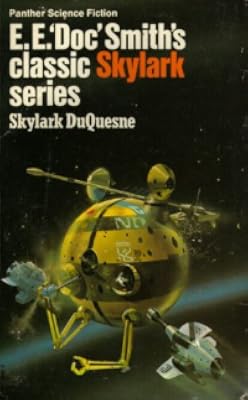
I first discovered E.E. 'Doc' Smith's Lensman books at the age of 14, on holiday in the Cumbrian fells in the early 1970s; in fact, my first copy of Grey Lensman came from the station bookstall on Carlisle Citadel station. I was first drawn in by the Chris Foss cover art, possibly the first UK paperback to show his work (though he had made professional sales already). Over the years, I read and re-read everything of Smith's that was published in the UK, but the Lensman novels remained my go-to for sf adventure, even though I quickly realised that they occupied a particular historical niche in the evolution of the genre. And then, as I matured, I turned away from these books as other people I knew and whose opinions I respected pointed show more out Smith's many flaws.
But with time came a different perspective. I kept reading histories of the genre that put Smith in context; and I read other so-called "Golden Age" sf that stacked up badly against Smith. Well, as Theodore Sturgeon said, "90% of everything is crap". So in the end, I decided that I should attempt a re-read, after something like fifty years. I knew what I was going to find; my question was going to be, "Just how bad is this?"
Then just a few days before I embarked on this task, I read a 1993 issue of the journal of the UK's academic Science Fiction Foundation, Foundation 59. Apart from finding some remarkably apposite comments in reviews of books set in the impossibly distant future year of 2021, I came across the following quote in an article by Czech fan/academic Cyril Simsa on the probably little-remembered US author Henry Slesar, and it put me in an interesting frame of mind for the upcoming re-read:
"A lot of [Slesar's] stories are perfectly respectable examples of the way sf was written in the '50s, and may even have seemed well above average for their day. But so much has changed in the genre in the interim: plot-lines which may once have seemed agreeably adventurous now seem trite and melodramatic, ideas which were part of sf's stock-in-trade are now unbearable clichés, the little philosophical homilies with which so many '50s sf writers liked to finish off their stories (the "moral", if you like) seem dated and prevent the story reaching a proper conclusion. In a world where fascism and civil war have come back to the streets of Europe, where naked manipulation of the political process by the mass media has become the norm, where rival drug gangs regularly shoot at one another with Uzi machine-pistols in the ruins of Los Angeles and computer networks will soon be offering us sex in cyberspace for real, it's difficult to read a story about a mad scientist with a beautiful blond daughter, or a solitary genius who invents a new variety of domestic robot, or indeed any story in which the moral turns out to be (in the words of the '50s B-feature) that "there are things man isn't meant to know", without disguising a smirk behind the palm of one's hand. (Then again, in fairness to Slesar, one has to ask whether the second-generation cyberpunks like Walter Jon Williams will seem any less ridiculous in 2022, and whether we won't perhaps be just as incapable of taking seriously anything with voguish references to "ice", "jacks", designer drugs, artificial intelligence, multinational corporations, computer voodoo, banghramuffin orbital rave platforms, elephants in mirrorshades and so on, in an age no doubt as unimaginably different from where we are now, as the '80s were to the writers of the '50s.)"
So, armed with that thought, I tackled, not Grey Lensman but the book immediately before it in the sequence, Galactic Patrol, on the grounds that it was written first and forms the basis of the whole series. I quickly found the authorial style familiar, because Smith adopted a slightly portentous fake archaic style for the text, which immediately put me in mind of William Hope Hodgson's The Night Land, though nowhere near as extreme as Hodgson. I suspect Smith used that style to try to lend some sort of maturity and gravitas to the text, possibly to make his 14-year-old readership feel that they were in the presence of an adult.
We are pitched into the story of the Galactic Patrol, who provide law and justice throughout the galaxy (does this sound familiar yet?). At the apex of the Patrol are the Lensmen (and they are all men), who wear the Lens, a piece of bio-engineered super-science from the mysterious Arisians that confers various telepathic powers on the wearer. We are then shown the conflict between the Patrol and the pirates of Boskone who are preying on the space shipping lanes. Again, this feels very familiar territory; the theme of an eons-long conflict between two ancient and powerful races, played out through proxies, was the background for Joe Straczynski's 1990s television series Babylon 5, although in the case of that series, the motives of the two races were less clear-cut. In Smith's case, the Arisians are Good and Boskone is Evil.
Smith describes Boskone in terms that immediately made me think of the idea that the modern corporation is a dysfunctional organisation, where the ends justify the means, and progress up the corporate ladder is achieved through back-stabbing, lies, deceit and trampling on those who are not strong enough to stand up against such naked ambition. We now recognise this as typical of Type A personalities and organisations which show a tendency towards the psychopathic; the worrying thing is that having set up the Patrol in general and the Lensmen in particular as the Good Guys, Smith then allows his elite, the Grey Lensmen, full freedom of thought and action. They can determine truth through the use of the Lens, and so can act as judge, jury and executioner because they are all so incorruptible that their word of law is incontrovertible. And they can employ any means to achieve their end - just the trait that Smith originally laid at the feet of Boskone. But there is no room in Smith's universe for ambiguity (it was just this ambiguity and the conflict it gives rise to in the real world that made Babylon 5 such an engaging piece of sf drama).
The dialogue in the novel is excruciating 1930s slang, extrapolated forward. I skimmed as much of the dialogue as I could. Interestingly, the minions of Boskone have dialogue that is far less purple, in line with the depiction of the organisation as cold, ruthless and efficient. I found myself taking to them, though some of the lesser Boskonians sound like 1940s RAF pilots.
Modern commentators brand Smith's work as sexist and racist. Sexist it certainly is: there are no female Lensmen, and the one female character, though feisty, is as stereotypical as a 1940s pin-up poster (and not Rosie the Riveter, either). On the racism, though, things are not quite so clear-cut. True, there do not seem to be any black Lensmen; but Smith introduces a variety of alien races who have unpleasant or strange appearances but who have many good qualities - intelligence, nobility, and honour - and who are put into the classification of "Good Guys". This was perhaps Smith's contribution to the genre; he depicted aliens who were not just nasty monsters who abducted the girl in the brass bikini, to be blasted into oblivion because they were obscene to our eyes, but who were worthy to be called Civilised. Smith wasn't the first to do this - Stanley Weinbaum usually takes that honour with the Martian Tweel in A Martian Odyssey - but within the context of blood-and-thunder space opera, his depiction of the good alien was out of the ordinary. Even the villains of Boskone were given the credit for having intelligence and morals, even if they were the wrong sort of morals.
After all this, if you can cope with the outdated slang, the purple prose and the propensity of the heroes to pull new advances in super-science out of thin air with each new chapter, the story itself holds up reasonably well, only really lapsing when Kimball Kinnison, the Grey Lensman, subverts an entire base of Boskone through mental manipulation, and allows many of their personnel to live - and indeed, receive a pardon for any crimes - because they are all basically Good People Who Have Gone Wrong. Amongst all the action, such an act that is almost out of Gilbert and Sullivan feels out of place. After all, the villains of Boskone are usually gunned or hacked down to a man, without quarter.
In the end, I emerged from the (rather abrupt) end of the novel intact. I read little that makes me want to re-read more, especially as the later Lensman novels keep upping the stakes in the evil-doing of the villains and the goodness and ingenuity of the good guys; whilst the prequels (Triplanetary and First Lensman) did a lot of plot gymnastics to arrive at the universe of Galactic Patrol. I feel myself more likely to go back to Dave Langford's Doc Smith pastiche Sex Pirates of the Blood Asteroid. But at least I have had my re-read, and I can put that particular demon to rest. show less
But with time came a different perspective. I kept reading histories of the genre that put Smith in context; and I read other so-called "Golden Age" sf that stacked up badly against Smith. Well, as Theodore Sturgeon said, "90% of everything is crap". So in the end, I decided that I should attempt a re-read, after something like fifty years. I knew what I was going to find; my question was going to be, "Just how bad is this?"
Then just a few days before I embarked on this task, I read a 1993 issue of the journal of the UK's academic Science Fiction Foundation, Foundation 59. Apart from finding some remarkably apposite comments in reviews of books set in the impossibly distant future year of 2021, I came across the following quote in an article by Czech fan/academic Cyril Simsa on the probably little-remembered US author Henry Slesar, and it put me in an interesting frame of mind for the upcoming re-read:
"A lot of [Slesar's] stories are perfectly respectable examples of the way sf was written in the '50s, and may even have seemed well above average for their day. But so much has changed in the genre in the interim: plot-lines which may once have seemed agreeably adventurous now seem trite and melodramatic, ideas which were part of sf's stock-in-trade are now unbearable clichés, the little philosophical homilies with which so many '50s sf writers liked to finish off their stories (the "moral", if you like) seem dated and prevent the story reaching a proper conclusion. In a world where fascism and civil war have come back to the streets of Europe, where naked manipulation of the political process by the mass media has become the norm, where rival drug gangs regularly shoot at one another with Uzi machine-pistols in the ruins of Los Angeles and computer networks will soon be offering us sex in cyberspace for real, it's difficult to read a story about a mad scientist with a beautiful blond daughter, or a solitary genius who invents a new variety of domestic robot, or indeed any story in which the moral turns out to be (in the words of the '50s B-feature) that "there are things man isn't meant to know", without disguising a smirk behind the palm of one's hand. (Then again, in fairness to Slesar, one has to ask whether the second-generation cyberpunks like Walter Jon Williams will seem any less ridiculous in 2022, and whether we won't perhaps be just as incapable of taking seriously anything with voguish references to "ice", "jacks", designer drugs, artificial intelligence, multinational corporations, computer voodoo, banghramuffin orbital rave platforms, elephants in mirrorshades and so on, in an age no doubt as unimaginably different from where we are now, as the '80s were to the writers of the '50s.)"
So, armed with that thought, I tackled, not Grey Lensman but the book immediately before it in the sequence, Galactic Patrol, on the grounds that it was written first and forms the basis of the whole series. I quickly found the authorial style familiar, because Smith adopted a slightly portentous fake archaic style for the text, which immediately put me in mind of William Hope Hodgson's The Night Land, though nowhere near as extreme as Hodgson. I suspect Smith used that style to try to lend some sort of maturity and gravitas to the text, possibly to make his 14-year-old readership feel that they were in the presence of an adult.
We are pitched into the story of the Galactic Patrol, who provide law and justice throughout the galaxy (does this sound familiar yet?). At the apex of the Patrol are the Lensmen (and they are all men), who wear the Lens, a piece of bio-engineered super-science from the mysterious Arisians that confers various telepathic powers on the wearer. We are then shown the conflict between the Patrol and the pirates of Boskone who are preying on the space shipping lanes. Again, this feels very familiar territory; the theme of an eons-long conflict between two ancient and powerful races, played out through proxies, was the background for Joe Straczynski's 1990s television series Babylon 5, although in the case of that series, the motives of the two races were less clear-cut. In Smith's case, the Arisians are Good and Boskone is Evil.
Smith describes Boskone in terms that immediately made me think of the idea that the modern corporation is a dysfunctional organisation, where the ends justify the means, and progress up the corporate ladder is achieved through back-stabbing, lies, deceit and trampling on those who are not strong enough to stand up against such naked ambition. We now recognise this as typical of Type A personalities and organisations which show a tendency towards the psychopathic; the worrying thing is that having set up the Patrol in general and the Lensmen in particular as the Good Guys, Smith then allows his elite, the Grey Lensmen, full freedom of thought and action. They can determine truth through the use of the Lens, and so can act as judge, jury and executioner because they are all so incorruptible that their word of law is incontrovertible. And they can employ any means to achieve their end - just the trait that Smith originally laid at the feet of Boskone. But there is no room in Smith's universe for ambiguity (it was just this ambiguity and the conflict it gives rise to in the real world that made Babylon 5 such an engaging piece of sf drama).
The dialogue in the novel is excruciating 1930s slang, extrapolated forward. I skimmed as much of the dialogue as I could. Interestingly, the minions of Boskone have dialogue that is far less purple, in line with the depiction of the organisation as cold, ruthless and efficient. I found myself taking to them, though some of the lesser Boskonians sound like 1940s RAF pilots.
Modern commentators brand Smith's work as sexist and racist. Sexist it certainly is: there are no female Lensmen, and the one female character, though feisty, is as stereotypical as a 1940s pin-up poster (and not Rosie the Riveter, either). On the racism, though, things are not quite so clear-cut. True, there do not seem to be any black Lensmen; but Smith introduces a variety of alien races who have unpleasant or strange appearances but who have many good qualities - intelligence, nobility, and honour - and who are put into the classification of "Good Guys". This was perhaps Smith's contribution to the genre; he depicted aliens who were not just nasty monsters who abducted the girl in the brass bikini, to be blasted into oblivion because they were obscene to our eyes, but who were worthy to be called Civilised. Smith wasn't the first to do this - Stanley Weinbaum usually takes that honour with the Martian Tweel in A Martian Odyssey - but within the context of blood-and-thunder space opera, his depiction of the good alien was out of the ordinary. Even the villains of Boskone were given the credit for having intelligence and morals, even if they were the wrong sort of morals.
After all this, if you can cope with the outdated slang, the purple prose and the propensity of the heroes to pull new advances in super-science out of thin air with each new chapter, the story itself holds up reasonably well, only really lapsing when Kimball Kinnison, the Grey Lensman, subverts an entire base of Boskone through mental manipulation, and allows many of their personnel to live - and indeed, receive a pardon for any crimes - because they are all basically Good People Who Have Gone Wrong. Amongst all the action, such an act that is almost out of Gilbert and Sullivan feels out of place. After all, the villains of Boskone are usually gunned or hacked down to a man, without quarter.
In the end, I emerged from the (rather abrupt) end of the novel intact. I read little that makes me want to re-read more, especially as the later Lensman novels keep upping the stakes in the evil-doing of the villains and the goodness and ingenuity of the good guys; whilst the prequels (Triplanetary and First Lensman) did a lot of plot gymnastics to arrive at the universe of Galactic Patrol. I feel myself more likely to go back to Dave Langford's Doc Smith pastiche Sex Pirates of the Blood Asteroid. But at least I have had my re-read, and I can put that particular demon to rest. show less
3 stars (or less) for story and writing quality, 48,000 stars for influence and imagination.
As I’ve gotten into classic sci fi it seems like almost everything eventually comes round to being influenced by E E Smith’s Lensmen series. Which is weird because it’s not a household name. I’d heard of the foundation trilogy, stranger in a stranger land, rendezvous with Rama, John Carter and other influential/important sci fi works before I ever heard about this here Lens thingy.
Well that’s probably because it’s not great. Don’t get me wrong it’s enjoyable but the writing isn’t great, it’s near humorless, and it’s outdated. If this were just a little bit better, I think everyone would know galactic patrol, but, as is, show more it’s a little swept under the rug.
Regardless of its reception, reading this it is easy to see how influential it is. It amazes me that this was originally written in the 30s. This has all the core pieces of sci fi as we still know it. Space ship battles, technobabble, laser guns, aliens, bizarre planets, tractor beams, etc.
If you are interested in sci fi history this is a must read. In particular the Lensmen really remind me of the Jedi and the technology reminds me of Star Trek’s warp drive and phasers. show less
As I’ve gotten into classic sci fi it seems like almost everything eventually comes round to being influenced by E E Smith’s Lensmen series. Which is weird because it’s not a household name. I’d heard of the foundation trilogy, stranger in a stranger land, rendezvous with Rama, John Carter and other influential/important sci fi works before I ever heard about this here Lens thingy.
Well that’s probably because it’s not great. Don’t get me wrong it’s enjoyable but the writing isn’t great, it’s near humorless, and it’s outdated. If this were just a little bit better, I think everyone would know galactic patrol, but, as is, show more it’s a little swept under the rug.
Regardless of its reception, reading this it is easy to see how influential it is. It amazes me that this was originally written in the 30s. This has all the core pieces of sci fi as we still know it. Space ship battles, technobabble, laser guns, aliens, bizarre planets, tractor beams, etc.
If you are interested in sci fi history this is a must read. In particular the Lensmen really remind me of the Jedi and the technology reminds me of Star Trek’s warp drive and phasers. show less
OK, compared to First Lensman this is a work of genius. There are still problems with the quality of the prose but at least it's strung together in something approaching a readable narrative. There are some problems caused by confines of space and amazing new technologies spring into existence when the story requires it.
The main problem with the book is that it's racist and sexist. Now, I don't mind a bit of one or the other, as long as it's casual, but here both are deliberate. It's not that the heroes happen to have red hair, it's that the white race have been bred by super beings to be better than the rest of our species. For God's sake, grow up!
This is the 3rd novel chronologically, but the first written and I think this is where show more you should start reading. To do otherwise would be like watching the prequels before you saw Star Wars. show less
The main problem with the book is that it's racist and sexist. Now, I don't mind a bit of one or the other, as long as it's casual, but here both are deliberate. It's not that the heroes happen to have red hair, it's that the white race have been bred by super beings to be better than the rest of our species. For God's sake, grow up!
This is the 3rd novel chronologically, but the first written and I think this is where show more you should start reading. To do otherwise would be like watching the prequels before you saw Star Wars. show less
Wow, I have really mixed emotions about this one...
On the one hand, I really enjoyed it. I mean, as epic space opera goes, it's right up there. I was attached to Kim as a character (eventually), and was rooting for him to defeat Helmuth.
On the other hand, sexist much? Yeah, yeah, I know, when this was written things were just that way. Uh, this took it a step beyond in places. There were literally NO female characters until the end of the book when Mac is finally introduced and is treated and even talked about by everyone but Kim as simply good breeding stock. She is a fairly strong character, not your wilting violet. I'll give him that, but it isn't much compared to the author's treatment of her. The rest of the women are just faceless show more nameless nurses. Here is a prime example of what I'm talking about:
"Therefore she passed along her illogical but cheering thought, and the nurses, being also women, accepted it without question as the actual and accomplished fact." Chapter 20
Uh...what?
You don't even want me to quote the Dr. & Haynes discussing her for a breeder with Kim...
My last issue, the reason this is a 3 star rather than 4 or 5 (aside from the above) is that there is a decided lack of wit. Where's my witty banter? I'm thinking Han Solo style? There was none of that. I can take my testosterone overload a lot better with some humor, clever, sassy, humor. One liners needed, stat!
So, action, cleverness of the sci-fi, great hero/villain, all there. I was totally on board. But, it fell a little short for me in areas. show less
On the one hand, I really enjoyed it. I mean, as epic space opera goes, it's right up there. I was attached to Kim as a character (eventually), and was rooting for him to defeat Helmuth.
On the other hand, sexist much? Yeah, yeah, I know, when this was written things were just that way. Uh, this took it a step beyond in places. There were literally NO female characters until the end of the book when Mac is finally introduced and is treated and even talked about by everyone but Kim as simply good breeding stock. She is a fairly strong character, not your wilting violet. I'll give him that, but it isn't much compared to the author's treatment of her. The rest of the women are just faceless show more nameless nurses. Here is a prime example of what I'm talking about:
"Therefore she passed along her illogical but cheering thought, and the nurses, being also women, accepted it without question as the actual and accomplished fact." Chapter 20
Uh...what?
You don't even want me to quote the Dr. & Haynes discussing her for a breeder with Kim...
My last issue, the reason this is a 3 star rather than 4 or 5 (aside from the above) is that there is a decided lack of wit. Where's my witty banter? I'm thinking Han Solo style? There was none of that. I can take my testosterone overload a lot better with some humor, clever, sassy, humor. One liners needed, stat!
So, action, cleverness of the sci-fi, great hero/villain, all there. I was totally on board. But, it fell a little short for me in areas. show less
Although it is the third book in the Lensman series, Galactic Patrol, along with Gray Lensman, forms the heart of the series and revolves around the exploits of Lensman Kimball Kinnison. The stories in this volume were the first parts written as part of the Lensman saga - although portions of Triplanetary were written earlier, they were not originally part of the Lensman story and was only later revised to connect it to the rest of the series. First Lensman was written later to bridge the events in Triplanetary to those in Galactic Patrol.
Kimball Kinnison, the hero of the book, graduates first in his class from the Academy, and is fitted for a Lens - the quasi-living symbol of authority that allows a Lensman to communicate show more telepathically (among other sundry powers). He is offered a big but dangerous assignment captaining an experimental ship with orders to capture a "pirate" Boskonian ship and extract information concerning a new power source that is allowing the pirates to run roughshod over the hapless patrol. Kimball is successful in capturing a ship, but must flee the converging pirate raiders. Much of the first third of the book is taken up with his efforts to evade his villainous pursuers and return his priceless information to Tellus (as Earth is known to the inhabitants of Civilization). In the process, Kinnison frees a previously unknown enslaved race from their previously unknown masters, making valuable allies. He also destroys several pirate ships, completely frustrates the main villain of the book "Helmuth speaking for Boskone" and deduces the location of one of the pirates' secret bases.
Kinnision, of course, successfully returns to Earth, and is promoted again, to the exalted rank of "Gray Lensman", endowed with virtually unlimited powers. He immediately sets out to infiltrate what he believes to be the main pirate base. Unfortunately, Kinnison is in over his head and the telepathically inclined "Wheelmen" who man the base discover and almost kill him before he can escape. At this point, the 1930s sensibilities of the story kick in, as Kinnision is assigned the pretty but tough nurse Clarissa MacDougall to help him convalesce. He behaves badly and is rude and condescending to her, but this is, of course, excused with a sort of "boys will be boys" attitude. Kinnison, once recovered, goes to Arisia to learn how better to use his Lens (unknowingly following an earlier trip by Helmuth to the planet, although Helmuth's purpose was to uncover the secret of the Lens for nefarious purposes). Kinnison is the first Lensman to be accepted for further training by the Arisians, and leaves weeks later with numerous additional capabilities.
Kinnison turns these capabilities to infiltrating a Patrol base for practice by controlling the minds of those around him. After he reveals himself to the base commander, he is asked to judge a murder case. At this point, what I consider to be the most disturbing thing about these books comes to the fore: as an incorruptible Lensman, Kinnision reads the minds of the two accused parties, determines which one is guilty, and using his mental powers, kills the culprit. This is accepted by all concerned as reasonable - the apparent incorruptibility of the Lensman is given as the reason for allowing them such summary powers. In effect, the rest of the human race becomes wards of the Lensmen, who are the only parties entrusted with true power. This is a sort of elitism that David Brin was reacting to when he wrote his portion of Star Wars on Trial, and it is just as pernicious in the Lensman books as it is in Star Wars. However, when reading the books one simply has to suspend disbelief and accept the premise of the story that the Lensman are an incorruptible bunch who always have the best interests of humanity in mind.
In the end, the enhanced Kinnison locates the evil Helmuth and arranges to destroy his secret base and kill off the villain with apparent ease – his powers making Helmuth no longer a serious opponent for Kinnision. The only saving grace to this somewhat anticlimactic ending is that Helmuth's defeat is fairly satisfying, and the reader can rest assured in the knowledge that he is not the true power behind Boksone (as evidenced by the three subsequent novels in the series).
Later science fiction is replete with stories that draw upon the Lensman series – in Babylon 5 the organic technology of the Vorlons (standing in for the Arisians) is reminiscent of the quasi-life of the Arisian-made lenses. The shields that form the basis of military technology in the Dune series of books, impenetrable to bullets yet vulnerable to blades, is strikingly similar to the shields found in these books. And the Jedi Knights in the prequels to Star Wars seem to operate in a manner very similar to the unattached, enhanced Kinnision, a parallel I believe that Lucas intended. It is also quite likely (in my mind) that story of the Star Wars prequels, concerning the Jedi fall from grace, was a reaction to the assumed incorruptibility of the Lensmen.
The Lensman series, as the granddaddy of all Space Opera, has proven to be incredibly influential on the field of science fiction, most notably science fiction on the screen (whether television or movies), and as a result, this book is a must read on that basis alone. The fact that the first two-thirds of the book is a series of exciting roller-coaster adventures makes the books that much better.
This review has also been posted to my blog Dreaming About Other Worlds. show less
Kimball Kinnison, the hero of the book, graduates first in his class from the Academy, and is fitted for a Lens - the quasi-living symbol of authority that allows a Lensman to communicate show more telepathically (among other sundry powers). He is offered a big but dangerous assignment captaining an experimental ship with orders to capture a "pirate" Boskonian ship and extract information concerning a new power source that is allowing the pirates to run roughshod over the hapless patrol. Kimball is successful in capturing a ship, but must flee the converging pirate raiders. Much of the first third of the book is taken up with his efforts to evade his villainous pursuers and return his priceless information to Tellus (as Earth is known to the inhabitants of Civilization). In the process, Kinnison frees a previously unknown enslaved race from their previously unknown masters, making valuable allies. He also destroys several pirate ships, completely frustrates the main villain of the book "Helmuth speaking for Boskone" and deduces the location of one of the pirates' secret bases.
Kinnision, of course, successfully returns to Earth, and is promoted again, to the exalted rank of "Gray Lensman", endowed with virtually unlimited powers. He immediately sets out to infiltrate what he believes to be the main pirate base. Unfortunately, Kinnison is in over his head and the telepathically inclined "Wheelmen" who man the base discover and almost kill him before he can escape. At this point, the 1930s sensibilities of the story kick in, as Kinnision is assigned the pretty but tough nurse Clarissa MacDougall to help him convalesce. He behaves badly and is rude and condescending to her, but this is, of course, excused with a sort of "boys will be boys" attitude. Kinnison, once recovered, goes to Arisia to learn how better to use his Lens (unknowingly following an earlier trip by Helmuth to the planet, although Helmuth's purpose was to uncover the secret of the Lens for nefarious purposes). Kinnison is the first Lensman to be accepted for further training by the Arisians, and leaves weeks later with numerous additional capabilities.
Kinnison turns these capabilities to infiltrating a Patrol base for practice by controlling the minds of those around him. After he reveals himself to the base commander, he is asked to judge a murder case. At this point, what I consider to be the most disturbing thing about these books comes to the fore: as an incorruptible Lensman, Kinnision reads the minds of the two accused parties, determines which one is guilty, and using his mental powers, kills the culprit. This is accepted by all concerned as reasonable - the apparent incorruptibility of the Lensman is given as the reason for allowing them such summary powers. In effect, the rest of the human race becomes wards of the Lensmen, who are the only parties entrusted with true power. This is a sort of elitism that David Brin was reacting to when he wrote his portion of Star Wars on Trial, and it is just as pernicious in the Lensman books as it is in Star Wars. However, when reading the books one simply has to suspend disbelief and accept the premise of the story that the Lensman are an incorruptible bunch who always have the best interests of humanity in mind.
In the end, the enhanced Kinnison locates the evil Helmuth and arranges to destroy his secret base and kill off the villain with apparent ease – his powers making Helmuth no longer a serious opponent for Kinnision. The only saving grace to this somewhat anticlimactic ending is that Helmuth's defeat is fairly satisfying, and the reader can rest assured in the knowledge that he is not the true power behind Boksone (as evidenced by the three subsequent novels in the series).
Later science fiction is replete with stories that draw upon the Lensman series – in Babylon 5 the organic technology of the Vorlons (standing in for the Arisians) is reminiscent of the quasi-life of the Arisian-made lenses. The shields that form the basis of military technology in the Dune series of books, impenetrable to bullets yet vulnerable to blades, is strikingly similar to the shields found in these books. And the Jedi Knights in the prequels to Star Wars seem to operate in a manner very similar to the unattached, enhanced Kinnision, a parallel I believe that Lucas intended. It is also quite likely (in my mind) that story of the Star Wars prequels, concerning the Jedi fall from grace, was a reaction to the assumed incorruptibility of the Lensmen.
The Lensman series, as the granddaddy of all Space Opera, has proven to be incredibly influential on the field of science fiction, most notably science fiction on the screen (whether television or movies), and as a result, this book is a must read on that basis alone. The fact that the first two-thirds of the book is a series of exciting roller-coaster adventures makes the books that much better.
This review has also been posted to my blog Dreaming About Other Worlds. show less
(Original Review, 1980-08-08)
I also picked up a couple of the Lensmen books after reading about them here in the SF-Lovers newsletter. Umm, as one of those narrow-minded types who happens to think the Golden Age of Science Fiction is right now, I recommend that anyone else who is tempted to do so scour your local used book stores before laying out real cash money for them.
The Lensmen books have all those neat features that gave SF its good name among middle-aged High School English teachers. All the problems that arise in the book (in this case, Galactic Patrol) threaten to End Civilization before the end of this chapter, if not by the next page. Oh My! But not to worry, our heroically heroic heroes (HHH's) have foreseen this very show more circumstance, allowing them to deus-ex-machinate a solution in the next paragraph. Whew. [2018 EDIT: Even in 1980 I already thought this was crap...]
The dialogue is, well, juvenile (oh but the descriptions are vivid, the valiant war-machine turned suddenly, thrusters blazing. Suddenly from all gun-ports a brilliant cone of orange destruction spewed forth, sundering the armored hull of the startled pirate ship.) Ships are boarded with grappling hook and sword, and space battles are concluded by hand to hand combat, in a fine swashbuckling tradition, though accompanied by the complication of taking place in free fall (this, incidentally, is not a problem for our HHH's, due to their swift reflexes and superior strength).
Well, it was okay when I was ten years old, but I only got halfway through the book before my strength gave out.
Actually, I think the Golden Age of S.F. is actually the extended present -- including all the good stuff from years gone by (Stanley G. Weinbaum, Cordwainer Smith, etc.). Not including Doc Smith, however.
[2018 EDIT: This review was written at the time as I was running my own personal BBS server. Much of the language of this and other reviews written in 1980 reflect a very particular kind of language: what I call now in retrospect a “BBS language”.] show less
I also picked up a couple of the Lensmen books after reading about them here in the SF-Lovers newsletter. Umm, as one of those narrow-minded types who happens to think the Golden Age of Science Fiction is right now, I recommend that anyone else who is tempted to do so scour your local used book stores before laying out real cash money for them.
The Lensmen books have all those neat features that gave SF its good name among middle-aged High School English teachers. All the problems that arise in the book (in this case, Galactic Patrol) threaten to End Civilization before the end of this chapter, if not by the next page. Oh My! But not to worry, our heroically heroic heroes (HHH's) have foreseen this very show more circumstance, allowing them to deus-ex-machinate a solution in the next paragraph. Whew. [2018 EDIT: Even in 1980 I already thought this was crap...]
The dialogue is, well, juvenile (oh but the descriptions are vivid, the valiant war-machine turned suddenly, thrusters blazing. Suddenly from all gun-ports a brilliant cone of orange destruction spewed forth, sundering the armored hull of the startled pirate ship.) Ships are boarded with grappling hook and sword, and space battles are concluded by hand to hand combat, in a fine swashbuckling tradition, though accompanied by the complication of taking place in free fall (this, incidentally, is not a problem for our HHH's, due to their swift reflexes and superior strength).
Well, it was okay when I was ten years old, but I only got halfway through the book before my strength gave out.
Actually, I think the Golden Age of S.F. is actually the extended present -- including all the good stuff from years gone by (Stanley G. Weinbaum, Cordwainer Smith, etc.). Not including Doc Smith, however.
[2018 EDIT: This review was written at the time as I was running my own personal BBS server. Much of the language of this and other reviews written in 1980 reflect a very particular kind of language: what I call now in retrospect a “BBS language”.] show less
My mother was reading this book at our grandparent's holiday house. She mentioned some crazy space battles and pirates, etc. "What do they do with the prisoners?" I asked.
"They kill them." she said. I was a little taken aback at this, being about 7, but I thought, fair enough, and read it after she was finished.
A hell of a lot of fun.
There are quite a few more Lensmen now. They are all incorruptible heroes, or they would not be given the Lenses by the Arisians. Think hardcore take-no-prisoners Green Lanterns on a lot lower power scale.
Kimball Kinnison is a young officer, that has just graduated, gained a Lens, being of the right stuff and is given command of a ship with some probably dodgy new technology.
The pirate organisation the show more Eddorians influence has a name, Boskone. Kinnison's job is to infiltrate. He does, and barely escapes alive thanks to his talents and his Lens.
A bodacious redhead nurses him back to health, and tells him off enough to get his attention. You know what happens next.
A better prepared, trained, and upgraded Kinnison will venture forth as a more powerful type of Lensman to fight the Boskonians some more.
Guilt-ridden whiners or conflicted vigilantes need not apply to the Patrol. A classic of Space Opera, although obviously of its time.
http://superprose.blogspot.com/2006/11/lensman-3-galactic-patrol.html show less
"They kill them." she said. I was a little taken aback at this, being about 7, but I thought, fair enough, and read it after she was finished.
A hell of a lot of fun.
There are quite a few more Lensmen now. They are all incorruptible heroes, or they would not be given the Lenses by the Arisians. Think hardcore take-no-prisoners Green Lanterns on a lot lower power scale.
Kimball Kinnison is a young officer, that has just graduated, gained a Lens, being of the right stuff and is given command of a ship with some probably dodgy new technology.
The pirate organisation the show more Eddorians influence has a name, Boskone. Kinnison's job is to infiltrate. He does, and barely escapes alive thanks to his talents and his Lens.
A bodacious redhead nurses him back to health, and tells him off enough to get his attention. You know what happens next.
A better prepared, trained, and upgraded Kinnison will venture forth as a more powerful type of Lensman to fight the Boskonians some more.
Guilt-ridden whiners or conflicted vigilantes need not apply to the Patrol. A classic of Space Opera, although obviously of its time.
http://superprose.blogspot.com/2006/11/lensman-3-galactic-patrol.html show less
Members
- Recently Added By
Lists

Gateway Book: Science Fiction
21 works; 26 members

S.F. Masterworks (Complete)
229 works; 15 members

Favorite Childhood Books
1,651 works; 519 members

Books Read in 2018
4,360 works; 110 members

Books Read in 2014
2,344 works; 89 members
Talk Discussions
Past Discussions
***Group Read: The Lensman Series (Spoiler-free) in 75 Books Challenge for 2010 (June 2010)
Author Information

10+ Works 9,198 Members
Some Editions
Awards and Honors
Awards
Series


Belongs to Publisher Series
Work Relationships
Is contained in
Has the adaptation
Common Knowledge
- Canonical title
- Galactic Patrol
- Original title
- Galactic Patrol
- Original publication date
- 1950
- People/Characters
- Kimball Kinnison; Worsel; Tregonsee
- Related movies
- SF Shinseiki Lensman (1984)
- Dedication
- to Clarrissa M. MacD. Hamnett and
Clarrissa MacD. S. Wilcox - First words
- Dominating twice a hundred square miles of campus, parade-ground, airport, and spaceport, a ninety-storey edifice of chromium and glass sparkled dazzlingly in the bright sunlight of a June morning.
- Last words
- (Click to show. Warning: May contain spoilers.)Then Helmuth; and as the fierce-driven metal slugs tore in their multitudes through his armor and through and through his body, riddling his every vital organ, that was... THE END.
- Original language
- English
- Canonical DDC/MDS
- 813.087625
Classifications
- Genres
- Science Fiction, Fiction and Literature
- DDC/MDS
- 813.087625 — Literature & rhetoric American literature in English American fiction in English By type Genre fiction Adventure fiction Speculative fiction Science fiction Space opera
- LCC
- PS3537 .M349 .G35 — Language and Literature American literature American literature Individual authors 1900-1960
- BISAC
Statistics
- Members
- 1,479
- Popularity
- 15,820
- Reviews
- 18
- Rating
- (3.54)
- Languages
- Czech, English, French, German
- Media
- Paper, Audiobook, Ebook
- ISBNs
- 29
- ASINs
- 45