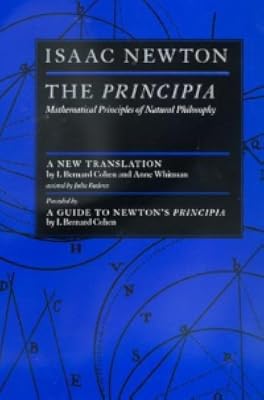
Principia Mathematica
by Isaac Newton
On This Page
Description
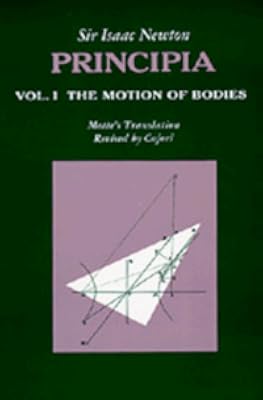
In his monumental 1687 work, Philosophiae Naturalis Principia Mathematica, known familiarly as the Principia, Isaac Newton laid out in mathematical terms the principles of time, force, and motion that have guided the development of modern physical science. Even after more than three centuries and the revolutions of Einsteinian relativity and quantum mechanics, Newtonian physics continues to account for many of the phenomena of the observed world, and Newtonian celestial dynamics is used to show more determine the orbits of our space vehicles. This authoritative, modern translation by I. Bernard Cohen and Anne Whitman, the first in more than 285 years, is based on the 1726 edition, the final revised version approved by Newton; it includes extracts from the earlier editions, corrects errors found in earlier versions, and replaces archaic English with contemporary prose and up-to-date mathematical forms. Newton's principles describe acceleration, deceleration, and inertial movement; fluid dynamics; and the motions of the earth, moon, planets, and comets. A great work in itself, the Principia also revolutionized the methods of scientific investigation. It set forth the fundamental three laws of motion and the law of universal gravity, the physical principles that account for the Copernican system of the world as emended by Kepler, thus effectively ending controversy concerning the Copernican planetary system. The translation-only edition of this preeminent work is truly accessible for today's scientists, scholars, and students. show lessTags
Recommendations










Member Recommendations
Member Reviews
Amazing -- so many things to discover then still tightly integrated together. Most of this work involves basics of physics and astronomy, including geometric proofs related to the moon's pull on tides, comets, fluid dynamics, et al. Newton did most of his truly cutting edge work in just a few concentrated years, but remained involved in political and educational offices for most of his 85 years. The geometric proofs often involve some very complex lemmas.
I am in awe of Isaac Newton. I can not fathom the intelligence required to write this work. It is truly an impressive accomplishment and I am luck to have found such a nice copy.
An excellent modern English 'translation' of Newton's epoch-making treatise.
Classics
Ratings
Members
- Recently Added By
Lists

Books that changed the world
67 works; 64 members

100 Books to Read in a Lifetime (That Are Older Than 200 Years)
415 works; 175 members

25 Greatest Science Books of All Time
33 works; 6 members

Greatest Books, allegedly
484 works; 9 members

Robert B. Downs's Books that Changed the World
16 works; 1 member

The Well-Educated Mind, Susan Wise Bauer, 2016
179 works; 3 members

The Complete Rory Gilmore Reading List
506 works; 5 members

Works cited in The New Science of the Enchanted Universe by Marshall Sahlin
141 works; 1 member

100
15 works; 1 member
Talk Discussions
Past Discussions
Folio Archives 335: Principia Mathematica by Isaac Newton 2008 in Folio Society Devotees (August 2023)
Author Information

170+ Works 3,411 Members
Born at Woolsthorpe, England, Sir Isaac Newton was educated at Trinity College, Cambridge University, where he graduated in 1665. During the plague of 1666, he remained at Woolsthorpe, during which time he formulated his theory of fluxions (the infinitesimal calculus) and the main outlines of his theories of mechanics, astronomy, and optics, show more including the theory of universal gravitation. The results of his researches were not circulated until 1669, but when he returned to Trinity in 1667, he was immediately appointed to succeed his teacher as professor of mathematics. His greatest work, the Mathematical Principles of Natural Philosophy, was published in 1687 to immediate and universal acclaim. Newton was elected to Parliament in 1689. In 1699, he was appointed head of the royal mint, and four years later he was elected president of the Royal Society; both positions he held until his death. In later life, Newton devoted his main intellectual energies to theological speculation and alchemical experiments. In April 1705, Queen Anne knighted Newton during a royal visit to Trinity College, Cambridge. He was only the second scientist to have been awarded knighthood. Newton died in his sleep in London on March 31, 1727, and was buried in Westminster Abbey. Because of his scientific nature, Newton's religious beliefs were never wholly known. His study of the laws of motion and universal gravitation became his best-known discoveries, but after much examination he admitted that, "Gravity explains the motions of the planets, but it cannot explain who set the planets in motion. God governs all things and knows all that is or can be done." (Bowker Author Biography) show less
Some Editions
Awards and Honors
Series
Belongs to Publisher Series
Work Relationships
Common Knowledge
- Canonical title
- Principia Mathematica
- Original title
- Philosophiae Naturalis Principia Mathematica
- Alternate titles
- Philosophiae Naturalis Principia Mathematica; Mathematical Principles
- Original publication date
- 1687-07-05; 1729
- People/Characters
- Isaac Newton
- First words
- Quam recondita sint simul et utilia Philosophiae Naturalis Principia Mathematica, norunt ii omnes qui vel ipsum clarissimi Authoris nomen audierunt.
The quantity of matter is the measure of the same, arising from its density and bulk conjointly. - Last words
- (Click to show. Warning: May contain spoilers.)Quomodo vero motus isti in spatiis liberis absque vorticibus peraguntur, intelligi potest ex Libro primo, et in Mundi Systemate plenius docebitur.
- Blurbers
- Sitter, W. De; Brown, Ernest W.; Russell, Henry Norris; Durand, W. F.
- Original language
- Latin
Classifications
Statistics
- Members
- 1,373
- Popularity
- 17,335
- Reviews
- 5
- Rating
- (4.30)
- Languages
- 10 — Chinese, English, French, German, Italian, Latin, Portuguese, Russian, Spanish, Swedish
- Media
- Paper, Ebook
- ISBNs
- 102
- ASINs
- 33