Dialogue Concerning the Two Chief World Systems: Ptolemaic and Copernican
by Galileo Galilei 
On This Page
Description
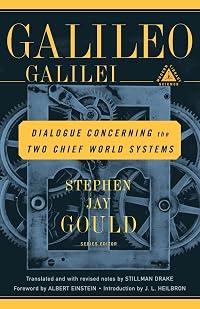
This 1967 edition of the Dialogue Concerning the Two Chief World Systems is a revision of a 1953 edition. It includes a foreword by Albert Einstein, which is presented in en face German and English versions. The translation itself is based on the definitive National Edition prepared under the direction of Antonio Favaro and published at Florence in 1897. The material specifically added to the text by Galileo himself after publication of the first edition (1632) has been included as well. show more In addition, the margins of the book include translations of Galileo's own postils (running notes), placed as nearly as possible beside their textual references. show lessTags
Recommendations













Member Reviews
Optional reading for my first-year students of Science: History and Culture. A very readable, readily understandable argument for a sun-centred solar system rather than the then current earth-centred universe.
Believe it or not, I found this to be one of the most interesting books I have ever read. Easily understood, it is a seminal work in the history of science. Excellent.
The classic that started modern science. Amazingly readable (unlike Newton's principia). The first popular science book!?
First edition, 1953
DIALOGO SOBRE LOS DOS MAXIMOS SISTEMAS DEL MUNDO PTOLEMAICO Y COPERNICANO
Galileo Galilei (1564-1642) se propuso cambiar la vieja visión física y filosófica del mundo, basada en la noción aristotélica de un mundo firme e inmóvil. En este libro, que sentó las bases de la física moderna, Galileo retomó las ideas formuladas por Copérnico sobre el movimiento terrestre del campo de la astronomía y lo planteó en el terreno general de la filosofía de la naturaleza, legándonos un texto que es a la vez de ciencia física y astronomía, de epistemología, lógica y filosofía, y de la cultura. Las notas de Antonio Beltrán, que es también traductor e introductor de la obra, ayudan al lector a comprender la profunda transformación show more intelectual que supuso el libro. show less
Galileo Galilei (1564-1642) se propuso cambiar la vieja visión física y filosófica del mundo, basada en la noción aristotélica de un mundo firme e inmóvil. En este libro, que sentó las bases de la física moderna, Galileo retomó las ideas formuladas por Copérnico sobre el movimiento terrestre del campo de la astronomía y lo planteó en el terreno general de la filosofía de la naturaleza, legándonos un texto que es a la vez de ciencia física y astronomía, de epistemología, lógica y filosofía, y de la cultura. Las notas de Antonio Beltrán, que es también traductor e introductor de la obra, ayudan al lector a comprender la profunda transformación show more intelectual que supuso el libro. show less
Aug 4, 2024Spanish
520.1GAL
Apr 19, 2020Italian
Ratings
Members
- Recently Added By
Lists

Books that changed the world
67 works; 64 members

100 Books to Read in a Lifetime (That Are Older Than 200 Years)
415 works; 175 members

Folio Society
831 works; 53 members

Italian Literature
558 works; 42 members

Greatest Books, allegedly
484 works; 9 members

Books by Cancelled People
40 works; 2 members

New Lifetime Reading Plan by Fadiman and Major
225 works; 5 members

The Well-Educated Mind, Susan Wise Bauer, 2016
179 works; 3 members
Author Information

247+ Works 3,859 Members
Galileo Galilei, the great astronomer and physicist whose researches played so crucial a role in the history of science, also occupies an important place in the history of philosophy for his part in overthrowing the predominant Aristotelian concept of the nature of the universe. Galileo considered himself a philosopher and referred to himself as show more such on the title pages of his most influential works. Much recent research has been devoted to examining both the philosophical background of Galileo's scientific achievements and the philosophical implications of his scientific method. Born in Pisa, the eldest son of a famous music theorist, Galileo entered on the study of medicine at the University of Pisa but quickly shifted his interest to mathematics. From 1589 to 1592, he taught mathematics at Pisa while studying independently with Jacopo Mazzoni, a distinguished professor of philosophy. His earliest scientific works, directed against Aristotle's account of freely falling bodies, date from this period. In 1592 he moved to Padua, where he lectured on mathematics and astronomy, and by 1597 he was defending the Copernican helicocentric theory of the universe in a letter to his friend Mazzoni. When in 1609, he learned of the invention of the telescope in Holland, Galileo quickly designed an improved version of the instrument for his own astronomical observations. His startling discoveries---including the satellites of Jupiter---were revealed in 1610 in his Starry Messenger (Sidereus nuncius), which led to his appointment as mathematician and philosopher to the Grand Duke of Tuscany. On a visit to Rome in 1611, he demonstrated the power of his instrument and defended the Copernican worldview in learned circles. Church authorities were divided on the question of whether the Copernican theory was consistent with scriptural accounts of the cosmos, and Galileo's position was attacked on theological grounds. He defended himself eloquently in his famous Letter to the Grand Duchess Christina (1615), arguing for the independence of scientific inquiry from theological constraints. Nevertheless, in the following year, he was forbidden to hold or teach the Copernican view. Retiring to Florence to pursue his scientific researches, Galileo let the Copernican question lie until a new pope, Urban VIII, seemed to offer a more favorable reception to his views. In 1632 he brought out his great Dialogue Concerning the Two Chief World Systems, a presentation of the Ptolemaic-Aristotelian and Copernican systems heavily weighted in favor of the scientific superiority of the latter. In spite of the support of his Florentine and Roman friends, Galileo was tried and forced to recant his defense of helicocentrism under the threat of torture; the Dialogue was placed on the Index of Prohibited Books and its author sentenced to house arrest for life. Galileo's last years were spent in scientific investigations that culminated in the publication of his Discourses on Two New Sciences (1638). Galileo's legacy as a philosopher lies in his outspoken defense of the autonomy of scientific investigation from philosophical and theological authority, and his conviction that mathematical proofs can and should be sought in physical science, that celestial and terrestrial phenomena can be accounted for by a single set of scientific laws, and that scientific explanations cannot be divorced from direct empirical observation of phenomena. (Bowker Author Biography) show less
Galileo Galilei has a Legacy Library. Legacy libraries are the personal libraries of famous readers, entered by LibraryThing members from the Legacy Libraries group.
Some Editions
Awards and Honors
Series
Belongs to Publisher Series
Common Knowledge
- Canonical title*
- Диалог о двух главнейших системах мира Птоломеевой и Коперниковой
- Original title
- Dialogo
- Original publication date
- 1638; 1632
*Some information comes from Common Knowledge in other languages. Click "Edit" for more information.
Classifications
- Genres
- Science & Nature, Nonfiction, General Nonfiction, History, Philosophy
- DDC/MDS
- 520 — Natural sciences & mathematics Astronomy Astronomy
- LCC
- QB41 .G1356 — Science Astronomy Astronomy General
- BISAC
Statistics
- Members
- 862
- Popularity
- 31,610
- Reviews
- 6
- Rating
- (4.07)
- Languages
- 13 — Dutch, English, French, German, Hungarian, Italian, Latin, Norwegian (Bokmål), Portuguese, Russian, Spanish, Swedish, Turkish
- Media
- Paper, Audiobook, Ebook
- ISBNs
- 39
- ASINs
- 22