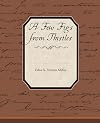
A Few Figs from Thistles
by Edna St. Vincent Millay 
On This Page
Description
1922. A volume of poems and sonnets from the Pulitzer prize-winning American poet Edna St. Vincent Millay. Contents: First Fig; Second Fig; Recuerdo; Thursday; To the Not Impossible Him; Macdougal Street; The Singing-Woman from the Wood's Ed She is Overheard Singing; The Prisoner; The Unexplorer; Grown-Up; The Penitent; Daph Portrait by a Neighb Midnight Oil; The Merry Maid; To Kathleen; To S.M.; The Philosopher; Sonnet-Love, Though for This; Sonnet-I Think I Should Have Loved You; show more Sonnet-Oh, Think Not I am Faithful; and Sonnet-I Shall Forget You Presently. See other titles by this author available from Kessinger Publishing. show lessTags
Recommendations

























Member Reviews
The poem I focused on from A Few Figs From Thistles is "The Unexplorer" (p 24). It is an incredibly short poem about a little girl who asks her mother where the road by their house leads. The mother replies it ends at the milk-man's door. For some reason that information suddenly ends the little girl's desire to go down the road. I am of a darker mind when I think the little girl is afraid of the milk-man and doesn't want to run into him when really it could be she thinks the milk-man's front door is not an exciting enough destination. So she has put it out of her mind. She is no longer curious. That's the thing about poetry. It is ambiguous enough that it could mean anything you want it to.
"Cut if you will, with Sleep's dull knife,
Each day to half its length, my friend,—
The years that Time takes off my life,
He'll take from off the other end!"
-Midnight Oil
I stumbled upon this slim book of poetry in E-book form and I’m glad I did. A short collection only 15 pages long, this is a nice way to familiarize yourself with Edna St. Vincent Millay if you are not yet acquainted with her work. (I wasn’t). These poems are playful, lighthearted, intelligent, and at times mischievous. Millay clearly shows her intent to live life to the fullest even in cases where convention might dictate otherwise for a woman of her time, or even now. I'm surprised she's not more well known. Upon completion I instantly craved more and have since show more ordered her Collected Poems. I hope others will be curious to read her as well. Some personal favorites from this collection include Recuerdo, Portrait by a Neighbor, Sonnets 1& IV, Daphne, and The Singing-Woman from the Wood’s Edge. show less
This is one of the collections that earned a Pulitzer for Millay. The poems are infused with the passion of youth. They express a sense of restlessness, and a desire to live a life more full than the average woman's of her day. Whether or not it's what Millay intended, the message I took from these poems is “carpe diem.”
This slim book is Millay’s second collection of poems. It has two sections; the first contains 19 brief poems, the second four thematically-related sonnets. The unity of theme extends to the poem in the first section as well. Taken together, they depict the persona of a young woman confident of her power to attract and abashed in her determination to sample life to the full. At the same time, the much-quoted four-liner that opens the collection—the first “fig”—makes clear that she is aware that such a life comes only with a cost.
In their own way, these poems are as impressive as those in her first collection, Renascence, although generally more playful and assertive. They brightened a train ride on a cold, gray day.
In their own way, these poems are as impressive as those in her first collection, Renascence, although generally more playful and assertive. They brightened a train ride on a cold, gray day.
This small book features some of Millay's early poetry. As with most collections, the poetry appeal varies from poem to poem. This collection, originally published in 1920, was expanded when republished in 1922. The "figs" were a couple of very short poems. I enjoyed the poems from the day when rhyme mattered.
I wasn't all that much of a fan honestly, and had to push myself through the second half of this one which surprised me. But I've been on a massive kick of reading poetry pieces since Sara's books last week. Maybe something more next week.
A treasure
Members
- Recently Added By
Lists

Books Read in 2016
4,666 works; 199 members
Author Information

129+ Works 6,679 Members
Edna St. Vincent Millay 1892-1950 Edna St. Vincent Millay, American poet, dramatist, lyricist, lecturer, and playwright, was born on February 22, 1892 in Rockland, Maine, and educated at Barnard College and at Vassar College, where she earned her B. A. (Her poem "Renascence" won fourth place in a contest and was published in The Lyric Year in show more 1912; this resulted in a scholarship to Vassar.) Millay's first volume of poetry, "Renascence and Other Poems," was published in 1917. In 1923, "The Ballad of the Harp-Weaver" won her a Pulitzer Prize in Poetry. Other works include: "A Few Figs from Thistles;" "Sonnets in American Poetry," "A Miscellany," "The Lamp and the Bell" and "There Are No Islands Any More." Millay also wrote the libretto for "The King's Henchman," one of the few American grand operas. Edna St. Vincent Millay married Eugen Jan Boissevain in 1923. Shortly after, they purchased a farm in upstate New York, which they called Steepletop. Millay lived here for the rest of her life, composing some of her finest work in a little shack separate from the main house. Boissevain died in 1949. Millay died of a heart attack in her home on October 19, 1950. (Bowker Author Biography) show less
Edna St. Vincent Millay has a Legacy Library. Legacy libraries are the personal libraries of famous readers, entered by LibraryThing members from the Legacy Libraries group.
Awards and Honors
Awards
Work Relationships
Is contained in
Common Knowledge
- Original publication date
- 1920
Classifications
Statistics
- Members
- 143
- Popularity
- 228,207
- Reviews
- 7
- Rating
- (4.18)
- Languages
- English
- Media
- Paper, Audiobook, Ebook
- ISBNs
- 14
- ASINs
- 12