The Bearskinner: A Tale of the Brothers Grimm
by Laura Amy Schlitz, Max Grafe (Illustrator)
On This Page
Description
A retelling of the Grimm fairy tale in which a despondent soldier makes a pact to do the devil's bidding for seven years in return for as much money and property as he could ever want.Tags
Recommendations





















Member Reviews
According to the jacket blurb, this is "an eerie and haunting tale about the subtle but persistent struggle between the two sides of ourselves, and the heroic strength it takes to claim a victory." The reteller, Laura Amy Schlitz, says "I went in search of a story that would tell students that no matter how bad things get, you hold on."
Now, in case you're not familiar with it, the original Grimm story is a bit different than this retelling. In the original, a soldier comes home from the wars with no skills of use. His brothers kick him out, and he wanders off, finally sitting down on a hill and resigning himself to starvation. The devil appears and offers him a bargain - if he wears the skin of a bear he's just shot, doesn't bathe or show more cut his hair for seven years, and won't say the Lord's Prayer, he'll be rich the rest of his life. If he breaks the deal, he belongs to the devil. The soldier agrees, and off he goes. Of course, after a few years he's a filthy monster, but people tolerate him because of his wealth. One night, he meets an old man in an inn. The man's fortune has declined and he's impoverished. Bearskin pays his debts and the man offers him one of his daughters in marriage in exchange. The two older girls are horrified, but the youngest agrees to honor her father's promise. For three more years, Bearskin roams the world, doing good and asking people to pray for him. He wins his bargain and returns wealthy (and clean). The two older girls don't recognize him and are all over him now - but he spurns them and takes the faithful youngest daughter. The two older girls commit suicide, and the devil takes their souls.
In this retelling, the soldier returns from war to devastation. His family is gone and he has no hope. After he agrees to the devil's bargain (which cuts him off from all prayer), he cycles deeper and deeper into despair, until one day he helps a beggar and she prays for him. He realizes there is hope yet, and he begins to use his wealth to help others, asking them to pray for him. Eventually, he pays the debts of a gambler, who promises one of his daughters. The middle daughter says she believes Bearskin has a "good heart" and promises to be his wife. After Bearskin wins his bargain, he returns and claims his faithful bride.
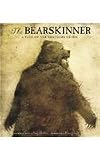
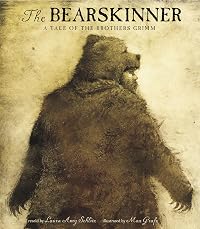
The artwork is dark and filled with half-seen patterns and the pages around the text have a look of parchment. Each illustration is done in shades of black, gray, and brown, with the devil's green coat and the yellow and white butterflies, representing the prayers of the poor, the only lighter colors. The spread showing the cleansed Bearskin greeting his bride is in warm golden-browns and the final page shows the raging devil in black and greens.
I differ a bit in my view of this little-known Grimm story from both the blurb and the author. The original tale isn't especially strong on morals, except for not judging by appearances. However, in this retelling, I see a story of redemption. The soldier is without hope or family and has no reason to live when he accepts a deal with the devil. However, as he sinks deeper and deeper into a morass of despair, he discovers hope. Eventually, he is reborn through the removal of his filthy coat, showing the kind and generous person he has become underneath. I guess it still has a "don't judge by appearances" moral too.
Verdict: This isn't a casual read for younger children, but a story for discussion and re-reading with an older group.
ISBN: 978-0763627300; Published October 2007 by Candlewick; Borrowed from the library; Added to my personal wishlist show less
Now, in case you're not familiar with it, the original Grimm story is a bit different than this retelling. In the original, a soldier comes home from the wars with no skills of use. His brothers kick him out, and he wanders off, finally sitting down on a hill and resigning himself to starvation. The devil appears and offers him a bargain - if he wears the skin of a bear he's just shot, doesn't bathe or show more cut his hair for seven years, and won't say the Lord's Prayer, he'll be rich the rest of his life. If he breaks the deal, he belongs to the devil. The soldier agrees, and off he goes. Of course, after a few years he's a filthy monster, but people tolerate him because of his wealth. One night, he meets an old man in an inn. The man's fortune has declined and he's impoverished. Bearskin pays his debts and the man offers him one of his daughters in marriage in exchange. The two older girls are horrified, but the youngest agrees to honor her father's promise. For three more years, Bearskin roams the world, doing good and asking people to pray for him. He wins his bargain and returns wealthy (and clean). The two older girls don't recognize him and are all over him now - but he spurns them and takes the faithful youngest daughter. The two older girls commit suicide, and the devil takes their souls.
In this retelling, the soldier returns from war to devastation. His family is gone and he has no hope. After he agrees to the devil's bargain (which cuts him off from all prayer), he cycles deeper and deeper into despair, until one day he helps a beggar and she prays for him. He realizes there is hope yet, and he begins to use his wealth to help others, asking them to pray for him. Eventually, he pays the debts of a gambler, who promises one of his daughters. The middle daughter says she believes Bearskin has a "good heart" and promises to be his wife. After Bearskin wins his bargain, he returns and claims his faithful bride.
The artwork is dark and filled with half-seen patterns and the pages around the text have a look of parchment. Each illustration is done in shades of black, gray, and brown, with the devil's green coat and the yellow and white butterflies, representing the prayers of the poor, the only lighter colors. The spread showing the cleansed Bearskin greeting his bride is in warm golden-browns and the final page shows the raging devil in black and greens.
I differ a bit in my view of this little-known Grimm story from both the blurb and the author. The original tale isn't especially strong on morals, except for not judging by appearances. However, in this retelling, I see a story of redemption. The soldier is without hope or family and has no reason to live when he accepts a deal with the devil. However, as he sinks deeper and deeper into a morass of despair, he discovers hope. Eventually, he is reborn through the removal of his filthy coat, showing the kind and generous person he has become underneath. I guess it still has a "don't judge by appearances" moral too.
Verdict: This isn't a casual read for younger children, but a story for discussion and re-reading with an older group.
ISBN: 978-0763627300; Published October 2007 by Candlewick; Borrowed from the library; Added to my personal wishlist show less
Man or Bear. When a person gives up hope, is he still human?
A retelling of the Grimms' "Bearskin." Not being a religious person I read "the devil" as greed and despair. I liked that Schlitz switched it up from being the youngest sister to the middle sister. In my mind, a middle sister would be more likely to accept her father's wishes than the baby sister. And I wasn't at all surprised that Schlitz chose to leave out the two sisters' suicides in response to their sister's happily-ever-after. In my opinion, the message or moral remained faithful to the original: true wealth comes not from having it all but sharing it with those who have less or nothing at all. (Additional or alternate message or moral could be that character (internal show more quality) is more important than external qualities; e.g., beauty.) The artwork, while dark and eerie, complemented the story perfectly.
4 stars show less
A retelling of the Grimms' "Bearskin." Not being a religious person I read "the devil" as greed and despair. I liked that Schlitz switched it up from being the youngest sister to the middle sister. In my mind, a middle sister would be more likely to accept her father's wishes than the baby sister. And I wasn't at all surprised that Schlitz chose to leave out the two sisters' suicides in response to their sister's happily-ever-after. In my opinion, the message or moral remained faithful to the original: true wealth comes not from having it all but sharing it with those who have less or nothing at all. (Additional or alternate message or moral could be that character (internal show more quality) is more important than external qualities; e.g., beauty.) The artwork, while dark and eerie, complemented the story perfectly.
4 stars show less
It's not a timid book, and would be great for older children, maybe fourth or fifth graders because of the content. The message of transformation and the effects of greed are wonderful things for children to learn about. I was slightly put off by some of the details, such as the fur crawling with maggots. Underneath the gruesome tale, however, was a beautiful story about a lost man who was willing to change his ways after he had realized the consequences of the deal he had made. The illustration even makes the story eerier and therefore better. Even the color schemes used spoke to the deep sadness felt by the main character. Again, a good read for older elementary students.
This classic Brothers Grimm tale reprises the archetypal trickster bargain, cast in a decidedly Christian setting. One of the Brothers lesser-known works (in that it has not been Disney-fied or otherwise sanitized for modern audiences), The Bearskinner tells the tale of a man who made a wager with the Devil. In return for seven years wearing a decaying bearskin, he will be rich the rest of his life. Should he forfeit the bargain by praying, however, the man will spend an eternity in Hell.
Most remarkable about this retelling is the illustrations. In explaining his choice of palate, Mark Grafe explains that he sought to infuse his work with a "special patina" of grime and tradition. The smeary monochrome colors evoke a barren and show more hopeless landscape through which the Bearskinner walks like a ghost. Virtually the only spot of color in the story is the Devil's rich green coat. Grafe does not play much with the layout of his illustrations, seemingly preferring to place the picture opposite the text. He has, however, created a couple of full-page spreads for the story, in which the text sits in a blank space in the composition.
Modern readers will be struck by the frank inclusion of Christian themes and characters in the story, as they are seldom associated with the fairy tale format. This can probably be attributed to the changing nature of oral tales over the centuries or even adaptations made by the Brothers Grimm in the transcribing of them. In any event, the Devil's magic is treated the same as that employed by witches and fairy godmothers other, more well-known stories. The Bearskinner's good works and the fidelity of his fiance are qualities much vaunted in the Christian cannon, but likewise have their roots in earlier moral schemas.
This story is more appropriate for storytime than individual reading, as the text is long and complex. Children in Kindergarten through fourth grade will enjoy The Bearksinner. show less
Most remarkable about this retelling is the illustrations. In explaining his choice of palate, Mark Grafe explains that he sought to infuse his work with a "special patina" of grime and tradition. The smeary monochrome colors evoke a barren and show more hopeless landscape through which the Bearskinner walks like a ghost. Virtually the only spot of color in the story is the Devil's rich green coat. Grafe does not play much with the layout of his illustrations, seemingly preferring to place the picture opposite the text. He has, however, created a couple of full-page spreads for the story, in which the text sits in a blank space in the composition.
Modern readers will be struck by the frank inclusion of Christian themes and characters in the story, as they are seldom associated with the fairy tale format. This can probably be attributed to the changing nature of oral tales over the centuries or even adaptations made by the Brothers Grimm in the transcribing of them. In any event, the Devil's magic is treated the same as that employed by witches and fairy godmothers other, more well-known stories. The Bearskinner's good works and the fidelity of his fiance are qualities much vaunted in the Christian cannon, but likewise have their roots in earlier moral schemas.
This story is more appropriate for storytime than individual reading, as the text is long and complex. Children in Kindergarten through fourth grade will enjoy The Bearksinner. show less
This is a story of the devils persuasive powers and that of a young soldier. The illustrations are dark and messy, yet beautiful in a grim way. They look to be done almost from sponge painting of sort. I enjoyed this tale immensely. The devil is presented in such a strong and beautiful manner, while the young soldier is portrayed as dark, scary, and gross. When the soldier ends up winning out over the devil by the end of the story, it turns out that the soldier is brave and beautiful and the devil runs away in rags. Theme: Morals and Values
Personal Response:
This book is very captivating. The focus of the illustrations is on the main character which keeps your attention there. This was an interesting portrayal of human nature. The Bearskinner becomes an outcast but still manages to find a place by helping the poor. As in all good tales, good triumphs over evil and there is happiness for good people in the end.
Curricular Connections:
What does this book teach about human nature?
How do the illustrations affect the mood of the book? (compare with other picture books)
How do we find meaning in life and a place in this world?
Read other Brothers Grimm fairy tales
Find other versions of this story. Compare the text, Compare the illustrations
This book is very captivating. The focus of the illustrations is on the main character which keeps your attention there. This was an interesting portrayal of human nature. The Bearskinner becomes an outcast but still manages to find a place by helping the poor. As in all good tales, good triumphs over evil and there is happiness for good people in the end.
Curricular Connections:
What does this book teach about human nature?
How do the illustrations affect the mood of the book? (compare with other picture books)
How do we find meaning in life and a place in this world?
Read other Brothers Grimm fairy tales
Find other versions of this story. Compare the text, Compare the illustrations
Gracefully told, masterfully illustrated, a classic tale with a great message for all ages. Before you read too far in, think about it? Could you make this deal with the devil?
Members
- Recently Added By
Lists

A Child's Book Tour of Germany
76 works; 5 members
Author Information

16 Works 6,090 Members
Laura Amy Schlitz is the writer of the 2008 Newbery Medal-winning Good Masters! Sweet Ladies!: Voices from the Medieval Village and the 2013 Newbery Medal-winning Spendors and Glooms. (Bowker Author Biography)
Awards and Honors
Distinctions
Common Knowledge
- Important places
- Germany
Classifications
Statistics
- Members
- 182
- Popularity
- 180,281
- Reviews
- 23
- Rating
- (4.19)
- Languages
- English
- Media
- Paper, Audiobook
- ISBNs
- 2
- ASINs
- 3