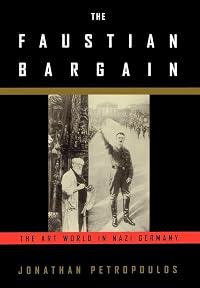
The Faustian Bargain: The Art World in Nazi Germany
by Jonathan Petropoulos
On This Page
Description
Nazi art looting has been the subject of enormous international attention in recent years, and the topic of two history bestsellers, Hector Feliciano's The Lost Museum and Lynn Nicholas's The Rape of Europa. But such books leave us wondering: What made thoughtful, educated, artistic men and women decide to put their talents in the service of a brutal and inhuman regime? This question is the starting point for The Faustian Bargain, Jonathan Petropoulos's study of the key figures in the art show more world of Nazi Germany. Petropoulos follows the careers of these prominent individuals who like Faust, that German archetype, chose to pursue artistic ends through collaboration with diabolical forces. Readers meet Ernst Buchner, the distinguished museum director and expert on Old Master paintings who "repatriated" the Van Eyck brothers' Ghent altarpiece to Germany, and Karl Haberstock, an art dealer who filled German museums with works bought virtually at gunpoint from Jewish collectors. Robert Scholz, the leading art critic in the Third Reich, who became an officer in the chief art looting unit in France and Kajetan Muhlmann-and a leading art historian-was probably the single most prolific art plunderer in the war (and arguably in history). Finally, there is Arno Breker, a gifted artist who exchanged his modernist style for monumental realism and became Hitler's favorite sculptor. If it is striking that these educated men became part of the Nazi machine, it is more remarkable that most of them rehabilitated their careers and lived comfortably after the war. Petropoulos has discovered a network of these rehabilitated experts that flourished in the postwar period, and he argues that this is a key to the tens of thousands of looted artworks that are still "missing" today. Based on previously unreleased information and recently declassified documents, The Faustian Bargain is a gripping read about the art world during this period, and a fascinating examination of the intense relationship between culture and politics in the Third Reich. show lessTags
Recommendations






























Member Reviews
This is dated. Very much so. New revelations and the deaths of the people that got away with stealing, plundering and so much more has moved this tale of deceit, theft and politics beyond this very basic and sometimes grating essay on how in Nazi Germany the art world people collaborated, participated and ran the art trade for over a decade, got away with it and went back to it after the war.
I didn't learn much. Petropoulos' writing seems at times to take the words of the people he interviewed as truth and gospel. Which is disturbing because since then huge caches of stolen artworks by the same people were found in Swiss banks (in Lohse's case) or in old Munich apartment.
The people that stole from, the people that were despoiled have show more all but disappear now and there are thousand of works that will never be given back.
You can give this essay a pass it's unfortunately not up to date anymore. show less
I didn't learn much. Petropoulos' writing seems at times to take the words of the people he interviewed as truth and gospel. Which is disturbing because since then huge caches of stolen artworks by the same people were found in Swiss banks (in Lohse's case) or in old Munich apartment.
The people that stole from, the people that were despoiled have show more all but disappear now and there are thousand of works that will never be given back.
You can give this essay a pass it's unfortunately not up to date anymore. show less
Ratings
Members
- Recently Added By
Author Information
12 Works 351 Members
Jonathan Petropoulos is the John V. Croul Professor of European History at Claremont McKenna College, Southern California.
Classifications
Statistics
- Members
- 113
- Popularity
- 289,416
- Reviews
- 1
- Rating
- (3.00)
- Languages
- English
- Media
- Paper, Ebook
- ISBNs
- 7