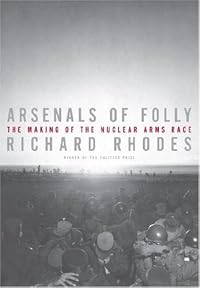
Arsenals of Folly: The Making of the Nuclear Arms Race
by Richard Rhodes
The Making of the Nuclear Age (3)
On This Page
Description
The story of the postwar superpower arms race, climaxing during the Reagan-Gorbachev decade. Drawing on a wealth of new documentation, Rhodes reveals how the Reagan administration's unprecedented arms buildup in the early 1980s led Soviet leader Andropov to conclude that Reagan must be preparing for a nuclear war. In 1983, when NATO staged a large series of field exercises, the Soviets came very close to launching a defensive first strike. Then Reagan launched the arms-reduction campaign of show more his second presidential term and set the stage for his 1986 summit with Gorbachev in Reykjavik. Rhodes also reveals the early influence of neoconservatives, demonstrating how the manipulation of government and public opinion with fake intelligence and threat inflation, which the administration of George W. Bush has used to justify current policies, were developed and applied in the Reagan era and even before.--From publisher description. show lessTags
Recommendations
















Member Reviews
Beginning with a gripping blow-by-blow account of the Chernobyl accident, Rhodes explores the nuclear arms race from 1986 through the dissolution of the Soviet Union in 1991 in this important and thought-provoking book. He demonstrates that throughout the entire Cold War period, the U.S. had superior numbers of strategic nuclear bombs and warheads. The U.S. political debates that conjured the threat and fear of Soviet first-strike capabilities were “as divorced from reality as the debates of medieval scholars about the characteristics of seraphim and cherubim.”
What accounts from this divergence of fact and policy? One astute observation by Rhodes is that military leaders made “what philosophy calls a category mistake, an show more assumption that nuclear explosives are military weapons in any meaningful sense of the term, and that [therefore] a sufficient quantity of such weapons can make us secure.”
Political concerns also have played a large role in nuclear arms accumulation. Rhodes points out that the Reagan administration sponsored “the largest peacetime buildup in American history.” Rhodes suggests that some of the motivation was “to starve the beast of government domestic spending, part of the conservative Republican agenda.” In addition, advisors to Reagan, Ford, and Bush such as Richard Perle, Don Rumsfeld, Dick Cheney, and Paul Wolfowitz blatantly twisted intelligence to conform to a bias that was anti-Soviet and pro-military-industrial complex. Particularly in the case of Reagan, advisors had more freedom for manipulation given a president who could not speak coherently without cue cards.
One riveting section of the book describes a very close call to nuclear war between the U.S. and the Soviet Union that took place in November 1983. “That,” Rhodes charges, “was the return on the neoconservatives’ long, cynical, and radically partisan investment in threat inflation and arms-race escalation.”
A continuing thread in the book is the intelligence, courage, and perseverance of Mikhail Gorbachev. Not only did he have to overcome the ossification of the Soviet system to effect perestroika, but the resistance of U.S. hardliners as well.
How appropriate that Rhodes ends his book with a quote from Robert Oppenheimer, whose opposition to a nuclear arms build-up helped to vitiate his career. Oppenheimer observed presciently in 1953, “We may anticipate a state of affairs in which two Great Powers will each be in a position to put an end to the civilization and life of the other, though not without risking its own. We may be likened to two scorpions in a bottle, each capable of killing the other, but only at the risk of his own life.” As Rhodes charges, the U.S. chose “to distend ourselves into the largest scorpion in the bottle.”
The risks of nuclear war, accidental or intentional, remain high. In fact, an article in Slate Magazine (“A Real Nuclear Option for the Nominees,” by Ron Rosenbaum, posted May 9, 2008) describes more recent “near misses” between U.S. and Russian nuclear-capable bombers. Surely Sarah Palin was looking out her kitchen window on November 22, 2007 when two U.S. F-22s scrambled from Elmendorf AFB in Alaska to intercept two Russian bombers as they approached Alaskan air space. Read this book, and pray the Obama administration turns the tide!
(JAF) show less
What accounts from this divergence of fact and policy? One astute observation by Rhodes is that military leaders made “what philosophy calls a category mistake, an show more assumption that nuclear explosives are military weapons in any meaningful sense of the term, and that [therefore] a sufficient quantity of such weapons can make us secure.”
Political concerns also have played a large role in nuclear arms accumulation. Rhodes points out that the Reagan administration sponsored “the largest peacetime buildup in American history.” Rhodes suggests that some of the motivation was “to starve the beast of government domestic spending, part of the conservative Republican agenda.” In addition, advisors to Reagan, Ford, and Bush such as Richard Perle, Don Rumsfeld, Dick Cheney, and Paul Wolfowitz blatantly twisted intelligence to conform to a bias that was anti-Soviet and pro-military-industrial complex. Particularly in the case of Reagan, advisors had more freedom for manipulation given a president who could not speak coherently without cue cards.
One riveting section of the book describes a very close call to nuclear war between the U.S. and the Soviet Union that took place in November 1983. “That,” Rhodes charges, “was the return on the neoconservatives’ long, cynical, and radically partisan investment in threat inflation and arms-race escalation.”
A continuing thread in the book is the intelligence, courage, and perseverance of Mikhail Gorbachev. Not only did he have to overcome the ossification of the Soviet system to effect perestroika, but the resistance of U.S. hardliners as well.
How appropriate that Rhodes ends his book with a quote from Robert Oppenheimer, whose opposition to a nuclear arms build-up helped to vitiate his career. Oppenheimer observed presciently in 1953, “We may anticipate a state of affairs in which two Great Powers will each be in a position to put an end to the civilization and life of the other, though not without risking its own. We may be likened to two scorpions in a bottle, each capable of killing the other, but only at the risk of his own life.” As Rhodes charges, the U.S. chose “to distend ourselves into the largest scorpion in the bottle.”
The risks of nuclear war, accidental or intentional, remain high. In fact, an article in Slate Magazine (“A Real Nuclear Option for the Nominees,” by Ron Rosenbaum, posted May 9, 2008) describes more recent “near misses” between U.S. and Russian nuclear-capable bombers. Surely Sarah Palin was looking out her kitchen window on November 22, 2007 when two U.S. F-22s scrambled from Elmendorf AFB in Alaska to intercept two Russian bombers as they approached Alaskan air space. Read this book, and pray the Obama administration turns the tide!
(JAF) show less
There's been a lot of books out about the history of the Cold War and the nuclear arms race written from many points of view. Many are written out of a particular agenda or with an eye to protecting (or improving) the reputations of actual participants. Arsenals of Folly is a pretty even-handed history from the early days of the Cold War to the breakup of the Soviet Union. Richard Rhodes has gone back to the original records and interviews with participants to set out the history from both sides of the conflict using an approach that lets us readers get into the heads of both US and Soviet leaders.
Rhodes begins with a detailed description of the Chernobyl incident, which first shows just how devastating even a small nuclear exchange show more could be and then is used to highlight Gorbachev's (and others') motivations for nuclear disarmament. This approach really works well, and captures the reader right away. From this discussion, he moves to the early days after World War II and specifically Mikhail Gorbachev's biography to show where Gorbachev's desire for change came from. The last third or so of the book details nuclear arms limitations talks in the late Reagan years, followed by the dissolution of the Soviet Union in the G. H. W. Bush presidency.
Through all this discussion, it becomes pretty clear that there were parties on both sides of the conflict that, for various reasons, didn't want arms reduction and were willing to do some pretty immoral things to keep it from happening. Gorbachev really shines in Rhodes' work as the one with the real vision to change the world, and in many ways, the US did itself and the world a disservice by not trusting him when the time came. The one weakness in Rhodes' research is that he doesn't give enough consideration to the uncertainty of our knowledge of the situation. It's pretty easy to see, now that the whole story's out on the table, what the right path was. It's a whole different problem trying to figure that out in the middle of events. This bias shows in Rhodes' choice not to include non-nuclear areas of conflict in the discussion. Decision-makers at the time on both sides had to consider all events, not just a limited set related to nuclear arms, when developing policy. In spite my concern, Arsenals of Folly is well worth reading, and we can learn an awful lot from Rhodes work. show less
Rhodes begins with a detailed description of the Chernobyl incident, which first shows just how devastating even a small nuclear exchange show more could be and then is used to highlight Gorbachev's (and others') motivations for nuclear disarmament. This approach really works well, and captures the reader right away. From this discussion, he moves to the early days after World War II and specifically Mikhail Gorbachev's biography to show where Gorbachev's desire for change came from. The last third or so of the book details nuclear arms limitations talks in the late Reagan years, followed by the dissolution of the Soviet Union in the G. H. W. Bush presidency.
Through all this discussion, it becomes pretty clear that there were parties on both sides of the conflict that, for various reasons, didn't want arms reduction and were willing to do some pretty immoral things to keep it from happening. Gorbachev really shines in Rhodes' work as the one with the real vision to change the world, and in many ways, the US did itself and the world a disservice by not trusting him when the time came. The one weakness in Rhodes' research is that he doesn't give enough consideration to the uncertainty of our knowledge of the situation. It's pretty easy to see, now that the whole story's out on the table, what the right path was. It's a whole different problem trying to figure that out in the middle of events. This bias shows in Rhodes' choice not to include non-nuclear areas of conflict in the discussion. Decision-makers at the time on both sides had to consider all events, not just a limited set related to nuclear arms, when developing policy. In spite my concern, Arsenals of Folly is well worth reading, and we can learn an awful lot from Rhodes work. show less
From reading Rhodes’ first two books, The Making of the Atomic Bomb and Dark Sun: The Making of the Hydrogen Bomb, I was expecting an in-depth and objective history of the arms race, but while this book contains some interesting information, it feels light and suffused with stale political opinion. The text has the tone of liberal newspaper editorial pages of the 80’s mocking Reagan, Stars Wars, or U.S. militarism. There is little sense of striving for a deeper perspective.
While no one can discount Gorbachev’s courageous role in toning down the arms race, an obvious bias mars this book: the Soviets are constantly portrayed as honestly “just trying to catch up” after the Cuban Missile Crisis, and scheming Americans seem show more determined to bring the world to the brink of nuclear war. Many of Reagan’s advisors are painted as out and out villains, evil neocons with “penchants” (the author’s term) for various irrational policies. One, Paul Nitze, is pathetically portrayed as reacting to some insidious childhood neurosis. (And I wouldn’t know if that was true or not, but it does seem like cheap psychological speculation simply designed to belittle the person yet another time.). A tone of sarcastic mockery seems applied to Americans, but not Soviets, throughout the book. The overly-long biography of Gorbachev is an unneeded sidetrack but one apparently intended to build him up as the hero of the story. The concept that the United States essentially managed to waste more money on armaments than the Soviets, and thus helped drive the Soviet Union into the ground, is dismissed as a “triumphalist” fantasy; yet obviously it must had had some effect on the Soviet economy and the resulting breakup of the Soviet Union, and should have been given some consideration as one more factor in the mix.
It seems pretty obvious that both sides were out of their skulls with paranoia and that bad information and fearing the worst led both sides to keep scrambling for as many weapons and advantages as they could get, no matter how irrational the whole thing was. It truly is a miracle we did not escalate into nuclear war anytime from the 50’s on. The story is one of human beings under extreme stress trying to consider how to survive, and I don’t think we need “heroes and villains” as a storyline to explain what happened. In some twisted way everyone was “doing their best.”
Creating a story of heroes and villains also seems to require that the book end with a tidy resolution, as if Gorbachev somehow singlehandedly took care of the entire nuclear weapons problem. But the lack of trust and paranoia, though muted, do go on, along with the possibility of nuclear arms being acquired by other and even more irrational countries or terrorist organizations, and I think a more objective look at the entire process could help us understand the next challenges ahead in our still-nuclear world. I don’t see the point of anyone trying to either build the Reagan administration up or tear it down now, seemingly just to rehash and defend opinions formed in the 80’s. What happened, happened, and I would have preferred to read a true history without a political axe to grind. And I would have expected much deeper research and more appreciation of the insane complexity of the problem than I believe is manifested in this book. show less
While no one can discount Gorbachev’s courageous role in toning down the arms race, an obvious bias mars this book: the Soviets are constantly portrayed as honestly “just trying to catch up” after the Cuban Missile Crisis, and scheming Americans seem show more determined to bring the world to the brink of nuclear war. Many of Reagan’s advisors are painted as out and out villains, evil neocons with “penchants” (the author’s term) for various irrational policies. One, Paul Nitze, is pathetically portrayed as reacting to some insidious childhood neurosis. (And I wouldn’t know if that was true or not, but it does seem like cheap psychological speculation simply designed to belittle the person yet another time.). A tone of sarcastic mockery seems applied to Americans, but not Soviets, throughout the book. The overly-long biography of Gorbachev is an unneeded sidetrack but one apparently intended to build him up as the hero of the story. The concept that the United States essentially managed to waste more money on armaments than the Soviets, and thus helped drive the Soviet Union into the ground, is dismissed as a “triumphalist” fantasy; yet obviously it must had had some effect on the Soviet economy and the resulting breakup of the Soviet Union, and should have been given some consideration as one more factor in the mix.
It seems pretty obvious that both sides were out of their skulls with paranoia and that bad information and fearing the worst led both sides to keep scrambling for as many weapons and advantages as they could get, no matter how irrational the whole thing was. It truly is a miracle we did not escalate into nuclear war anytime from the 50’s on. The story is one of human beings under extreme stress trying to consider how to survive, and I don’t think we need “heroes and villains” as a storyline to explain what happened. In some twisted way everyone was “doing their best.”
Creating a story of heroes and villains also seems to require that the book end with a tidy resolution, as if Gorbachev somehow singlehandedly took care of the entire nuclear weapons problem. But the lack of trust and paranoia, though muted, do go on, along with the possibility of nuclear arms being acquired by other and even more irrational countries or terrorist organizations, and I think a more objective look at the entire process could help us understand the next challenges ahead in our still-nuclear world. I don’t see the point of anyone trying to either build the Reagan administration up or tear it down now, seemingly just to rehash and defend opinions formed in the 80’s. What happened, happened, and I would have preferred to read a true history without a political axe to grind. And I would have expected much deeper research and more appreciation of the insane complexity of the problem than I believe is manifested in this book. show less
This is one of the best histories I have read in a very long time. Rhodes uses nuclear weapons policy as the lens through which he views the Cold War. His discussion of Gorbachev is quite interesting and well done, but his detailed account of how Gorbachev and Reagan negotiated the INF and START reductions is simply amazing in its detail and clarity. This is a must read book, especially for those too young to remember what it was like to live with the threat of nuclear annihilation.
A fascinating history of the nuclear arms race and the cold war. One gets a sense for the extremely tense and paranoid atmosphere that the atomic bomb created. It's a history of held breath, everyone tensed, waiting, and terrified. Truly chilling to think that one wrong move might have ended life as we know it.
Arsenals of Folly presents the story of the U.S. – Soviet nuclear arms race, and how and why it took so long to reach disarmament agreements. The book starts with a description of the horrors of the Chernobyl nuclear power plant accident in the mid-80’s ( a soviet style plant with a graphite moderated core and no robust containment building like the U.S. plants have), and how that accident convinced soviet leadership of the dangers of nuclear weapons. It is Rhodes' contention that some familiar names from the current Bush administration, like Richare Perle and Paul Wolfowitz, with their anti-soviet beliefs and fearful advice during their stints of the Reagan administration, may have contributed to lengthening the arms race - show more contrary to the desires of the soviet leadership, especially Mikhail Gorbachev. Somewhat slow in parts, but still probably of interest to modern world history buffs. show less
This was an incredible work! What really struck me was how much more culpable the US is in the area of creating obstacles to peace. Another factor that surprised me was how Perle, Wolfowitz, and Cheney have always worked for world domination and not just their more visible role.
Members
- Recently Added By
Author Information

28+ Works 10,127 Members
Richard Rhodes, the award-winning author of twenty-two books, lives and works mi the California coast above Half Moon Bay.
Awards and Honors
Series

Common Knowledge
- Original publication date
- 2007-10
- Important events
- Cold War
- Epigraph
- Reality is that which, when you don't believe in it, doesn't go away. -- Peter Viereck
- Dedication
- For Chuck Hansen, 1947-2003
- First words
- On the Saturday morning in April 1986 when the alarms went off at the Institute for Nuclear Power Engineering of the Byelorussioan Academy of Sciences, in a forest outside Minsk, the nuclear physicist Stanislav Shushkevich th... (show all)ought the institute's reactor was bleeding radiation.
- Last words
- (Click to show. Warning: May contain spoilers.)The discovery of how to release nuclear energy was a fact, not a choice, a new understanding of the natural world. It revealed that there was no limit to the amount of energy that might be packaged into small, portable, and relatively inexpensive weapons; that there could be no defense against such weapons, each of which could destroy a city; that therefore a policy of common security in the short run and a program of abolition in the long run would be necessary to accommodate the new reality and avoid disaster. Recoiling from such urgencies, which would require negotiation, compromise, and a measure of humility, we chose instead to distend ourselves into the largest scorpion in the bottle. Obstinately misreading the failure of our authoritarian counterpart on the other side of the world, to our shame and misfortune, we continue to claim an old and derelict sovereignty that the weapons themselves deny.
Classifications
- Genres
- History, Nonfiction, General Nonfiction, Science & Nature
- DDC/MDS
- 355.021709045 — Society, Government, and Culture Public administration & military science The Military - Land, Air & Sea / Warfare War Topics Nuclear War
- LCC
- U264 .R48 — Military Science Military science (General) Atomic warfare. Atomic weapons
- BISAC
Statistics
- Members
- 386
- Popularity
- 80,399
- Reviews
- 11
- Rating
- (3.79)
- Languages
- English
- Media
- Paper, Audiobook, Ebook
- ISBNs
- 7
- ASINs
- 5