The Man on the Ceiling
by Steve Rasnic Tem, Melanie Tem
On This Page
Description
Two interwoven memoirs of love, loss, and family with a haunted, frightening edge. In 2000, American Fantasy Press published an unassuming chapbook titled The Man on the Ceiling, Inside was a dark, surreal, discomfiting story of the horrors that can befall a family. It was so powerful that it won the Bram Stoker Award, International Horror Guild Award, and World Fantasy Award--the only work ever to win all three. Now, Melanie Tem and Steve Rasnic Tem have re-imagined the story, expanding on show more the ideas to create a compelling work that examines how people find a family, how they hold a family together despite incomprehensible tragedy, and how, in the end, they find love. Loosely autobiographical, The Man on the Ceiling has the feel of a family portrait painted by Salvador Dali, where story and reality blend to find the one thing that neither can offer alone: truth. show lessTags
Recommendations












Member Reviews
The Man on the Ceiling, written by the married team of Melanie Tem and Steve Rasnic Tem, is an extension of the award-winning novella by the same name. As of 2008, the novella was the only work to win all three major dark fantasy and horror awards: the World Fantasy Award, the Bram Stoker Award, and the International Horror Guild Award. I haven't read the original The Man on the Ceiling, but if it is anything near the caliber of the book, it well deserves the accolades.
The Man on the Ceiling is a difficult book for me to describe, so instead I'll quote the text itself as it will do a better job than I could ever manage:
"This memoir--or testament, if you will--is as much a biography of one family's imagination as chronicle of real life show more events. It is about both our love and our fear, about what we know and what we cannot know but can imagine. And although what happens in the imagination may be real in a different way than the apparent history of waking events, it is real just the same."
Even before the book begins, the authors affirm that "Everything we're about to tell you here is true," a sentiment that is continually repeated throughout the text--a gentle but terrifying reminder that just because something is categorized as fiction doesn't mean that it false. The Man on the Ceiling is brutally honest, and demands the head-on confrontation and acceptance of our fears. The book is indeed True.
The Tem's are both award-winning authors of horror and dark fantasy in their own right and are incredibly imaginative. Their roles as storytellers permeate the book and their lives. The basis for much of The Man on the Ceiling draws on the Tem's experiences as the adoptive parents of troubled children. A particular touchstone is the tragic death of one of their children when he was only nine years old. The intense emotions of love, joy, grief, and despair are intertwined to create a marvelous and profoundly genuine work.
One of the reasons I find the book so hard to describe is because it is so utterly surreal; I have never read anything like it before. It is visceral, gut-wrenching, and horrifying. But at the same time, while it is disquieting, I found it oddly comforting. There's no real plot to speak of--it's more like a drifting exploration of feelings, life, and death. The stories told and the moments depicted are intricately related and it is surprising how cohesive the book is despite its dark kaleidoscopic nature. It's difficult to tell what is real and what is not, but in the end it doesn't really matter because it's all true.
I came across The Man on the Ceiling mostly by accident and decided to pick up the book more on a whim than anything else. I am so glad that I did. First, I checked it out from my local library (there was a waiting list), but it wasn't long until I knew I needed my own copy of the book. While it is often described as horror, that characterization only begins to touch on the depth and complexity of the work. The Man on the Ceiling, and especially its style, is not something that everyone will appreciate. However, it is absolutely one of the best books I've read. The Man on the Ceiling is an extraordinarily evocative book, and I know it is one I'll come back to again.
Experiments in Reading show less
The Man on the Ceiling is a difficult book for me to describe, so instead I'll quote the text itself as it will do a better job than I could ever manage:
"This memoir--or testament, if you will--is as much a biography of one family's imagination as chronicle of real life show more events. It is about both our love and our fear, about what we know and what we cannot know but can imagine. And although what happens in the imagination may be real in a different way than the apparent history of waking events, it is real just the same."
Even before the book begins, the authors affirm that "Everything we're about to tell you here is true," a sentiment that is continually repeated throughout the text--a gentle but terrifying reminder that just because something is categorized as fiction doesn't mean that it false. The Man on the Ceiling is brutally honest, and demands the head-on confrontation and acceptance of our fears. The book is indeed True.
The Tem's are both award-winning authors of horror and dark fantasy in their own right and are incredibly imaginative. Their roles as storytellers permeate the book and their lives. The basis for much of The Man on the Ceiling draws on the Tem's experiences as the adoptive parents of troubled children. A particular touchstone is the tragic death of one of their children when he was only nine years old. The intense emotions of love, joy, grief, and despair are intertwined to create a marvelous and profoundly genuine work.
One of the reasons I find the book so hard to describe is because it is so utterly surreal; I have never read anything like it before. It is visceral, gut-wrenching, and horrifying. But at the same time, while it is disquieting, I found it oddly comforting. There's no real plot to speak of--it's more like a drifting exploration of feelings, life, and death. The stories told and the moments depicted are intricately related and it is surprising how cohesive the book is despite its dark kaleidoscopic nature. It's difficult to tell what is real and what is not, but in the end it doesn't really matter because it's all true.
I came across The Man on the Ceiling mostly by accident and decided to pick up the book more on a whim than anything else. I am so glad that I did. First, I checked it out from my local library (there was a waiting list), but it wasn't long until I knew I needed my own copy of the book. While it is often described as horror, that characterization only begins to touch on the depth and complexity of the work. The Man on the Ceiling, and especially its style, is not something that everyone will appreciate. However, it is absolutely one of the best books I've read. The Man on the Ceiling is an extraordinarily evocative book, and I know it is one I'll come back to again.
Experiments in Reading show less
I have to be honest here: I'm biased. Not in the obvious way though. Steve Rasnic Tem and Melanie Tem were the writers-in-residence during the dreaded Week 5 of Odyssey 2005. Well, them and Melanie's guide dog, Dominic, who I think kept us all sane. The Tems were a sharp couple, and they thoroughly interacted and engaged with every single one of us students, and they always gave each us of their full attention. I have to admit, I didn't always agree with their crits (of my own work, of course. ;)) but they were open, honest, and willing to TALK about the work and get to know us better, and that left a far more lasting impression in my mind than anything else.
The only writing of theirs I've read were two short stories (one from each show more writer) right before they showed up at Odyssey. I didn't pay much attention then, because I didn't know them and the stories didn't grab me at the time, and I've never sought out their work. Until now.
I saw this book through LibraryThing's Early Reviewer Program, and I didn't hesitate to sign up for an ARC. Why not? This was a book they'd written TOGETHER, and it had a gorgeous cover. I couldn't pass it up.
And it turns out, I didn't have to. I won my copy of the ARC, and decided to hell with whatever I thought of the book, I was getting the REAL copy anyway, so I passed my ARC on to and snuggled up with the REAL, pretty-cover copy.
This is one of those reviews that doesn't need a cut. Hell, it doesn't even need a blurb about the premise, because the book is beautiful, surreal, and haunting in such a subtle way you're not even sure it's happening until it suddenly grips you. The Man on the Ceiling is in many ways, creative non-fiction, but it's practically an interstitial work, a book that blurs the lines between fact, fiction, memory, and imagination, but grounds it all in truth. I rarely had trouble discerning when Melanie wrote versus Steve, and the times I did, it didn't matter. Their writing flows together, entwines in such a way that having a book with two different first person POVs feels like it's come from one body, one mind, one soul. But it isn't.
I'm not entirely sure how my reaction to this book is based on the fact I got to spend a week with this amazing couple. I suspect quite a bit, to be honest, but yet, you can't argue the beauty of the whole book put together. I was reminded of Valente's work. I was reminded of Winterson's. And that's high praise. There's such a simple, deceptive beauty to this prose that you don't even realize that at the book's heart, it's horror, but horror in the most realistic ways imaginable. Key word: imagine.
My Rating
Must Have: close to "the keeper shelf," but suspect it might take a second reading to bump it up a notch. Like I said, it's very possible I'm simply biased, but I thoroughly enjoyed this read, this autobiography of the Tem's imagination, of their lives, of their children. It's a surreal piece, and one not easily forgotten. show less
The only writing of theirs I've read were two short stories (one from each show more writer) right before they showed up at Odyssey. I didn't pay much attention then, because I didn't know them and the stories didn't grab me at the time, and I've never sought out their work. Until now.
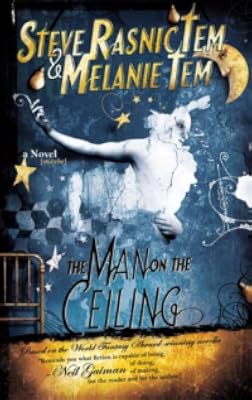
I saw this book through LibraryThing's Early Reviewer Program, and I didn't hesitate to sign up for an ARC. Why not? This was a book they'd written TOGETHER, and it had a gorgeous cover. I couldn't pass it up.
And it turns out, I didn't have to. I won my copy of the ARC, and decided to hell with whatever I thought of the book, I was getting the REAL copy anyway, so I passed my ARC on to and snuggled up with the REAL, pretty-cover copy.
This is one of those reviews that doesn't need a cut. Hell, it doesn't even need a blurb about the premise, because the book is beautiful, surreal, and haunting in such a subtle way you're not even sure it's happening until it suddenly grips you. The Man on the Ceiling is in many ways, creative non-fiction, but it's practically an interstitial work, a book that blurs the lines between fact, fiction, memory, and imagination, but grounds it all in truth. I rarely had trouble discerning when Melanie wrote versus Steve, and the times I did, it didn't matter. Their writing flows together, entwines in such a way that having a book with two different first person POVs feels like it's come from one body, one mind, one soul. But it isn't.
I'm not entirely sure how my reaction to this book is based on the fact I got to spend a week with this amazing couple. I suspect quite a bit, to be honest, but yet, you can't argue the beauty of the whole book put together. I was reminded of Valente's work. I was reminded of Winterson's. And that's high praise. There's such a simple, deceptive beauty to this prose that you don't even realize that at the book's heart, it's horror, but horror in the most realistic ways imaginable. Key word: imagine.
My Rating
Must Have: close to "the keeper shelf," but suspect it might take a second reading to bump it up a notch. Like I said, it's very possible I'm simply biased, but I thoroughly enjoyed this read, this autobiography of the Tem's imagination, of their lives, of their children. It's a surreal piece, and one not easily forgotten. show less
 This review was written for LibraryThing Early Reviewers.
Surreal to the point of near trippiness and yet very realistic, this fictionalized account of real events ("everything we're telling you here is true") grips the reader at a gut level. Any person who can even imagine having children will find this horrifying novel difficult to set aside. “The Man on the Ceiling” is the story of parents who having lost a child (exact reasons unknown) struggle to deal with the aftermath of emotions and delusions that flow from the sudden and horrible loss of a loved one. While, to some, the effects they use may seem overdone and overwrought, for anyone who has suffered a loss like this it will all seem oh so real. The pain from this sort of death can cause those left behind to not exactly lose touch show more with reality, but rather to find the “real” less tangible than desolation of their own emotional landscape… one becomes lost in an internal war zone of obvious and hidden dangers. For most people this “other” world can take a long time to (mostly) escape from, others may never even make the beginning steps to heal this tragedy. “The Man on the Ceiling” is labeled as a horror novel and it is in the sense that it attempts to capture one of life’s most horrifying events, the loss on a person one loves deeply. show less
This review was written for LibraryThing Early Reviewers.A very unusual sort of book, this "fictional memoir" tells the story of Steve and Melanie, two writers who have adopted a number of children, one of whom died tragically. The stream of consciousness narrative drifts between the two writers, who muse upon death, the art of storytelling, and family relationships.
More than once the authors tell the reader that "everything we're telling you is true," which makes this book strangely compelling and unsettling. Although this is labeled as "horror fiction," the horror is rooted in real life and the pain of losing someone you love. The "man on the ceiling" of the title seems to be a sort of grim reaper, always present if not always seen. The writing is elegant and lyrical, creating a dream-like show more fluidity that feels natural and effortless. Readers expecting a traditionally structured novel will be frustrated, but if you're willing to go with it this is a wise, rewarding book. show less
More than once the authors tell the reader that "everything we're telling you is true," which makes this book strangely compelling and unsettling. Although this is labeled as "horror fiction," the horror is rooted in real life and the pain of losing someone you love. The "man on the ceiling" of the title seems to be a sort of grim reaper, always present if not always seen. The writing is elegant and lyrical, creating a dream-like show more fluidity that feels natural and effortless. Readers expecting a traditionally structured novel will be frustrated, but if you're willing to go with it this is a wise, rewarding book. show less
This review was written for LibraryThing Early Reviewers.One of the constant refrains in "The Man on the Ceiling" is that everything the authors are telling us is true. They repeat it again and again, almost talismanically. True, in this case, clearly does not mean "real" -- as the book describes, among other imaginary stories and events, a man who lives in the ceiling of Steve and Melanie Tem's house. True, in this case, means something more like "right" or "honest". Ironically, I think a "true" autobiography of these two people would have made for a more powerful and enthralling book. The authors are a couple that has adopted several troubled kids, including one who dies tragically at a very young age. There is no real plot or story here -- the book is more a series of stories, show more observations, vignettes, memories and fables -- and important details are glossed over or shrouded in imagination and fantasy, making the line between true-as-in-real versus true-as-in-right frustratingly blurry. There are certainly moments of beautiful language, and fabulous elements of joy and tragedy, but not enough to really carry this slightly indulgent book. show less
This review was written for LibraryThing Early Reviewers.This is an odd little book: a biographical, explorative discussion of the imagination, of the story we build in our lives to explain various anxieties. The un-marked balance between fact and fiction occasionally distracted me, despite the book's assertion that everything is "truth". The self-involved nature of the book (the authors writing about their imaginations) sometimes distracted me too. But, most of the time, I found it a compelling form of narrative, fascinatingly interstitial. It is definitely worth reading for those who want to explore the many shapes a novel can take, the many aspects it can tug into itself. Genre lines are refreshingly absent.
A strange sort of memoir, at times genuinely frightening, at others quite touching, but at all times just a little too slight. I never read the original (well praised) novella, so I can't really judge, but I'm not sure there was cause to expand it here. There's a great deal to really like, but it doesn't hang together in any form I could really love.
This review was written for LibraryThing Early Reviewers.Members
- Recently Added By
Lists

Shirley Jackson Award Winners and Shortlist 2007-2020
77 works; 6 members
Author Information

148+ Works 1,014 Members

40+ Works 600 Members
Awards and Honors
Awards
Common Knowledge
- Canonical title
- The Man on the Ceiling
- Original publication date
- 2008
- People/Characters
- Steve Tem; Melanie Tem
- Epigraph
- Everything we're about to tell you here is true.
- Dedication
- For our children, who gave us their blessing.
- First words
- Awake. Someone in the room. Asleep. Dreaming.
- Quotations
- This memoir--or testament, if you will--is as much a biography of one family's imagination as chronicle of real life events. It is about both our love and our fear, about what we know and what we cannot know but can imagine.... (show all) And although what happens in the imagination may be real in a different way than the apparent history of waking events, it is real just the same.
If you love someone, they leave you. But if you don't love someone, they leave you, too. So your choice isn't between loving and losing but only between loving and not loving. - Last words
- (Click to show. Warning: May contain spoilers.)Everything we tell them will be true.
- Blurbers
- Gaiman, Neil; Ellison, Harlan
- Disambiguation notice
- Looking for the award-winning novella of the same title? See here. Please do not combine the novel and the novella.
Classifications
Statistics
- Members
- 119
- Popularity
- 274,089
- Reviews
- 13
- Rating
- (3.68)
- Languages
- English
- Media
- Paper
- ISBNs
- 2
- ASINs
- 1