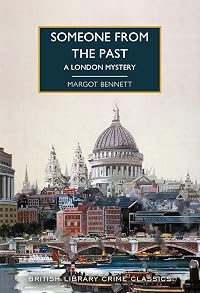
Someone from the Past
by Margot Bennett
On This Page
Description
"An acerbic, tightly structured whodunit that remains a brilliant example of how to do more with less."—Kirkus ReviewsSarah has been receiving threatening anonymous letters seemingly from a former lover. Just one day after revealing this information to her co- worker Nancy, Sarah is shot and found in her bedroom by one of her past flames, Donald. Desperate to clear any evidence of Donald's presence at the scene for her own infatuations, Nancy finds herself as the key suspect when she is show more discovered in the apartment.
As the real killer uses the situation to their advantage, Margot Bennett crafts a tense and nuanced story through flashbacks to Sarah's life and loves in this Gold- Dagger-award-winning story of deceit and murder.
. Historical Fiction. Fiction. Mystery. show less
Tags
Recommendations
































Member Reviews
I'm going to spoil the ending of this one to some degree. I'll try to say some general things first, so you can tell whether you care about the spoiling.
This is another novel reissued as a British Library Crime Classic—just this past year, 2023. Margot Bennett was the first woman to win the Gold Dagger (though there was at least one woman on the shortlist every previous year). She never wrote another crime novel after this one, mostly turning instead to writing for television. Did she quit on a high?
In some ways, yes. The book is a fairly successful marriage of the classic form of the whodunnit with some then-contemporary psychological content. As in the previous winner, the psychologies of the main characters are foregrounded and show more examined as putative explanations for their actions—murder is more than base motive. But, unlike with the previous winner, there is a genuine, well-executed mystery at the core of the novel: which among four suspects, all complete shits of varying consistency, murdered the protagonist's friend?
The protagonist is a youngish woman, Nancy, who is a writer for magazines. Her dead friend is Sarah. The four suspects are all terrible, terrible men with whom Nancy, Sarah, or both have romantic pasts or presents. I say "romantic". This feels like a euphemism here, since none of the relationships described are obviously loving, in the sense we should hope to use that word.
The book works, insofar as it does, because the four male suspects are all convincingly bad. One of them is actively trying to frame Nancy for Sarah's death, and going some way to succeeding. She doesn't know which of them it is, and the police are on to her (not without reason—she doesn't always help herself). Meanwhile, all four terrible men take turns at being personally horrible to Nancy, each in their own entirely believable way. So we believe that any of them could be capable of the crime, and we don't know which it is until the last few pages. This engaging, well-wrought plot is written up tightly enough to create tension, with adept use of flashback to fill in the characters. It's all helped along by snappy, funny dialogue; the introduction by Martin Edwards speculates that Bennett identified with Nancy, and she certainly gets all the very best lines.
There are two reasons why I'm not entirely sold on this book. The first is that it is so appallingly, irredeemably squalid. Perhaps this is exactly as it was for young women writers in the 1950s, but oh dear, the grime and the stink and the horrible, horrible men make you itch as you read. And this brings me to the second reason, and the spoiler. After the mystery is solved, after all is settled, after we know which of the shits is a murderer, after we and Nancy know they are all shits: after all that, she falls swooning into the arms of the worst of the shits, the one who has treated her most appallingly, whose only positive quality appears to be his innocence of murder.
Now, there is a question of how seriously this ending should be taken. It's possible that Bennett meant it as a sort of tragic coda—that she sees the obvious problems with the proposition, and sees Nancy as deserving of them, as no better than she ought to be. But I don't think this is so. I think this is meant to be a consummate, cheering resolution. To modern sensibilities, it is certainly not cheering, and really not believable—in fact, close to incomprehensible. It mars what is otherwise a very fine book, worth reading for its plot, its dialogue, and its itchy squalor. show less
This is another novel reissued as a British Library Crime Classic—just this past year, 2023. Margot Bennett was the first woman to win the Gold Dagger (though there was at least one woman on the shortlist every previous year). She never wrote another crime novel after this one, mostly turning instead to writing for television. Did she quit on a high?
In some ways, yes. The book is a fairly successful marriage of the classic form of the whodunnit with some then-contemporary psychological content. As in the previous winner, the psychologies of the main characters are foregrounded and show more examined as putative explanations for their actions—murder is more than base motive. But, unlike with the previous winner, there is a genuine, well-executed mystery at the core of the novel: which among four suspects, all complete shits of varying consistency, murdered the protagonist's friend?
The protagonist is a youngish woman, Nancy, who is a writer for magazines. Her dead friend is Sarah. The four suspects are all terrible, terrible men with whom Nancy, Sarah, or both have romantic pasts or presents. I say "romantic". This feels like a euphemism here, since none of the relationships described are obviously loving, in the sense we should hope to use that word.
The book works, insofar as it does, because the four male suspects are all convincingly bad. One of them is actively trying to frame Nancy for Sarah's death, and going some way to succeeding. She doesn't know which of them it is, and the police are on to her (not without reason—she doesn't always help herself). Meanwhile, all four terrible men take turns at being personally horrible to Nancy, each in their own entirely believable way. So we believe that any of them could be capable of the crime, and we don't know which it is until the last few pages. This engaging, well-wrought plot is written up tightly enough to create tension, with adept use of flashback to fill in the characters. It's all helped along by snappy, funny dialogue; the introduction by Martin Edwards speculates that Bennett identified with Nancy, and she certainly gets all the very best lines.
There are two reasons why I'm not entirely sold on this book. The first is that it is so appallingly, irredeemably squalid. Perhaps this is exactly as it was for young women writers in the 1950s, but oh dear, the grime and the stink and the horrible, horrible men make you itch as you read. And this brings me to the second reason, and the spoiler. After the mystery is solved, after all is settled, after we know which of the shits is a murderer, after we and Nancy know they are all shits: after all that, she falls swooning into the arms of the worst of the shits, the one who has treated her most appallingly, whose only positive quality appears to be his innocence of murder.
Now, there is a question of how seriously this ending should be taken. It's possible that Bennett meant it as a sort of tragic coda—that she sees the obvious problems with the proposition, and sees Nancy as deserving of them, as no better than she ought to be. But I don't think this is so. I think this is meant to be a consummate, cheering resolution. To modern sensibilities, it is certainly not cheering, and really not believable—in fact, close to incomprehensible. It mars what is otherwise a very fine book, worth reading for its plot, its dialogue, and its itchy squalor. show less
This is the third novel by Bennett that I have read, and is said to be the last crime novel written by her before turning her attention to writing for television and movies. This is surprising given this novel won the (British) Crime Writers Association's book of the year in 1958, with Bennett being elected to the (invitation only) Detection Club the following year.
I was not impressed by her The Man Who Didn't Fly thinking it was somewhat convoluted and I could warm to any of the characters. Her Widow of Bath was much more straight forward and interesting, but this book is by far the best of them.
Sarah and Nancy, both in their twenties, are long term friends, who share a number of close friends and acquaintances. Sarah reveals to Nancy show more that she has been receiving anonymous letters from someone who claims to be one of her past flames threatening her death. Knowing that there is a small group of likely suspects, Sarah asks Nancy to consider who might be responsible.
However before Nancy getting very far, Donald, Nancy's beau, in a drunken stupor, visits Sarah only to discover she has been shot dead. Believing in his innocence, Nancy visits Sarah's apartment to ensure that Donald has not mistakenly left any incriminating evidence against him.
But Nancy's visit is noticed and the police start to suspect her as the culprit. A series of events, largely caused by Nancy's own investigations, lead to further reasons to suspect Nancy.
The characters were interesting, but I do question why Donald does not come to Nancy's support, recognising of course that he might be suspected as lying simply to exonerate Nancy.
And I though the eventual solution came too readily and somewhat 'convenient'.
But a worthwhile read none the less.
Big Ship
24 July 2025 show less
I was not impressed by her The Man Who Didn't Fly thinking it was somewhat convoluted and I could warm to any of the characters. Her Widow of Bath was much more straight forward and interesting, but this book is by far the best of them.
Sarah and Nancy, both in their twenties, are long term friends, who share a number of close friends and acquaintances. Sarah reveals to Nancy show more that she has been receiving anonymous letters from someone who claims to be one of her past flames threatening her death. Knowing that there is a small group of likely suspects, Sarah asks Nancy to consider who might be responsible.
However before Nancy getting very far, Donald, Nancy's beau, in a drunken stupor, visits Sarah only to discover she has been shot dead. Believing in his innocence, Nancy visits Sarah's apartment to ensure that Donald has not mistakenly left any incriminating evidence against him.
But Nancy's visit is noticed and the police start to suspect her as the culprit. A series of events, largely caused by Nancy's own investigations, lead to further reasons to suspect Nancy.
The characters were interesting, but I do question why Donald does not come to Nancy's support, recognising of course that he might be suspected as lying simply to exonerate Nancy.
And I though the eventual solution came too readily and somewhat 'convenient'.
But a worthwhile read none the less.
Big Ship
24 July 2025 show less
Ratings
Members
- Recently Added By
Lists

Books Read in 2025
4,091 works; 97 members
Author Information

18+ Works 662 Members
Some Editions
Awards and Honors
Awards
Series
Belongs to Publisher Series
British Library Crime Classics (Novel)
Common Knowledge
- Canonical title
- Someone from the Past
- Original publication date
- 1958
Classifications
Statistics
- Members
- 62
- Popularity
- 498,264
- Reviews
- 3
- Rating
- (3.00)
- Languages
- English, German
- Media
- Paper, Audiobook, Ebook
- ISBNs
- 9
- ASINs
- 5