
John Dickson Carr (1906–1977)
Author of Three Coffins
About the Author
John Dickson Carr, the master of locked room mysteries, was born in Uniontown, Pennsylvania, in 1906. He was educated at Haverford College and the Sorbonne in Paris. Carr is a prolific writer with more than 80 novels and collections of short stories to his credit. He began his writing career at the show more age of 26 with his first published novel, It Walks At Night. Some of his most popular works are The Three Coffins (1935), The Burning Coat (1937), and The Bride of Newgate (1951). Carr also collaborated with Adrian Doyle, the son of Sir Arthur Conan Doyle in The Exploits of Sherlock Holmes (1954). Carr met his wife in 1932 and settled in England in 1933. He was drafted by the United States military in World War II, and was ordered to remain in England and work with the BBC. He lived in many cities throughout the world until 1967, when he permanently moved to Greenville, South Carolina. John Dickson Carr also wrote mystery novels under the name Carter Dickson. He died in Greenville in 1977. (Bowker Author Biography) show less
Series
Works by John Dickson Carr
Dr. Fell Mysteries: To Wake the Dead/The Blind Barber/The Crooked Hinge/The Case of the Constant Suicides (1988) 52 copies, 2 reviews
Merrivale Holds the Key: Two Classic Locked-Room Mysteries: The Plague Court Murders / The Red Widow Murders (1935) 38 copies
A John Dickson Carr Trio: The Three Coffins/The Crooked Hinge/The Case of the Constant Suicides (1957) 34 copies, 2 reviews
The Dr. Gideon Fell Mysteries Volume One: The Blind Barber, Death-Watch, and To Wake the Dead (2018) 9 copies
Dr Gideon Fell: The Complete BBC Radio Drama Collection: Eight Full-Cast Crime Dramas from the Golden Age of Detective Fiction (2021) 6 copies
The Bowstring Murders | The White Priory Murders | The Red Widow Murders | The Peacock Feather Murders (1996) 6 copies
Gideon Fell - There is No Perfect Crime: The Black Spectacles/Till Death Do Us Part/He Who Whispers/The Sleeping Sphinx (1976) 5 copies
カー短篇集. 2 3 copies
The John Dickson Carr Omnibus: Hag's Nook/The Mad Hatter Mystery/The Eight of Swords (2000) 3 copies
Poison in Jest | The Bowstring Murders | The Burning Court | The Problem of the Wire Cage | The Emperor's Snuff-Box | The Nine Wrong Answers (2003) 3 copies
カー短篇集. 3 3 copies
カー短篇集. 1 3 copies
Sir Arthur Conan Doyle Great Stories — Editor — 2 copies
Secret Radio 2 copies
The Unexpected Instinct 2 copies
Death by Invisible Hands 2 copies
Desafio à polícia 2 copies
NOVELAS ESCOGIDAS 2 copies
Oscura sospecha 2 copies
Il lago d'oro 2 copies
The Other Hangman [Short Story] 2 copies
O ENIGMA DA CRIPTA 1 copy
OS TRÊS ATAÚDES 1 copy
Fantasma in mare 1 copy
The Crime In Nobody's Room 1 copy
O CASO DO COCHE FANTASMA 1 copy
Svart sabbat 1 copy
El codo de Satanás 1 copy
Il-Kastell Ras ta' Mewt 1 copy
Åttan i svärd 1 copy
Il mistero di Muriel 1 copy
Terrore sul Ponte di Londra 1 copy
Gideon Fell 1 copy
The Wrong Problem 1 copy
The House in Goblin Wood 1 copy
HUn Icolpo di pistola 1 copy
AYAK İZLERİ 1 copy
Skeleton in the Clock 1 copy
HLa Isposa di Newgate 1 copy
HIl Imostro del plenilunio 1 copy
Veleni letali 1 copy
O Mistério da Areia Vermelha 1 copy
Rösten 1 copy
Det slutna rummet 1 copy
Saper morire 1 copy
Associated Works
The Game Is Afoot: Parodies, Pastiches, and Ponderings of Sherlock Holmes (1994) — Contributor — 216 copies, 2 reviews
London After Midnight : A Tour of Its Criminal Haunts (1996) — Contributor; Contributor — 155 copies
The Mammoth Book of Locked-Room Mysteries and Impossible Crimes (2000) — Contributor — 134 copies, 1 review
101 Years' Entertainment: The Great Detective Stories 1841-1941 (1941) — Contributor — 111 copies, 1 review
Who Killed Father Christmas? and Other Seasonal Mysteries (2023) — Contributor — 77 copies, 2 reviews
Ghosts from the Library: Lost Tales of Terror and the Supernatural (2023) — Contributor — 75 copies, 1 review
Bodies from the Library 5: Forgotten Stories of Mystery and Suspense from the Golden Age of Detection (2022) — Contributor — 47 copies, 1 review
The Mystery Hall of Fame: An Anthology of Classic Mystery and Suspense Stories (1984) — Contributor — 36 copies, 1 review
The Poison Belt: Together with The Disintegration Machine and When The World Screamed (1964) — Introduction, some editions — 34 copies
All but Impossible! An Anthology of Locked Room and Impossible Crime Stories by Members of the Mystery Writers of America (1981) — Contributor — 30 copies
To the Queen's Taste: The First Supplement to 101 Years Entertainment Consisting of the Best Stories Published in the First Four Years of Ellery Queen's Mystery Magazine (1946) — Contributor — 28 copies
The Locked-Room Mysteries (The Four Just Men, The Mystery of the Yellow Room, The Hollow Man) (2017) — Contributor — 18 copies, 1 review
Tricks and Treats: An Anthology of Mystery Stories by the Mystery Writers of America (1976) — Contributor — 16 copies
Academy Mystery Novellas: Women Sleuths, Police Procedurals, Locked Room Puzzles, Great British Detectives (1991) — Contributor — 13 copies
Rejser i tid og rum : en bog om science fiction (1973) — Author, some editions — 12 copies, 1 review
Reader's Digest Great Stories of Mystery and Suspense, 1974, Volume 2 (1974) — Contributor — 10 copies
The Magazine of Fantasy and Science Fiction January 1957, Vol. 12, No. 1 (1957) — Contributor — 9 copies, 1 review
More Murder on Cue: Stage, Screen & Radio Favorites: Stories from Ellery Queen's Mystery Magazine (1990) — Contributor — 9 copies
The Magazine of Fantasy and Science Fiction January 1955, Vol. 8, No. 1 (1955) — Contributor — 7 copies
Nieuwe verhalen die Hitchcock koos — Contributor — 6 copies
Crimes and Misfortunes: The Anthony Boucher Memorial Anthology of Mysteries — Contributor — 5 copies
Detective-verhalen — Contributor — 3 copies
The Dark Eyes of London | The Eight of Swords | The Iron Gates | The Second Confession | The Tragedy of Y (1965) — Contributor — 1 copy
The Waxworks Murder | A Gun to Play With | An Air That Kills — Contributor — 1 copy
Bedrooms Have Windows | Ninth Life | The Door to Doom — Contributor — 1 copy
Tagged
Common Knowledge
- Canonical name
- Carr, John Dickson
- Legal name
- Carr, John Dickson
- Other names
- Dickson, Carter
Dickson, Carr
Fairbairn, Roger - Birthdate
- 1906-11-30
- Date of death
- 1977-02-27
- Gender
- male
- Education
- Haverford College
Sorbonne - Occupations
- novelist
short story writer - Organizations
- Baker Street Irregulars
Detection Club (Britain) - Awards and honors
- MWA Grand Master (1963)
Ellery Queen prize (for short stories) - Cause of death
- lung cancer
- Nationality
- USA
- Birthplace
- Uniontown, Pennsylvania, USA
- Places of residence
- England, UK
Greenville, South Carolina, USA (death)
Uniontown, Pennsylvania, USA (birth) - Place of death
- Greenville, South Carolina, USA
- Burial location
- Springwood Cemetery, Greenville, South Carolina, USA
- Associated Place (for map)
- Greenville, South Carolina, USA
Members
Discussions
Found: Murder mystery book in Name that Book (February 2025)
Exploits of Sherlock Holmes in Combiners! (February 2023)
Reviews

‘’H.M.’s room, spacious in decayed finery, is in the most ancient part of the damp old rabbit-warren, once a part of Whitehall Palace: it looks down over a bleak strip of garden, the Victoria Embankment, and the river. A smoky blue twilight - the frost twilight of Christmas week - blurred the window now. Bennett could see reflections from the lamps along the parapet of the Embankment; he could hear the window rattle to the pelting hooting of buses, and the stir of the fire under the show more battered white-marble mantelpiece.’’
A Hollywood starlet, who has been desperately trying to convince Britain that she can actually act, is found murdered in a pavilion surrounded by the traces of a heavy December. With absolutely zero evidence, James Bennett and Sir Henry Merrivale will try to find the culprit of an impossible crime.
This mystery is the epitome of the tradition of the Christmas Murder mystery. The imposing setting, dark and mysterious, the enigmatic victim, the cast of characters, the sympathetic amateur sleuth, the snow, the howling wind, the spectres in the corridors. The atmosphere is superb, and the story is nothing short of remarkable.
BUT. The dialogue is insufferable. Good Lord, who speaks with a dozen ‘’oh ah’’s every two sentences? With the bright exception of Bennett, the interactions are atrocious, Kate and Louise’s exclamations are absurdly dramatic, there is too much ‘’show, not tell’’ and Sir Henry is simply NOT amusing.
If you can distance yourselves from the dialogue, you’ll enjoy this Christmas mystery immensely. Unfortunately, I did not. show less
A Hollywood starlet, who has been desperately trying to convince Britain that she can actually act, is found murdered in a pavilion surrounded by the traces of a heavy December. With absolutely zero evidence, James Bennett and Sir Henry Merrivale will try to find the culprit of an impossible crime.
This mystery is the epitome of the tradition of the Christmas Murder mystery. The imposing setting, dark and mysterious, the enigmatic victim, the cast of characters, the sympathetic amateur sleuth, the snow, the howling wind, the spectres in the corridors. The atmosphere is superb, and the story is nothing short of remarkable.
BUT. The dialogue is insufferable. Good Lord, who speaks with a dozen ‘’oh ah’’s every two sentences? With the bright exception of Bennett, the interactions are atrocious, Kate and Louise’s exclamations are absurdly dramatic, there is too much ‘’show, not tell’’ and Sir Henry is simply NOT amusing.
If you can distance yourselves from the dialogue, you’ll enjoy this Christmas mystery immensely. Unfortunately, I did not. show less
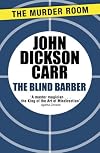
A Drunken Farce, without a Locked Room
Review of The Murder Room eBook (November 19, 2012) of the Harper and Brothers hardcover original (October 1, 1934)
The Blind Barber is a particularly weak entry for the Dr. Gideon Fell series and hopefully a one-off with its reliance on drunken comic antics. Dr. Fell is approached at home by his friend, the writer Henry (Hank) Morgan who was a passenger on the Queen Victoria cruise liner due to dock at Southampton after its journey from New York City. Morgan has managed to get ashore ahead of time via a smaller crew vessel as the larger ship awaits a docking berth.
Morgan relates a tale of how he and a group of friends had got themselves mixed-up in the middle of a jewelry heist and then found a body apparently murdered by a cutthroat razor (the single brief tie-in to the title) but when bringing it to the attention of the ship's authorities they found that the body had disappeared. Enormous amounts of alcohol are consumed throughout, adding to the befuddlement of the characters. There were various other irritations such as having 3 characters deliver their dialogue in fake accented dialogue: a Norwegian, a Scot and an Italian.
What might be funny in small doses becomes insufferable when used several dozen times.
There are also extended fake French language passages, usually involving ranting about the alcohol intake.
The front cover of the original 1934 Harper and Brothers hardcover. Image sourced from Goodreads.
To top it off, there are artefacts which demonstrate that a sloppy proofread / copy edit of the text scan was done to produce the eBook edition. Various scan typos were not fixed, even some that should have been caught by spellcheck such as the word: "endorsemHnt" (sic).
Dr. Fell is able to explain it all of course and even to cable a message to the authorities to have the culprit arrested upon docking. Overall, there was too little deduction, even though Fell lists 16 clues which point to the villain during the course of the story-telling. Disappointingly, I thought the bad 'un was apparent fairly early on, unlike most John Dickson Carr books which usually involve confusing puzzles in the so-called "locked room" sub-genre.
Avoid this one, even if you are a Dr. Fell or John Dickson Carr completist.
Bonus Track
Even among the dregs and the dross, I thought this one passage describing inebriation 🥴😵 was rather good:
Trivia and Links
John Dickson Carr (1906-1977) is one of the 99 authors listed in The Book of Forgotten Authors>/i> (2017) by Christopher Fowler. He is No. 20 in the alphabetical listing which you can see towards the bottom of my review here.
John Dickson Carr took the inspiration for Dr. Gideon Fell's appearance from that of author G.K. Chesterton (1874-1936), writer of the Father Brown mysteries and other works.
See photograph at https://upload.wikimedia.org/wikipedia/commons/thumb/7/75/Gilbert_Chesterton.jpg...
Photograph of G.K. Chesterton. Image sourced from Wikipedia.
The source of the name Dr. Fell is apparently from the apocryphal epigram:
Review of The Murder Room eBook (November 19, 2012) of the Harper and Brothers hardcover original (October 1, 1934)
Uninsured jewels belonging to ?!£&/! viscounts were stolen while murdering thieves posed as Harley Street doctors at his table. Blood-stained blankets and razors mysteriously appeared in the cabins; women vanished but did not vanish; the nephews of eminent American administrators first went mad and gibbered of bears and geography then ranshow more
amok with bug-powder guns, tried to poison him and finally threatened him with razors. Indeed, an unprejudiced listener would have decided that the situation aboard the Queen Victoria was past hope. - the ship's captain summarizes the mayhem of events on board his ship.
The Blind Barber is a particularly weak entry for the Dr. Gideon Fell series and hopefully a one-off with its reliance on drunken comic antics. Dr. Fell is approached at home by his friend, the writer Henry (Hank) Morgan who was a passenger on the Queen Victoria cruise liner due to dock at Southampton after its journey from New York City. Morgan has managed to get ashore ahead of time via a smaller crew vessel as the larger ship awaits a docking berth.
Morgan relates a tale of how he and a group of friends had got themselves mixed-up in the middle of a jewelry heist and then found a body apparently murdered by a cutthroat razor (the single brief tie-in to the title) but when bringing it to the attention of the ship's authorities they found that the body had disappeared. Enormous amounts of alcohol are consumed throughout, adding to the befuddlement of the characters. There were various other irritations such as having 3 characters deliver their dialogue in fake accented dialogue: a Norwegian, a Scot and an Italian.
“You get somet’ing to gag him wit’ till he cool down, or he call de chief mate and den maybe we iss all in de brig." “do you t’ank we are right, or iss dere a mistake? Dat wass no yoke, what dey tell us. If dey say dere is nobody missing, den ay don’t see how dere is somebody missing. Maybe we talk about a murder and dere is no murder.”
"'Auld Ayr, wham ne'er a town surpasses,'" announced Dr. Kyle, with a gesture that indicated him to be a local boy and proud of it, "'for honest men and bonnie lasses'! Aye! A statement ye ken, Mr. Morgan, frae the wairks o' the great Scottish poet, Rabbie Burrrns. Sit down Mr. Morgan. And perhaps yell tak a drap o' whusky, eh? 'The souter tauld his queerest stories__.'"
“So! So! You have trieda to de-ceive me, eh? You have a trieda toa deceive Signor Benito Furioso Camposozzi, eh? Sangua della madonne, I feex you! You tella me he eesa all-right, eh? Haah! What you call all-aright, eh? I tell you, signorina, to youra face, he eesa DRUNK!”
What might be funny in small doses becomes insufferable when used several dozen times.
There are also extended fake French language passages, usually involving ranting about the alcohol intake.
“Eh, bien, eh bien! Encore tu bois! Toujours tu bois! Ah, zut, alors!” She became cutting. “Tu m’a donné votre parole d’honneur, comme un soldat de la France! Et qu’est-ce que je trouve? Un soldat de la France, hein! Non!” She drew back witheringly. “Je te vois en buvant le GIN!”
The front cover of the original 1934 Harper and Brothers hardcover. Image sourced from Goodreads.
To top it off, there are artefacts which demonstrate that a sloppy proofread / copy edit of the text scan was done to produce the eBook edition. Various scan typos were not fixed, even some that should have been caught by spellcheck such as the word: "endorsemHnt" (sic).
Dr. Fell is able to explain it all of course and even to cable a message to the authorities to have the culprit arrested upon docking. Overall, there was too little deduction, even though Fell lists 16 clues which point to the villain during the course of the story-telling. Disappointingly, I thought the bad 'un was apparent fairly early on, unlike most John Dickson Carr books which usually involve confusing puzzles in the so-called "locked room" sub-genre.
Avoid this one, even if you are a Dr. Fell or John Dickson Carr completist.
Bonus Track
Even among the dregs and the dross, I thought this one passage describing inebriation 🥴😵 was rather good:
Each of his trio had consumed exactly one bottle of champagne; and, while he would have scorned the imputation that he could become the least sozzled on a quart of fizz, he could not in honesty deny certain insidious manifestations. For example, it seemed to him that he was entirely without legs, and that his torso must be moving through the air in a singularly ghostly fashion;
Trivia and Links
John Dickson Carr (1906-1977) is one of the 99 authors listed in The Book of Forgotten Authors>/i> (2017) by Christopher Fowler. He is No. 20 in the alphabetical listing which you can see towards the bottom of my review here.
John Dickson Carr took the inspiration for Dr. Gideon Fell's appearance from that of author G.K. Chesterton (1874-1936), writer of the Father Brown mysteries and other works.
See photograph at https://upload.wikimedia.org/wikipedia/commons/thumb/7/75/Gilbert_Chesterton.jpg...
Photograph of G.K. Chesterton. Image sourced from Wikipedia.
The source of the name Dr. Fell is apparently from the apocryphal epigram:
I do not like thee, Doctor Fell,show less
The reason why – I cannot tell;
But this I know, and know full well,
I do not like thee, Doctor Fell.

My vote for my favourite HM novel by John Dickson Carr. I think it's the way he starts off with possibly his most extraordinary idea for a murder - the set up, the setting, the situation - and then builds on it. At the time of reading I had a theory that Carr was genuinely trying to take the book to yet more extraordinary levels of excitement at the end of each chapter because by the end of the book you're almost breathless at the invention of the whole thing. HM's humour also is at it's show more best and least jarring and for my money it stands with "The Hollow Man" as Carr at the peak of his substantial writing form. Absolutely one of my most cherished crime novels ever. show less

I have remarked before in these pages of my surprise at the doggedness and sheer perseverance (or perhaps I mean simple lack of discernment) evinced by my younger reading self. As I grow older, I find myself re-reading books more frequently. Several times over the last few years I have gone back to a book of which I have fond memories from my first reading of it back in the distant days of my youth, only to find it evoking very different responses now.
Of course, that is sometimes merely a show more reflection of greater experience of life acquired in the interim, but there have been a substantial number of cases where I baulk in amazement that I ever managed to persevere through to the end, let alone manage that and emerge with positive memories.
This was one such case. I recall reading this perhaps thirty ... maybe nearer forty … years ago, at a period when I positively devoured traditional murder mysteries. John Dickson Carr is still esteemed as one of the masters of that particular genre, and this particular book is often cited as his masterpiece, and perhaps the apotheosis of the locked room mystery. Indeed, Dickson Carr devotes one whole chapter to a tutorial on the locked room mystery, delivered by his learned (and exceptionally self-regarding) avatar, Dr Gideon Fell who was protagonist of most of his novels.
I was prompted top reread this after having enjoyed Peter Lovesey’s novel, Bloodhounds, in which his own less cerebral but immensely more pragmatic protagonist, Superintendent Peter Diamond, is faced with a locked room mystery of his own. Lovesey, a prolific and masterful writer of crime fiction himself, ventures into metafiction in Bloodhounds as the victim and field of suspects are all members of a society which meets regularly to discuss their own respective views about crime fiction. The murder, or at least the first of them, confronting Diamond is consciously modelled on events in Dickson Carr’s The Hollow man.
Unfortunately, far from encountering the nostalgic treat that I was anticipating, I found this book very turgid, and written with a self-congratulatory air that I found positively repellent. It has not aged well. Yes, the plot is very cleverly constructed, but the whole book is presented as a simple demonstration of how clever Gideon Fell and John Dickson Carr both are. There is a strong carapace of smugness that I struggled to penetrate.
I don’t think that this is simply a reflection of the book’s age. I have recently reread a few books of similar vintage by the likes of Agatha Christie and Ngaio Marsh, and while it is clear that they hail from a different time, I have had no problems enjoying them for what they are. Anytway, whatever the underlying reason, I will not be revisiting any more of John Dickson Carr’s books for quite a while. show less
Of course, that is sometimes merely a show more reflection of greater experience of life acquired in the interim, but there have been a substantial number of cases where I baulk in amazement that I ever managed to persevere through to the end, let alone manage that and emerge with positive memories.
This was one such case. I recall reading this perhaps thirty ... maybe nearer forty … years ago, at a period when I positively devoured traditional murder mysteries. John Dickson Carr is still esteemed as one of the masters of that particular genre, and this particular book is often cited as his masterpiece, and perhaps the apotheosis of the locked room mystery. Indeed, Dickson Carr devotes one whole chapter to a tutorial on the locked room mystery, delivered by his learned (and exceptionally self-regarding) avatar, Dr Gideon Fell who was protagonist of most of his novels.
I was prompted top reread this after having enjoyed Peter Lovesey’s novel, Bloodhounds, in which his own less cerebral but immensely more pragmatic protagonist, Superintendent Peter Diamond, is faced with a locked room mystery of his own. Lovesey, a prolific and masterful writer of crime fiction himself, ventures into metafiction in Bloodhounds as the victim and field of suspects are all members of a society which meets regularly to discuss their own respective views about crime fiction. The murder, or at least the first of them, confronting Diamond is consciously modelled on events in Dickson Carr’s The Hollow man.
Unfortunately, far from encountering the nostalgic treat that I was anticipating, I found this book very turgid, and written with a self-congratulatory air that I found positively repellent. It has not aged well. Yes, the plot is very cleverly constructed, but the whole book is presented as a simple demonstration of how clever Gideon Fell and John Dickson Carr both are. There is a strong carapace of smugness that I struggled to penetrate.
I don’t think that this is simply a reflection of the book’s age. I have recently reread a few books of similar vintage by the likes of Agatha Christie and Ngaio Marsh, and while it is clear that they hail from a different time, I have had no problems enjoying them for what they are. Anytway, whatever the underlying reason, I will not be revisiting any more of John Dickson Carr’s books for quite a while. show less
Lists
Awards


You May Also Like


Associated Authors
Statistics
- Works
- 228
- Also by
- 151
- Members
- 18,930
- Popularity
- #1,155
- Rating
- 3.6
- Reviews
- 407
- ISBNs
- 885
- Languages
- 18
- Favorited
- 38

