On This Page
Description
Johann Christoph Friedrich von Schiller (1759-1805) was a German poet, philosopher, historian, and dramatist. Schiller wrote many philosophical papers on ethics and aesthetics. He developed the concept of the Schone Seele (beautiful soul), a human being whose emotions have been educated by his reason, so that Pflicht und Neigung (duty and inclination) are no longer in conflict with one another; thus "beauty," for Schiller, is not merely a sensual experience, but a moral one as well: the Good show more is the Beautiful. His philosophical work was also particularly concerned with the question of human freedom, a preoccupation which also guided his historical researches. Schiller is considered by most Germans to be Germanys most important classical playwright. Critics have noted his innovative use of dramatic structure and his creation of new forms, such as the melodrama and the bourgeois tragedy. Amongst his famous works are Love and Intrigue (1784), Don Carlos (1787), The Minister (1796), The Death of Wallenstein (1799), The Piccolomini (1800) and Mary Stuart (1800). show lessTags
Recommendations















































Member Reviews
Only now, in the third part, does the drama of the Wallenstein trilogy (1799) really break loose, and this is expressed in both action scenes and in very charged, even pathetic monologues and dialogues, and a perhaps predictable, but nevertheless intense denouement. Schiller really turns into a new Shakespeare here, clearly very much inspired by King Lear. The doubter Wallenstein, surrounded by loyal and false advisors, cannot escape his fate. Compared to the first and second parts, the female characters come somewhat more to the fore (and they too play both a good and an evil role), but they still remain very superficial figures.
My historical self cannot help but say that I had the impression that Schiller wants to make Wallenstein a show more ‘German’ hero above all: he suggests that his forbearing attitude towards Sweden and Saxony has mainly to do with that. I know too little about the impossibly complex history of the Thirty Years’ War, but anachronistic nationalist sentiment (on the part of Schiller) may be at play here. In any case, this third part certainly makes up for the lack of action and commitment of parts 1 and 2 of this trilogy. show less
My historical self cannot help but say that I had the impression that Schiller wants to make Wallenstein a show more ‘German’ hero above all: he suggests that his forbearing attitude towards Sweden and Saxony has mainly to do with that. I know too little about the impossibly complex history of the Thirty Years’ War, but anachronistic nationalist sentiment (on the part of Schiller) may be at play here. In any case, this third part certainly makes up for the lack of action and commitment of parts 1 and 2 of this trilogy. show less
In die besten Momente ist Wallensteins Tod etwas näh eine deutsche Macbeth--die welche meint, Macbeth mit weniger Mythos und mehr Geschicht, weniger Blut und mehr Politik, weniger heldischem Unsinn und mehr verzweifeltem Verhandlungen von Leute in Ernst. Im Gegenzatz zu Piccolomini, Schiller hat ein wenig Dramaturgie gelernt--die Öffnung mit Wallenstein und dem Astrologe ist fesselnd; Zuhörerfängend sozusagen. (Ob Shakespeare liegt in diese Weise noch gerade weiter; Macbeth oder Othello sind Balleten der Bestürzung; Wallenstein ist noch langsamer, heftiger--Gespräch über Aktion. Schillers Poesie fällt nicht durch, auch nicht Coleridges in Übersetzung--ich bedenke mich nun wenn Lyrik, wenn es hinter shakespearische show more Hexerei bleibt zurück, könnte überhaupt zu schwerverdaulich für die Bühne manchmal sein. Es funktioniert, und recht stark--aber fliegt nicht los. (Oder vielleicht meine limitierte Deutschverständnis macht mir taub:)
Und später, wann jeder probiert seine Chance zu greifen aber noch Wahlmöglichkeiten zu präservieren, immer siegen aber noch beliebt sein und sich ehrenwert fühlen. Die Szene mit Piccolomini und Buttler ist unmöglich straff, und Buttler schaut endlich weich unter den Druck--fällt von Soldat bis Killer. Also hat Wallenstein Erfolg als tragischer Held: die Generalen krümeln und betrügen, die Frauen schreien, Max(".") Piccolomini und Thekla lenkt man ab; Wallenstein hat viele Tricks, aber endlich "Wallenstein is in it for Wallenstein"; in ein Welt, darin die alte Sicherheiten von Religion und Volksstamm zerstört sind, pässt das für heldische Pracht. Macbeths Untergang ist reines Ziel; Othellos, Impulsivität; Wallensteins Tod entspringt aus die Unmöglichkeit, eine mythische Zeichnung in grausame Zeit zu sein. Er ist kein Macbeth; sein Mannschaft lieben und wollen ihn hinterstehen; aber endlich müssen jener selbst schützen. In die Lage der Modernität kann man noch seine eigene Ruhm jagen, aber nicht romantisch, nicht sauber: es ist verhandeln oder Tod. Wallenstein, der proto-Nietszcheisher, versteht das zu spät, und verhandelt als er sinkt, mit dem Kaiser, O. Piccolomini, die Schweden, die Soldaten, irgendjemand. Es ist rührend. show less
Und später, wann jeder probiert seine Chance zu greifen aber noch Wahlmöglichkeiten zu präservieren, immer siegen aber noch beliebt sein und sich ehrenwert fühlen. Die Szene mit Piccolomini und Buttler ist unmöglich straff, und Buttler schaut endlich weich unter den Druck--fällt von Soldat bis Killer. Also hat Wallenstein Erfolg als tragischer Held: die Generalen krümeln und betrügen, die Frauen schreien, Max(".") Piccolomini und Thekla lenkt man ab; Wallenstein hat viele Tricks, aber endlich "Wallenstein is in it for Wallenstein"; in ein Welt, darin die alte Sicherheiten von Religion und Volksstamm zerstört sind, pässt das für heldische Pracht. Macbeths Untergang ist reines Ziel; Othellos, Impulsivität; Wallensteins Tod entspringt aus die Unmöglichkeit, eine mythische Zeichnung in grausame Zeit zu sein. Er ist kein Macbeth; sein Mannschaft lieben und wollen ihn hinterstehen; aber endlich müssen jener selbst schützen. In die Lage der Modernität kann man noch seine eigene Ruhm jagen, aber nicht romantisch, nicht sauber: es ist verhandeln oder Tod. Wallenstein, der proto-Nietszcheisher, versteht das zu spät, und verhandelt als er sinkt, mit dem Kaiser, O. Piccolomini, die Schweden, die Soldaten, irgendjemand. Es ist rührend. show less
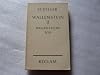
The Reclam E-book is a surprisingly useful edition for reading Wallensteins Tod. It has a number of footnotes to provide historical background and to explain things in the play. It also has some useful essays at the end talking about the play. Most useful is the list of characters with indications of how close their depiction matches the historical reality.
Ratings
Members
- Recently Added By
Author Information

1,130+ Works 11,278 Members
Friedrich Schiller was born in Marbach, Germany, the son of an army surgeon, a profession for which he himself was later educated. He never wanted to practice medicine, however, and found an outlet for his dissatisfaction in writing poetry and plays. Schiller's first play was to be performed was The Robbers (1781), a rallying cry for the freedom show more and idealism of youth against the tyranny and hypocrisy that Schiller saw all around him. The play was an immediate success, but Schiller, who had taken unauthorized leave from his regiment to watch the performance, was arrested and forbidden by the ruling Duke to write anything but medical books in the future. In defiance of the order, Schiller fled the duchy and, although suffering great poverty, continued to write. The remainder of Schiller's life was a struggle against poverty and, in his last years, a struggle against tuberculosis. Each of Schiller's nine plays is a masterpiece of situation, characterization, subtle psychology, and brilliant dramatic technique. Most of his plays focus on historical subjects, such as Mary Queen of Scots, Joan of Arc, or the Swiss hero William Tell. Schiller uses these period characters and settings to suit his own themes, which center on individual freedom, justice, and heroism. He often sacrifices historical accuracy in order to make a point. Schiller's place in German literature is very near the top. Among German dramatists there are none better, and perhaps only his friend German poet and playwright Goethe can be called an equal. (Bowker Author Biography) show less
Some Editions
Awards and Honors
Notable Lists
Series

Belongs to Publisher Series
Work Relationships
Is contained in
Schiller’s Werke : nach den vorzüglichsten Quellen revidirte Ausgabe. Vierter-Fünfter Theil. Dramen II. by Friedrich Schiller
Schiller: Wallenstein & Wilhelm Tell (Text In German - Wallensteins Lager // Die Piccolomini // Wallensteins Tod // Wilhelm Tell - Afterword By: Dr. Friedrich Wagner) by Friedrich Schiller (indirect)
Die Räuber / Don Carlos / Wallenstein / Kabale und Liebe. Meisterwerke der Weltliteratur Band 9 und Band 10 by Friedrich Schiller (indirect)
Schillers Werke : Auswahl in sechs Bänden. 6 Band: Wallenstein. Demetrius by Friedrich Schiller (indirect)
Guillermo Tell Los bandidos ; Intriga y amor ; Wallenstein ; Don Carlos by Friedrich Schiller (indirect)
Schiller : Wallensteins Lager + Die Piccolomini + Wallensteins Tod + Dokumente by Ernesto Grassi (indirect)
Has as a reference guide/companion
Common Knowledge
- Canonical title
- The Death of Wallenstein
- Original title
- Wallensteins Tod
- Original publication date
- 1799
- People/Characters*
- Wallenstein, Herzog zu Friedland, kaiserlicher Generalissimus im Dreißigjährigen Kriege; Piccolomini; Seni, Astrologe Wallensteins; Illo, Feldmarschall, Wallensteins Vertrauter; Terzky
- Important places
- Pilsen, Bohemia; Eger, Bohemia
- Important events
- Thirty Years' War
- Original language
- German
- Disambiguation notice
- 3150000424 Reclam UB
*Some information comes from Common Knowledge in other languages. Click "Edit" for more information.
Classifications
- Genre
- Fiction and Literature
- DDC/MDS
- 832.63 — Literature & rhetoric German & related literatures German drama 1750–1832 : 18th century; classical period; romantic period 1759–1805 Schiller, Johann Christoph Friedrich
- LCC
- PT1101 .S334 — Language and Literature German, Dutch and Scandinavian literatures German literature Collections General
- BISAC
Statistics
- Members
- 179
- Popularity
- 181,847
- Reviews
- 3
- Rating
- (4.10)
- Languages
- Dutch, English, German, Spanish
- Media
- Paper, Audiobook, Ebook
- ISBNs
- 14
- ASINs
- 17