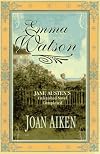
Emma Watson
by Joan Aiken
On This Page
Description
Emma Watson has been brought up by her aunt in a wealthy and refined household, an educated lifestyle far removed from her widowed father and five siblings. So when her aunt enters into an imprudent second marriage, nineteen-year-old Emma is sent back home and must join her sisters in their pursuit of a husband... Aiken takes on the fate of Austen's characters with confidence and skill, flawlessly entwining themes of loss and love together in this stunning regency pastiche.Tags
Recommendations














Member Reviews
I've had this lying on my bookshelves for years, and was happy to have it immediately to hand right after reading Jane Austen's The Watsons, an abandoned fragment of a novel of only 17,500 words. I quite liked Emma Watson, Austen's protagonist. Like Fanny Price, she's someone who was raised away from her birth family by a rich relation--except she had expectations of being an heiress, which were disappointed by her rich aunt marrying again, throwing her back to her original family. Her family is respected enough to be able to mix with the best families, including a Lord interested in Emma, and comfortable enough to have a servant, but in the circles they run around in are considered "poor." Only nineteen, Emma has a lot more confidence show more than Fanny Price, and a lot less snobbishness than her namesake Emma Woodhouse. She endeared herself to me when she goes to the rescue of a ten-year-old boy stood up at a dance. I'm only sorry there wasn't more, and we had to leave Emma soon after a ball parting from her brother and his wife.
So I grabbed Aiken's novel, said to be a continuation, and was immediately disappointed--because what it really is, is more a re-imagining. It doesn't take up where Austen left off or use any passages of the original but reworks the material, and coming straight from the wellspring it seemed a rather poor imitation of Austen's style without Austen's insights and wit--and I was immediately struck by pointless differences. Mrs Blake in Austen's novel is a widow--in Aiken's she's the wife of a living naval officer. And in Austen's novel Emma's invalid father seems, even if physically weak, still sharp mentally while Aiken makes him befuddled.
That's nothing compared though to the marked difference in quality. I don't expect Aiken to equal Austen, who is one of the great novelists in the English language, but if this were a Regency romance with no connection to Austen, it wouldn't recommend itself as in any way exceptional. And as a continuation--well, Austen told her sister Cassandra her intentions and I read them at the end of the text of The Watsons--Aiken doesn't honor them. So I can't recommend this either as a "completion" of The Watsons for those who'd love to see Austen's intentions played out or a romantic historical novel on its own merits. show less
So I grabbed Aiken's novel, said to be a continuation, and was immediately disappointed--because what it really is, is more a re-imagining. It doesn't take up where Austen left off or use any passages of the original but reworks the material, and coming straight from the wellspring it seemed a rather poor imitation of Austen's style without Austen's insights and wit--and I was immediately struck by pointless differences. Mrs Blake in Austen's novel is a widow--in Aiken's she's the wife of a living naval officer. And in Austen's novel Emma's invalid father seems, even if physically weak, still sharp mentally while Aiken makes him befuddled.
That's nothing compared though to the marked difference in quality. I don't expect Aiken to equal Austen, who is one of the great novelists in the English language, but if this were a Regency romance with no connection to Austen, it wouldn't recommend itself as in any way exceptional. And as a continuation--well, Austen told her sister Cassandra her intentions and I read them at the end of the text of The Watsons--Aiken doesn't honor them. So I can't recommend this either as a "completion" of The Watsons for those who'd love to see Austen's intentions played out or a romantic historical novel on its own merits. show less
Well, I just finished reading yet another Austen-inspired book titled, The Watsons (courtesy of Miss Austen) & Emma Watson (contributed by Joan Aiken). Aiken takes the readers through her vision of where The Watsons would have ended--had Austen's novel been completed.
I wish I could say this was a truly astounding book, but at the most, it was an interesting read. In my opinion, you really have to get over the hang up of Aiken diverting so much from Austen's writing style in order to accept the story. On it's own, it may have been fine, but when you pair it up with The Watsons and jump from one story straight to the other, well...there's a huge feeling of dischord.
My strongest feeling about the book was the disappointment in Aiken's use show more of the male characters. Without giving too much away, Emma has a selection of men presented to her throughout the story, yet her romantic interest winds up very briefly and really without much to ponder on. A character plucked out of nowhere and set in front of her and she decides this is it? Come now...a little more depth to the relationship would have been glady appreciated!
The other relationships in the novel are typical and non-eventful. Very few surprises at all. The Watson sisters remind me a great deal of another famous set of sisters (hint...P&P). Perhaps that's where Aiken drew from when she fleshed out her characters. I could almost have imagined the story as an alternate ending for P&P had Lizzy and Jane not found their true loves.
All in all, the book kept my attention, though perhaps not for all the right reasons. I was really curious most of the time to see what more sad events could befall Emma. The more I got away from The Watsons, the more I was able to enjoy Aiken's style for her own and not constantly compare it to Miss Austen's....which seemed only fair to both women! Truly, no one is comparable to the Miss Austen!! show less
I wish I could say this was a truly astounding book, but at the most, it was an interesting read. In my opinion, you really have to get over the hang up of Aiken diverting so much from Austen's writing style in order to accept the story. On it's own, it may have been fine, but when you pair it up with The Watsons and jump from one story straight to the other, well...there's a huge feeling of dischord.
My strongest feeling about the book was the disappointment in Aiken's use show more of the male characters. Without giving too much away, Emma has a selection of men presented to her throughout the story, yet her romantic interest winds up very briefly and really without much to ponder on. A character plucked out of nowhere and set in front of her and she decides this is it? Come now...a little more depth to the relationship would have been glady appreciated!
The other relationships in the novel are typical and non-eventful. Very few surprises at all. The Watson sisters remind me a great deal of another famous set of sisters (hint...P&P). Perhaps that's where Aiken drew from when she fleshed out her characters. I could almost have imagined the story as an alternate ending for P&P had Lizzy and Jane not found their true loves.
All in all, the book kept my attention, though perhaps not for all the right reasons. I was really curious most of the time to see what more sad events could befall Emma. The more I got away from The Watsons, the more I was able to enjoy Aiken's style for her own and not constantly compare it to Miss Austen's....which seemed only fair to both women! Truly, no one is comparable to the Miss Austen!! show less
Nicht aus Anmaßung, sondern, in Aikens eigenen Worten, aus "Liebe und Bewunderung" geboren, haben ihre Geschichten die Welten und Charaktere von Jane Austens Meisterwerken Emma, Mansfield Park und Sense and Sensibility so getreu nachempfunden, dass selbst die Puristen unter Austens Fans zufriedengestellt wurden. In Emma Watson vervollständigt Aiken The Watsons, indem sie den unverkennbar pointierten Stil ihrer Mentorin einfängt und sich als meisterhafte Geschichtenerzählerin erweist.
May 18, 2020German
Ratings
Members
- Recently Added By
Lists

Austenland
165 works; 12 members
Author Information

216+ Works 19,821 Members
Joan Delano Aiken was born in Rye, Sussex, England, on September 4, 1924, the daughter of the Pulitzer Prize winner, writer Conrad Aiken. She was raised in a rural area and home schooled by her mother until the age 12. She then attended Wychwood School, a boarding school in Oxford. Her work first appeared in 1941 when the British Broadcasting show more Corporation, where she worked as a librarian, broadcast some of her short stories on their Children's Hour program. Aiken also worked at St. Thomas's Hospital, and in 1943 she moved to the reference department of the London office of the United Nations, where she collected information about resistance movements. She worked for the UN until 1949, all the while continuing to write stories. In 1953 a collection of short fiction called All You've Ever Wanted and Other Stories was published. While writing The Wolves of Willoughby Chase, begun in 1952, her husband became ill and died of lung cancer in 1955. After working for five years as a copy editor at Argosy Magazine, and at the J. Walter Thompson Advertising Firm, she returned and finished the book in 1963. The Wolves of Willoughby Chase won the Lewis Carroll Shelf Award and was made into a successful film in 1988. In 1969 The Whispering Mountain won the Guardian Children's Book Award, and in 1972, Night Fall won America's Edgar Allen Poe Award for juvenile mystery. Aiken is best known for her adult "fantasy" stories. She has received awards for children's fiction and for mystery fiction, and has also written ''sequels'' to Jane Austen books. She collaborated with her daughter to write many episodes of her Arabel and Mortimer the raven series for the BBC. In all, Aiken wrote 92 novels - including 27 for adults - as well as plays, poems and short stories, although she was best known as a writer of children's stories. Joan Aiken died in January of 2004 at the age of 79. (Bowker Author Biography) show less
Work Relationships
Contains
Common Knowledge
- Canonical title
- Emma Watson
- Original title
- Emma Watson
- Original publication date
- 1996
Classifications
Statistics
- Members
- 134
- Popularity
- 244,074
- Reviews
- 3
- Rating
- (2.94)
- Languages
- English, German
- Media
- Paper, Ebook
- ISBNs
- 13
- ASINs
- 2