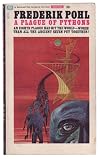
A Plague of Pythons
by Frederik Pohl
On This Page
Description
A Plague of Pythons is a science fiction novel by American writer Frederik Pohl. Serialized in Galaxy Science Fiction in October and December 1962, the novel was published in 1965, and an updated version was published in 1984 under the title Demon in the Skull. The title derives from the words "Domina Pythonis" used as part of an exorcism ritual performed in the first chapter to scare away the "demons" that seem to possess people in the novel. The novel opens in a world reduced to a grim show more struggle for existence after a plague of madness that afflicted individuals at random. Some two years previously, every government in the world was attacked by its own military machinery, which then self-destructed. All civilian air transport was similarly destroyed, along with major cities like San Francisco. After the initial meltdown, people began claiming to be "possessed". They would commit crimes of violence, but afterward they would claim to have had no control over their actions. This leads to ... show lessTags
Recommendations







Member Reviews
Sometimes I wonder why I continue to read "junky" science fiction books. This novel came out in 1965, almost 50 years ago. I think the main reason is that I like old-fashioned storytelling and sometimes I come across real surprises (good ones) such as this. For most of the book this really reads as a horror story of demonic possession - worldwide possession where almost anyone is at risk of being taken over at any time. The modern day equivalent of witch trials apparently have returned, with a twist. If possession is proven, you are not held accountable. If you are determined to be a hoaxer you are likely to be executed by firing squad the next day, after an immediate trial.
We follow the story of a man named Chandler who is on trial show more for his life for a viscous rape the day before at the antibiotics factory where he works. The populace does not believe he was possessed. He escapes being sentenced to death when the jury forewoman herself becomes possessed during the trial and declares him not guilty. There is an uproar and Chandler is branded and released outside of town. This all sounds a little crazy, and it is, but Pohl manages to write this in a way that lets the reader know how badly the madness has affected society. Civilization is clearly on the verge of complete collapse. No one knows if demons have invaded the world or some strange aliens or what.
Chandler jumps a train out of town and the real story begins. He is first captured (or recruited) by a semi-crazy group of people who have developed some unconventional ways to fight the possession but all hell quickly breaks loose there. Chandler eventually discovers the source of madness and we see what happens. This was a page turner for me. Not great literature but a story that had my attention.
3+ stars show less
We follow the story of a man named Chandler who is on trial show more for his life for a viscous rape the day before at the antibiotics factory where he works. The populace does not believe he was possessed. He escapes being sentenced to death when the jury forewoman herself becomes possessed during the trial and declares him not guilty. There is an uproar and Chandler is branded and released outside of town. This all sounds a little crazy, and it is, but Pohl manages to write this in a way that lets the reader know how badly the madness has affected society. Civilization is clearly on the verge of complete collapse. No one knows if demons have invaded the world or some strange aliens or what.
Chandler jumps a train out of town and the real story begins. He is first captured (or recruited) by a semi-crazy group of people who have developed some unconventional ways to fight the possession but all hell quickly breaks loose there. Chandler eventually discovers the source of madness and we see what happens. This was a page turner for me. Not great literature but a story that had my attention.
3+ stars show less
A plague of pythons takes place in the near future, in a world where possession is normal. Huh? Possession? Yes, really. Nobody really knows who is doing the possessing or why. All that is known is that it started from one day to the next, people were getting possessed and performed unspeakable acts without being able to stop it. Possession became so common that it is now a common defense at trials: I did it, but it wasn't my fault, because I was possessed. Unfortunately, this doesn't work for Chandler, since he raped and murdered a girl while in a pharmaceutical plant, and everyone knows hardly anyone ever gets possessed in places that have anything to do with pharmaceuticals, so he must be lying. He only narrowly manages to escape his show more fate, but he does get exiled. This starts a journey in which he tries to find ways to prevent possession and to find its cause.
The style of this book is relatively rational, but even though its not overly emotional, it is still quite engaging and mysterious. The writing is easy-going and doesn't distract from the story. Mostly, you want to find out what will happen to Chandler and what is going on with all these possessions. In the end, the story is all about power, and what it does to people. I thought this book was excellent. I was afraid it would disappoint, it being a bit old and science fiction to boot (I usually read fantasy), but there was no need to worry. It didn't feel outdated or stuffy (this is the feel I get from some of the older SF works). I reminded me a bit of John Wyndham's work, so if you liked that, you might want to give this a try too. show less
The style of this book is relatively rational, but even though its not overly emotional, it is still quite engaging and mysterious. The writing is easy-going and doesn't distract from the story. Mostly, you want to find out what will happen to Chandler and what is going on with all these possessions. In the end, the story is all about power, and what it does to people. I thought this book was excellent. I was afraid it would disappoint, it being a bit old and science fiction to boot (I usually read fantasy), but there was no need to worry. It didn't feel outdated or stuffy (this is the feel I get from some of the older SF works). I reminded me a bit of John Wyndham's work, so if you liked that, you might want to give this a try too. show less
An elite group of people can enter your brain and take over your body at will.
Pohl is normally a good author, but I have never been able to finish this particular book.
Maybe someday.
Maybe someday.
Ratings
Members
- Recently Added By
Lists

Best Science Fiction Novels
816 works; 426 members
Talk Discussions
Past Discussions
70s novella, mind control helmets, people possessed and joyridden in Name that Book (September 2011)
Author Information

641+ Works 42,909 Members
Frederik Pohl was born in New York City on November 26, 1919. More interested in writing than in school, he dropped out of high school in his senior year and took a job with a publishing company. After serving as a public relations officer in the United States Army from 1943 to 1945, he returned to publishing as copywriter for Popular Science, a show more literary agent for several sci-fi writers, and the editor for the magazines Galaxy and If from 1959 until 1969, with If winning three successive Hugo awards. His first published work, a poem entitled Elegy to a Dead Satellite: Luna, was printed in Amazing Stories magazine in 1937 under the pen name Elton Andrews. His first science fiction novels were published in the mid 1960's, some written in collaboration with other writers, others created alone. During his lifetime, he won over 16 major awards for his writing (much of which was published pseudonymously) including six Hugo Awards and three Nebula Awards. His works include Gateway, which won the Campbell Memorial, Hugo, Locus SF, and Nebula Awards, Beyond the Blue Event Horizon, and Jem, which won the National Book Award in 1979. He also embraced blogging in his later years, using his online journal as an ongoing sequel to his autobiography, The Way the Future Was. He died on September 2, 2013 at the age 93. (Bowker Author Biography) show less
Some Editions
Series
Belongs to Publisher Series
Work Relationships
Is contained in
Is expanded in
Common Knowledge
- Original title
- A Plague of Pythons
- Original publication date
- 1965
- Important places
- O'ahu, Hawai'i, USA
- Dedication
- For Lester del Rey well and truly called The Magnificent
- First words
- "Hey, Chandler," said Larry Grantz, the jailer. "I can get fifty to one for a conviction. What do you think?"
- Last words
- (Click to show. Warning: May contain spoilers.)He would wear it just long enough to clean up all the loose ends -- just that long and not one second longer, he pledged, and knew as he pledged it that he lied.
- Original language
- English
- Disambiguation notice
- This story should not be combined with the short story that appeared in the Galaxy Magazine, in 1962, by Galaxy Publishing.
Classifications
Statistics
- Members
- 296
- Popularity
- 108,357
- Reviews
- 4
- Rating
- (3.12)
- Languages
- English, French, German
- Media
- Paper, Audiobook, Ebook
- ISBNs
- 13
- ASINs
- 19