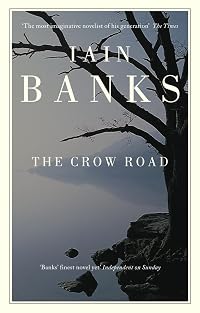
The Crow Road
by Iain Banks
On This Page
Description
From its bravura opening onwards, THE CROW ROAD is justly regarded as an outstanding contemporary novel. 'It was the day my grandmother exploded. I sat in the crematorium, listening to my Uncle Hamish quietly snoring in harmony to Bach's Mass in B Minor, and I reflected that it always seemed to be death that drew me back to Gallanach.' Prentice McHoan has returned to the bosom of his complex but enduring Scottish family. Full of questions about the McHoan past, present and future, he is also show more deeply preoccupied: mainly with death, sex, drink, God and illegal substances... show lessTags
Recommendations






Member Recommendations
Member Reviews
"People can be teachers and idiots; they can be philosophers and idiots; they can be politicians and idiots;.......a genius can be an idiot. The world is largely run for and by idiots."
'Crow Road' opens with a funeral with a quite memorable first paragraph:
“It was the day my grandmother exploded. I sat in the crematorium, listening to my Uncle Hamish quietly snoring in harmony to Bach’s Mass in B minor, and I reflected that it always seemed to be death that drew me back to Gallanach.”
Prentice McHoan, the main narrator, is the middle son of a uniquely dysfunctional family who is estranged from his avowedly atheist father because he simply cannot accept the concept that death is simply the end of the road. He spends a lot of time show more contemplating “the crow road,” a Scottish expression for death, the possibility of an afterlife, and the fate of his Uncle Rory, who disappeared eight years earlier.
Most of the story takes place in the present, 1991, but also moves back and forth in time (often without any hint from the author about the transition). Prentice hails from the imaginary village of Gallanach in Argyll, is studying History at a Glasgow university and Britain is about to enter the First Gulf War.
After the first 400 or so pages the novel suddenly becomes a murder mystery, although we cannot be sure whether there ever was in fact a murder.
There is a good deal of humour, some excellent character development, a large amount of whiskey drinking (the drug of choice) along with a liberal sprinkling of historical/cultural references that help to set the book in a certain time and place. However, Scotland with its fog-shrouded countryside, ancient burial sites, henges and castles becomes a character in its own right.
Banks is a clever writer who has become one of my authors of choice of late. Once again I thoroughly enjoyed his writing style with it's subtle wit but whilst I enjoyed the elements that revolved around family relationships, which I felt that he set up beautifully, I found the murder/mystery element a bit of a let down. Personally I felt it as if Banks had no idea quite how to tie up the loose ends that he had spun. I also wanted to scream at Prentice to open his eyes, I just couldn't believe that he was so blind to what was right in front of his eyes even if he does finally get the girl.
An enjoyable but flawed piece of escapism. show less
'Crow Road' opens with a funeral with a quite memorable first paragraph:
“It was the day my grandmother exploded. I sat in the crematorium, listening to my Uncle Hamish quietly snoring in harmony to Bach’s Mass in B minor, and I reflected that it always seemed to be death that drew me back to Gallanach.”
Prentice McHoan, the main narrator, is the middle son of a uniquely dysfunctional family who is estranged from his avowedly atheist father because he simply cannot accept the concept that death is simply the end of the road. He spends a lot of time show more contemplating “the crow road,” a Scottish expression for death, the possibility of an afterlife, and the fate of his Uncle Rory, who disappeared eight years earlier.
Most of the story takes place in the present, 1991, but also moves back and forth in time (often without any hint from the author about the transition). Prentice hails from the imaginary village of Gallanach in Argyll, is studying History at a Glasgow university and Britain is about to enter the First Gulf War.
After the first 400 or so pages the novel suddenly becomes a murder mystery, although we cannot be sure whether there ever was in fact a murder.
There is a good deal of humour, some excellent character development, a large amount of whiskey drinking (the drug of choice) along with a liberal sprinkling of historical/cultural references that help to set the book in a certain time and place. However, Scotland with its fog-shrouded countryside, ancient burial sites, henges and castles becomes a character in its own right.
Banks is a clever writer who has become one of my authors of choice of late. Once again I thoroughly enjoyed his writing style with it's subtle wit but whilst I enjoyed the elements that revolved around family relationships, which I felt that he set up beautifully, I found the murder/mystery element a bit of a let down. Personally I felt it as if Banks had no idea quite how to tie up the loose ends that he had spun. I also wanted to scream at Prentice to open his eyes, I just couldn't believe that he was so blind to what was right in front of his eyes even if he does finally get the girl.
An enjoyable but flawed piece of escapism. show less
This story literally begins with a bang. Two things brought me and this book together...well actually three...,many of you know by now that I will read strange things in order to fulfill a challenge. Other than the challenge...I had to see if grandma literally exploded...and it was written by one of my favorite authors, Iain Banks. I had read about half way through and thought that Prentice must surely be a long lost cousin of mine. He would have fit in perfectly with my big, gruff Scottish grandfather. His exploits in this eccentric Scottish family are funny and so desperately true. You will find a bit of everything in here...mystery, magic, myths and it conveys it all with a first hand account that could only have been told the better show more if wee Prentice were telling you the story himself over a dram or two. Not a dull moment in it and always surprising. This book is definitely worth reading. Oh...and don't forget to find out about grandma:) show less
And it is like this.
Suddenly tears spring from your eyes and and you are too surprised by them to be able to stop the small flood that follows. Not entirely timely since you are in your favourite coffee shop hereabouts waiting for a vegetable tagine.
* * * *
Prentice, you prat, how can you not see the bleeding obvious right in front of your nose? As I wait for my tagine, I’m wondering what those who like to divide writing up by quality where literature is ‘best’ call Banks? Not literature. Presumably not trash. What? Good fiction, perhaps? As opposed to the bad stuff that is popularly read? Banks does like the reader to know what’s going on all the way and consequently from the very first moment we meet Ashley we know she is the show more one. If only there was a way to tell fucking Prentice Prat that. Just to make really sure at this point that we know what is going on, Verity, the one he thinks is the one, has no character whatsoever. Not one whit.
Though maybe, come to think of it, maybe Banks just can’t do women. Don’t get me wrong, I adore Ashley, who wouldn’t want to be her? But she is a character written for boys, isn’t she? Utterly loyal to her idea of you no matter what sort of idiot you are, and how blind you are; forgiving of every shitty thing you do to her – hey. Writing this down makes me realise it it were a Mills and Boon certain people would be calling it revoltingly sexist. But it’s ummmm. A step up of sorts, methinks you think and boys read Banks and – well, it’s different, isn’t it? Nup. I don’t see it myself. And I think back to Complicity in which in a different way, the girl - for there is one - is what a man would want too.
* * * *
The little girl had nightmares about cabbage. Even worse, she laid awake, the very thought of cabbage scaring sleep away.
* * * *
An author who can’t resist cleverness, even when he should. (Aside: isn’t there a decent editor left in England?) The first two hundred pages jar with me. They are about how witty the author is. A pity because the second half of the book is well worth it.
This is the sort of thing I mean, p. 54.
‘And how are your studies going?’
‘Oh, just fine.’
‘Good, good.’
‘And the twins; are they both well?’
‘Fine, fine’ Fergus nodded, presumably allocating his two daughters a word each in his reply.’
Too smart for his own good. Yes witty, all things being equal, the thing about a word for each daughter. But all things are not equal, aren’t they? Hello, Banks. There are readers here and we aren’t complete idiots. Fergus, as we have already just discovered, and is reinforced duing the book, typically repeats everything in this way. Clever line that shouldn’t be there. Only an author rather too much in love with himself would find a need to keep that there. Only an editor who was shagging him would let him get away with it. Or so I imagine.
* * * *
I’m picking these white pieces of ?? out of my tagine. Potato skin, I wonder, as a pile grows next to my bowl. But I try biting into one and it’s thicker and – well, nastier – than potato skin. I pick up the candle and examine these things by its light – they’ve veins – they’re – oh. That’s what they are.
* * * *
And the little girl – whose mother, quite possibly provider of the worst cooked vegetables in the galaxy, had always refused to cook cabbage because it was an abomination – could scarcely begin to imagine how dreadful it must be. And I think back to being that little girl and every cabbage fear she had was justified by this moment. Cabbage sucks.
* * * *
It takes Prentice Prat for ever, and every brain cell the Lord bestowed upon him to very, very dimly begin to understand about Ashley. But eventually. Eventually.
* * * *
And this book is all sorts of things lacking in subtlety. It is a murder mystery where we know it is a murder and who done it even as it is being done. And it is a love story we know is going to end happily if we wait long enough. And it is chock full of slightly zany characters who live slightly zany lives for us to be mostly amused by, and occasionally moved by.
Splendid scenes where Kenneth describes the actual making of the earth in Scotland longer than a prehistory ago, movements of vast pieces of the world. It makes me think of sex.
Unchallenging, escapist entertainment. ‘Eternally pleasant’ was my friend Harry’s summation. So, not literature then. But what? I’m asking the people who like to divide things up this way.
* * * *
And as your tears fall, in light too dim to see cabbage or tears, you think what a prat you are. Because towards the very end of the book as you innocently sit here, drinking your tea, you arrive at a scene which could be you, you and your loved one, and there is that moment, where like young children before they are trained to separate their emotions from each other; you hover in that childlike way between tears and smiles, weeping and laughing.
And what makes you a prat is that this is just a good writer telling a story and the whole point of what he does is that he is like an astrologer or a fortune cookie. Get everybody in. Make each person think you are writing for them. To them.
* * * *
And if I have in the least succeeded in writing this in the modern literary style adopted by Banks, you will think, dear reader, that I write to you.
xxxx show less
This fascinating, very literate novel begins with a funeral, and its description in the first paragraph of the book has become somewhat iconic:
“It was the day my grandmother exploded. I sat in the crematorium, listening to my Uncle Hamish quietly snoring in harmony to Bach’s Mass in B minor, and I reflected that it always seemed to be death that drew me back to Gallanach.”
(Apparently, someone forgot to remove Grandma’s pacemaker before the cremation.)
The narrator, Prentice McHoan, thinks a lot about “the crow road,” which is a Scottish expression for death, and the possibility (or not) of an afterlife. Prentice, the product of a rather dysfunctional (in its own unique way, of course) family, also contemplates his romances, show more the life of his father, and the fate of his Uncle Roary, who disappeared eight years earlier. The book goes back and forth in time (often with only a slight hint about the transition from the author), but most of the story takes place in the present, which in this story is 1991. In that year, Prentice was a university student from the imaginary village of Gallanach in Argyll, and Britain was about to enter the First Gulf War.
Banks adds a number of [fun to look back at today] cultural references that help situate the book in time, and which must have added a sense of relevancy when he published it in 1992.
Prentice, estranged from his father who is an avowed atheist, has trouble accepting the stoicism about death advocated by atheists. Nor does he care to embrace the concept of death as the total end of the road. His ruminations on the meaning of life and death are a central theme of the book.
In a remarkable plot evolution, the Bildungsroman of the first 400 pages becomes - for about 90 pages, a murder mystery, although we cannot be sure whether there was in fact a murder.
Along the way, there is a good deal of humor, especially over family relationships, and some excellent character development. The ending resolves the mysteries as well as some of the existential angst.
Banks is a clever and competent, though occasionally florid, writer. I wanted to read this book because it has been called a modern classic, and because I had heard that it provides a fairly accurate snapshot of some of the elements in Scotland that inform the culture. There is a great deal about cars, whisky, and storytelling. In addition, Scotland itself serves as a character, with Banks often setting the scene with fog-covered cliffs, old burial sites, henges, and the castles - both intact and not so much - that still dot the landscape.
The book was adapted by the BBC into a popular TV series in Britain in 1996.
Evaluation: The Crow Road is not a page turner, but it's not really a murder mystery either. It is more of a family saga with a coming-of-age protagonist and an interesting twist. I won’t soon forget Prentice McHoan and his family.
(JAB) show less
“It was the day my grandmother exploded. I sat in the crematorium, listening to my Uncle Hamish quietly snoring in harmony to Bach’s Mass in B minor, and I reflected that it always seemed to be death that drew me back to Gallanach.”
(Apparently, someone forgot to remove Grandma’s pacemaker before the cremation.)
The narrator, Prentice McHoan, thinks a lot about “the crow road,” which is a Scottish expression for death, and the possibility (or not) of an afterlife. Prentice, the product of a rather dysfunctional (in its own unique way, of course) family, also contemplates his romances, show more the life of his father, and the fate of his Uncle Roary, who disappeared eight years earlier. The book goes back and forth in time (often with only a slight hint about the transition from the author), but most of the story takes place in the present, which in this story is 1991. In that year, Prentice was a university student from the imaginary village of Gallanach in Argyll, and Britain was about to enter the First Gulf War.
Banks adds a number of [fun to look back at today] cultural references that help situate the book in time, and which must have added a sense of relevancy when he published it in 1992.
Prentice, estranged from his father who is an avowed atheist, has trouble accepting the stoicism about death advocated by atheists. Nor does he care to embrace the concept of death as the total end of the road. His ruminations on the meaning of life and death are a central theme of the book.
In a remarkable plot evolution, the Bildungsroman of the first 400 pages becomes - for about 90 pages, a murder mystery, although we cannot be sure whether there was in fact a murder.
Along the way, there is a good deal of humor, especially over family relationships, and some excellent character development. The ending resolves the mysteries as well as some of the existential angst.
Banks is a clever and competent, though occasionally florid, writer. I wanted to read this book because it has been called a modern classic, and because I had heard that it provides a fairly accurate snapshot of some of the elements in Scotland that inform the culture. There is a great deal about cars, whisky, and storytelling. In addition, Scotland itself serves as a character, with Banks often setting the scene with fog-covered cliffs, old burial sites, henges, and the castles - both intact and not so much - that still dot the landscape.
The book was adapted by the BBC into a popular TV series in Britain in 1996.
Evaluation: The Crow Road is not a page turner, but it's not really a murder mystery either. It is more of a family saga with a coming-of-age protagonist and an interesting twist. I won’t soon forget Prentice McHoan and his family.
(JAB) show less
The Crow Road starts off as a low-key family chronicle. It begins by quietly unfolding itself in alternating chapters, switching between timelines, when it follows the young student Prentice and his storytelling father Kenneth about fifteen years apart, as they negotiate the familial bonds and tensions that keep a large family and assorted in-laws tied together or driven apart. Banks slowly builds up tension and momentum, fills out his characters’ personalities to the point where they cannot but clash, and almost unnoticably his family-cum-coming-of-age-novel turns into a mystery that hurtles towards a signature climax that comes close to being over the top, but is carried off beautifully.
Banks mixes the tragic with the growing-up show more experiences; the contemplative quest for life’s answers and god with the comedic; and the ambitious mingling of genres with the low-key tone of a skilful author in control. The masterful telling of these stories as well as Banks’ love for his characters and the setting kept me interested, even in the parts dedicated mostly to character development, because I could tell he was going somewhere big, and I’d enjoy it more if I got to know the characters better.
The characters are likable or immature in precisely the right way: not as a way to trigger cheap reader involvement, but as relevant to the story and how it was told. The out-of-the-blue stretches with humour, the sudden events and plot twists, and even the creeping genre shift did not seem like cover-ups for a story out of the author’s control, but felt entirely natural: at all levels, the novel was kept shifting and moving, even at low speeds.
The more I think about it, the more I like this novel: it was well-plotted, well-executed, and told even better by an author who clearly knows his trade. show less
Banks mixes the tragic with the growing-up show more experiences; the contemplative quest for life’s answers and god with the comedic; and the ambitious mingling of genres with the low-key tone of a skilful author in control. The masterful telling of these stories as well as Banks’ love for his characters and the setting kept me interested, even in the parts dedicated mostly to character development, because I could tell he was going somewhere big, and I’d enjoy it more if I got to know the characters better.
The characters are likable or immature in precisely the right way: not as a way to trigger cheap reader involvement, but as relevant to the story and how it was told. The out-of-the-blue stretches with humour, the sudden events and plot twists, and even the creeping genre shift did not seem like cover-ups for a story out of the author’s control, but felt entirely natural: at all levels, the novel was kept shifting and moving, even at low speeds.
The more I think about it, the more I like this novel: it was well-plotted, well-executed, and told even better by an author who clearly knows his trade. show less
I was reading 'The Crow Road' on Peterborough station when a random man asked me whether I'd read [b:The Wasp Factory|567678|The Wasp Factory|Iain Banks|https://images.gr-assets.com/books/1434940562s/567678.jpg|3205295]. I replied with total honesty: “Yes, and I hated it.” This appeared to amuse him. My experiences with Ian Banks novels have varied wildly. His writing is always accomplished; he is undoubtedly a craftsman with words. His characters and themes, however, are not always to my taste. I enjoyed 'The Crow Road', a family saga with a mystery in the last few chapters. Prentice the narrator was largely sympathetic and his family were appealingly vivid and odd. Banks certainly fleshes out a convincingly eccentric set of show more relatives. Indeed, as I read I contemplated the foibles, fallings-out, and fiascos in my own family from a novelistic angle. The McHoan family experience a great deal more drama than mine is accustomed to, but this is told in a naturalistic manner so doesn't seem excessive or forced. The family relationships are delicately drawn and convincing. I did wonder how normal it was that the whole family drank such a lot, though. Maybe my close family are unusually abstemious? The depiction of intergenerational and political differences were a lot easier to relate to.
The whole book is also a love letter to Scotland, which was perhaps my favourite aspect. The landscapes are beautifully evoked and many scenes take place during journeys by car or train and other interstitial moments. I found the narrative moving and involving, sometimes even profound. Although this isn't my favourite Banks novel (currently [b:Transition|6436659|Transition|Iain M. Banks|https://images.gr-assets.com/books/1425502839s/6436659.jpg|6626240]), it's definitely one that I appreciated. show less
The whole book is also a love letter to Scotland, which was perhaps my favourite aspect. The landscapes are beautifully evoked and many scenes take place during journeys by car or train and other interstitial moments. I found the narrative moving and involving, sometimes even profound. Although this isn't my favourite Banks novel (currently [b:Transition|6436659|Transition|Iain M. Banks|https://images.gr-assets.com/books/1425502839s/6436659.jpg|6626240]), it's definitely one that I appreciated. show less
The day that Prentice McHoan’s grandmother explodes is the day that the McHoan family essentially starts blowing apart. Prentice has always wondered about what happened to his freewheeling Uncle Rory, a somewhat itinerant travel writer who hasn’t been seen in about a decade. And other members of his family seem to be possessed of secrets and deep undercurrents. Meanwhile, it’s the early 1990s, the Gulf War is starting to rage, and Prentice himself is trying to figure out what he wants to do with his life. Investigating what happened to Rory, and what his fragmentary unfinished writings mean, becomes an obsession.
This is the sort of book you really need to sit with and immerse yourself in, like Prentice becomes immersed in the show more secrets of his family’s past. Once I found the time to do so, I couldn’t put it down. The shifts in timelines are handled well, for the most part — toward the very end it gets a bit tangled. But there are some rewarding “aha!” moments. A bonus for 21st-century readers is the opportunity to hoot with laughter at early 1990s computers (I love that sort of thing). And bonuses for this particular 21st-century reader were the scene involving the airplane (yay airplanes!) and the fact that Peter Capaldi played Uncle Rory in the miniseries and was very well cast, based on what I’ve read here.
I was personally less than fond of some of the sex scenes, but they can easily be squint-read or skimmed over.
I’d recommend this if you’ve heard of the miniseries and want to read the book, or if you’re interested in Scottish fiction. show less
This is the sort of book you really need to sit with and immerse yourself in, like Prentice becomes immersed in the show more secrets of his family’s past. Once I found the time to do so, I couldn’t put it down. The shifts in timelines are handled well, for the most part — toward the very end it gets a bit tangled. But there are some rewarding “aha!” moments. A bonus for 21st-century readers is the opportunity to hoot with laughter at early 1990s computers (I love that sort of thing). And bonuses for this particular 21st-century reader were the scene involving the airplane (yay airplanes!) and the fact that Peter Capaldi played Uncle Rory in the miniseries and was very well cast, based on what I’ve read here.
I was personally less than fond of some of the sex scenes, but they can easily be squint-read or skimmed over.
I’d recommend this if you’ve heard of the miniseries and want to read the book, or if you’re interested in Scottish fiction. show less
Members
- Recently Added By
Lists

The Guardian's 1000 Novels Everyone Must Read
1,005 works; 550 members

1001 Books You Must Read Before You Die
1,448 works; 1,134 members

Best Contemporary Literary Fiction (Around the Last 30 Years)
388 works; 124 members
20th Century Literature
1,161 works; 55 members

Best Crime Fiction
262 works; 39 members

Top Five Books of 2015
811 works; 241 members

Top Five Books of 2017
757 works; 231 members

Powell's Indiespensable
79 works; 6 members

Best First Lines
133 works; 8 members

1,001 BYMRBYD Concensus
723 works; 27 members

Julie Parson’s Old Books
52 works; 4 members

Animals in the Title
498 works; 11 members

Books Read in 2020
4,379 works; 124 members

Books Read in 2016
4,666 works; 199 members

Most Popular Books Tagged Scotland
35 works; 2 members

Books Bought & Received as Gifts in 2014
81 works; 1 member

What Makes This Book So Great
102 works; 16 members

My TBR
371 works; 3 members
Books With Our Favorite First Lines
168 works; 104 members

Jim's Bookshelf
16 works; 1 member

living room bookshelf
150 works; 1 member
Talk Discussions
Past Discussions
Group Reda, February 2022: The Crow Road in 1001 Books to read before you die (March 2022)
Author Information

25+ Works 31,796 Members
Some Editions
Awards and Honors
Work Relationships
Has the adaptation
Common Knowledge
- Canonical title
- The Crow Road
- Original title
- The Crow Road
- Original publication date
- 1992
- People/Characters
- Prentice McHoan; Kenneth McHoan; Mary Lewis McHoan; Roderick McHoan; Ilsa McHoan; Hamish McHoan (show all 21); Antonia McHoan; Fiona McHoan Urvill; Lewis McHoan; James McHoan; Darren Watt; Ashley Watt; Dean Watt; Lachlan Watt; Fergus Urvill; Helen Urvill; Diana Urvill; Verity Walker; Janice Rae; Margot McGuskie McHoan; Margaret Thatcher (election)
- Important places
- Scotland; Kuwait (invasion by Iraq)
- Important events
- Gulf War (1990-1991)
- Related movies
- The Crow Road (1996 | IMDb)
- Dedication
Again, for Ann,
And with thanks to:
James Hale,
Mic Cheetham,
Andy Watson
and Steve Hatton- First words
- It was the day my grandmother exploded.
- Last words
- (Click to show. Warning: May contain spoilers.)I thought of Ashley, on the other side of that ocean, and wondered what she was doing right now, and hoped that she was well, and happy, any maybe thinking of me, and then I just stood there, grinning like a fool, and take a deep, deep breath of that sharp, smoke-scented air and raised my arms to the open sky, and said, 'Ha!'
- Blurbers
- Gibson, William; Welsh, Irvine
- Original language
- English
Classifications
Statistics
- Members
- 3,425
- Popularity
- 4,887
- Reviews
- 61
- Rating
- (4.02)
- Languages
- 7 — Czech, Dutch, English, Finnish, French, German, Russian
- Media
- Paper, Audiobook, Ebook
- ISBNs
- 22
- ASINs
- 13