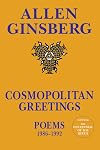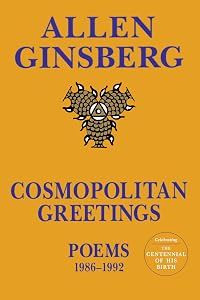
Cosmopolitan Greetings: Poems 1986-1992
by Allen Ginsberg
On This Page
Description
Published on the fiftieth anniversary of the founding of the Beat Generation - that historic encounter in 1944 in New York City between Allen Ginsberg, Jack Kerouac, and William Burroughs - Cosmopolitan Greetings is the first new collection of poems from Allen Ginsberg since his highly acclaimed book White Shroud appeared in 1986. In Cosmopolitan Greetings, Ginsberg's ebullient spirit, his compassion, humor, playfulness, and candor are as refreshing as ever. These are poems from the autumn show more years of his life, a time of extensive activity and engagement for the public figure and a period of reflection and meditation for the Buddhist. The poet confronts evil in the world - the ravages of government, dictators, and the CIA; the wanton destruction of natural resources and of our planet; the suffering of the persecuted, the victims of war - and he does it fearlessly and with passion. Death lurks around the corners of these poems, but Ginsberg's zest for life remains undiminished. His search for love is as poignant, funny, and energetic as his attempt to understand why he writes poetry. There is a wonderful balance in this collection between memory and desire. Ginsberg's ardent pursuit of younger lovers alternates with his poignant revisiting of family, friends, and scenes from his earlier days. Cosmopolitan Greetings demonstrates a variety of poetic style and voice. Some of the poems here have dance rhythms; others are song lyrics, and some are accompanied by sheet music on the facing page. There's even an original comic strip - "Deadline Dragon Comix" - in which Ginsberg's publisher is gently taken to task for pressuring the poet about deadlines. The poems in Cosmopolitan Greetings are vintage Allen Ginsberg; fresh, hopeful, full of humanity and soul in the face of the darkness of our times. show lessTags
Recommendations











Member Reviews
The Beats insisted "First thought, best thought," something Ginsberg reiterated in this collection. First thought should not however, in my opinion, mean published thought. Because I really could have done without all the rectal/anal references, especially the narration of what happens when he sits on the toilet. Also unnecessary were the nonsensical ones, unless those were originally meant as public chants.
If anyone ever wondered what Ginsberg's politics were, this book will set them straight (so to speak).
If anyone ever wondered what Ginsberg's politics were, this book will set them straight (so to speak).
I bought this after listening to the man speak at my (second) college. He recited, among others, 'Sphincter,' and so I wound up waiting two decades to get my nerve up to read this. Turns out that the poems don't get much more graphically grotesque, and some are downright sweet. Still, there are a lot here that don't mean anything to me - after all I'm not a gay man, nor Jewish, nor Beat, nor old, nor neurotic, nor political. On the the third hand, I'm glad I did read/skim this, rather than just donate it unread.
I found myself pretty lost with a lot of this material as there are so many references to (at the time) current events which I have no idea about.
The minority, which I didn't feel so out of my depth with, was stunning, as expected of mr Ginsberg.
The minority, which I didn't feel so out of my depth with, was stunning, as expected of mr Ginsberg.
The best of the craft of poetry.
Dedica: "for Sergio Poggianella "A HF", 4/2/96
Ratings
Members
- Recently Added By
Author Information

301+ Works 16,990 Members
Irwin Allen Ginsberg was born in Newark, New Jersey, the son of poet and teacher Louis Ginsberg. In 1948, he received a B.A. degree from Columbia University. Ginsberg began writing poetry while still in school and first gained wide public recognition in 1956 with the long poem Howl. Howl has had a stormy history. When it was first recited at show more poetry readings, audiences cheered wildly. It was published by Lawrence Ferlinghetti's City Lights Books and printed in England. Before the printed copies could be distributed, however they were seized by U.S. custom officials as obscene. After a famous court case in which the poem was found not to be obscene, the work sold rapidly and Ginsberg's reputation was assured. Regarded as the foremost port of the Beat generation (as group of rebellious writers who opposed conformity and sough intensity of experience), Ginsberg's work is concerned with many subjects of contemporary interest, including drugs, sexual confusion, the voluntary poverty of the artist and rebel, and rejection of society. He is a poet with a significant message, and his criticism of American society is part of a long tradition of American writers who have questioned their country's values. Ginsberg received numerous honors, including a Woodbury Poetry Prize, a National Institute of Arts and Letters Award, and a National Book Award for poetry. Ginsberg was a Pulitzer Prize finalist in 1995 for his book Cosmopolitan Greetings: Poems 1986-1992. Ever the Bohemian, he had numerous occupations throughout his lifetime including dishwasher, porter, book reviewer, and spot welder. He died in April 1997 of complications due to liver cancer. (Bowker Author Biography) show less
Awards and Honors
Awards
Work Relationships
Is contained in
Common Knowledge
- Original publication date
- 1994
Classifications
Statistics
- Members
- 202
- Popularity
- 162,414
- Reviews
- 5
- Rating
- (3.79)
- Languages
- English, Italian
- Media
- Paper
- ISBNs
- 5
- ASINs
- 1