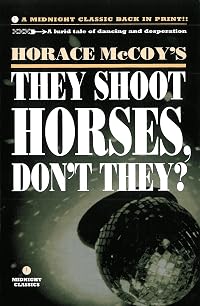
They Shoot Horses, Don't They?
by Horace McCoy
On This Page
Description
Fiction. Literature. During the Depression, Gloria and Robert enter a dance marathon in return for three square meals a day and a chance at winning the big-money prize. Under the intense scrutiny of the media, corporate sponsors and obsessive fans, the competing couples are put through a series of gruelling and humiliating feats of endurance, until they begin to fight among themselves and betray each other. As days and weeks go by, the tension reaches boiling point, and this pitch-black tale show more of desire and desperation heads towards a violent conclusion. show lessTags
Recommendations





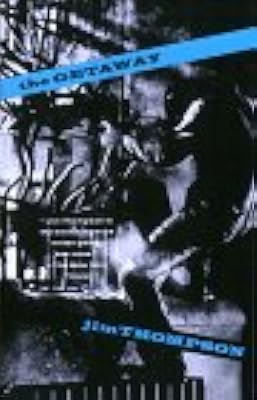
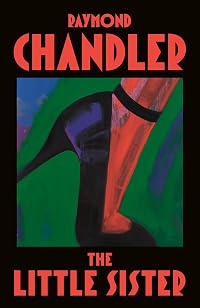
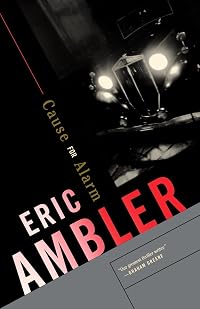

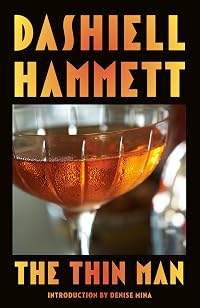




Member Reviews
Horace McCoy’s 1935 novel They Shoot Horses, Don’t They? contains one of the bleakest lines in all of literature. It’s where Gloria, who dances in the marathon dance, asks without a trace of irony or black humor, ”Why are these high-powered scientists always screwing around trying to prolong life instead of finding pleasant ways to end it?” Can there ever be a more negative, more downbeat, pessimistic view of life?
Turns out, Gloria was raised in the most dreadful way, by abusive, cruel people in West Texas. She eventually escaped, moving to Los Angeles, looking to make it in Hollywood movies. Can there ever be a staler, more pathetic aspiration, to see the pretend, artificial world of Hollywood as your salvation?
To be abused show more and debased as a child growing up and then, as a young adult, to be pushed into marathon dancing – the true bloodsport of the Great Depression. And then, after receiving your fifty dollars for a month and a week of marathon dancing, handing your partner a pistol and asking him to blow your brains out. Vintage 1930s America captured in Horace McCoy’s outstanding classic. show less
A very odd little tale, verging on the bizarre if wasn't for the fact that those crazy dance marathons actually happened. McCoy's writing is very taut and contains a heavy dose of dialogue reminiscent of pulp noir fiction that flows along nicely. Apparently the structure - Robert's flashbacks from the dock - was considered experimental when written in the 30s, but I think it works exceedingly well.
The images evoked are a vivid portrait of the misery and despair of many in the depression era and the whole package turns out to be a weird existential look at the times.
The images evoked are a vivid portrait of the misery and despair of many in the depression era and the whole package turns out to be a weird existential look at the times.
"For the first week we had to dance, but after that you didn't. All you had to do was keep moving." (pg. 24)
A cracking short read, the great appeal of They Shoot Horses, Don't They? by Horace McCoy is its originality. Though conventionally hard-boiled in style and unremarkable (though certainly capable) in pace, character and dialogue, the book is so unique an idea that, as a jaded long-time reader, I was thankful for every minute of it.
The central metaphor – mirrored in the title – is absolutely exquisite. The book follows two depressed, directionless young people during a time of acute economic hardship, humiliatingly reduced to competing in an exhausting dance marathon merely to find their next meal. This becomes, in McCoy's show more hands, a metaphor for the grind of modern, moribund life, where you are herded into things you find demeaning and are expected to jump for a few scattered coins, and they work you and work you and when you eventually, inevitably, drop down exhausted and defeated they take you out and shoot you like a horse with a broken leg. Without ever over-explaining it, McCoy laces every line of his short novel with the implications of this metaphor, and the result is a literary experience that is entirely effortless.
Indeed, the book is almost accidental literature; McCoy was a pulp crime writer embittered by his life – having been whacked in the face by the Great Depression – who had hit upon the idea for the novel while working at one of these dance marathons (unfortunately, they were real). When the French existentialists (quite rightly) praised it as a kindred spirit to their school, there's an element of elevation rather than discovery.
That said, it is – for us – discovery; the book is a hidden gem and incredibly relevant for a contemporary generation that has faced two historic recessions in little over ten years, and all during a time of social and cultural disconnect. They Shoot Horses, Don't They? reminded me, in some ways, of the 2019 Joker movie, in that it tells a sad and necessary story about social and economic hardship in an appealing and original way. Bitter pills never tasted so sweet. show less
A cracking short read, the great appeal of They Shoot Horses, Don't They? by Horace McCoy is its originality. Though conventionally hard-boiled in style and unremarkable (though certainly capable) in pace, character and dialogue, the book is so unique an idea that, as a jaded long-time reader, I was thankful for every minute of it.
The central metaphor – mirrored in the title – is absolutely exquisite. The book follows two depressed, directionless young people during a time of acute economic hardship, humiliatingly reduced to competing in an exhausting dance marathon merely to find their next meal. This becomes, in McCoy's show more hands, a metaphor for the grind of modern, moribund life, where you are herded into things you find demeaning and are expected to jump for a few scattered coins, and they work you and work you and when you eventually, inevitably, drop down exhausted and defeated they take you out and shoot you like a horse with a broken leg. Without ever over-explaining it, McCoy laces every line of his short novel with the implications of this metaphor, and the result is a literary experience that is entirely effortless.
Indeed, the book is almost accidental literature; McCoy was a pulp crime writer embittered by his life – having been whacked in the face by the Great Depression – who had hit upon the idea for the novel while working at one of these dance marathons (unfortunately, they were real). When the French existentialists (quite rightly) praised it as a kindred spirit to their school, there's an element of elevation rather than discovery.
That said, it is – for us – discovery; the book is a hidden gem and incredibly relevant for a contemporary generation that has faced two historic recessions in little over ten years, and all during a time of social and cultural disconnect. They Shoot Horses, Don't They? reminded me, in some ways, of the 2019 Joker movie, in that it tells a sad and necessary story about social and economic hardship in an appealing and original way. Bitter pills never tasted so sweet. show less
In the background of the marathon dance events, organized so that money can be made on the suffering of others, during the time when people had nothing to eat (period post 1929) so were willing to do whatever necessary, we are told a story of a woman who is at the end of her strength, person slowly growing ever so bitter and cruel, and who, definitely being aware of it, decides that that is it and that life has no point. She is even bitter because she just cannot end herself, while suffering the very thought that extinguishing of her own life would not register anywhere. Everything she touches, or that touches her, just feels dirty,corrupt, even kind acts from people that do happen, but finally end up as misinterpreted or ignored by show more her. It is story of a person that from early age got chewed by the very society and then spit out, without that energy spark that should drive humans onward, left as if there is no future ahead (or to be more precise no future she wants, that she sees in various high society stories and glamor magazines (very disturbing elements here with modern social media)).
There are a lot of people like this in every age and time, even today, and some like to name them nihilists, but these are not intellectuals that seek oblivion of everything, all the while keeping themselves outside any harm.
These are ordinary people who could have normal lives but at some point decided that if they cannot have what they want then nothing matters, and they just made the headlong plunge into the black hole of emotions. They do not pretend for shock value to want to die - they actually want it. And times of crisis only underline the difficulties, and only exacerbate the negativity. In the end folks like this just take with them those that try to enjoy life as much as is possible, which is what happens to her dance partner. People who will try to help, feel the pain and then, through innate naivete or stupidity, might even try to help these depression-holes out of their misery. Only to end up with their own life destroyed in the process.
This is short read, but very difficult one. It is truly heartbreaking seeing someone willing to give up of this gift called life just because at the moment things do not go their way. Nobody knows how they would react in situations like this, and hopefully one will never know, but it is difficult to just see people ..... implode. Terrible.
Very interesting novel, I was aware of the movie but not the book. Difficult read, but it is more than obvious that it contains autobiographical elements. It is not quick read, starts slowly but then with each chapter (I especially like parallel sections from the trial to show the level of madness) accelerates into the spiral of darkness that can only end in one way. Very dark novel.
Recommended to people interested in societal extremes, and reactions of people under accumulated stress. show less
There are a lot of people like this in every age and time, even today, and some like to name them nihilists, but these are not intellectuals that seek oblivion of everything, all the while keeping themselves outside any harm.
These are ordinary people who could have normal lives but at some point decided that if they cannot have what they want then nothing matters, and they just made the headlong plunge into the black hole of emotions. They do not pretend for shock value to want to die - they actually want it. And times of crisis only underline the difficulties, and only exacerbate the negativity. In the end folks like this just take with them those that try to enjoy life as much as is possible, which is what happens to her dance partner. People who will try to help, feel the pain and then, through innate naivete or stupidity, might even try to help these depression-holes out of their misery. Only to end up with their own life destroyed in the process.
This is short read, but very difficult one. It is truly heartbreaking seeing someone willing to give up of this gift called life just because at the moment things do not go their way. Nobody knows how they would react in situations like this, and hopefully one will never know, but it is difficult to just see people ..... implode. Terrible.
Very interesting novel, I was aware of the movie but not the book. Difficult read, but it is more than obvious that it contains autobiographical elements. It is not quick read, starts slowly but then with each chapter (I especially like parallel sections from the trial to show the level of madness) accelerates into the spiral of darkness that can only end in one way. Very dark novel.
Recommended to people interested in societal extremes, and reactions of people under accumulated stress. show less
Waltzing with Absurdity
When your world falls down around you, when most of everything you believed true proves false, as happened to many in the Great Depression, then the entire idea of existence, of your existence can go from optimistic to hopeless, from rational (or at least somewhat rational) to completely absurd, in the sense of meaningless. With this in mind, you have a reasonable framework for understanding why Robert Syverten stands before a judge receiving his death sentence for the murder of Gloria Beatty. Here you have the bright eternal optimist, Robert, dancing with the ground-down pessimist, Gloria, both isolated in a ring of absurdity, the marathon dance ring (popular entertainment in the 1920s and 1930s).
Robert and show more Gloria meet by accident at a movie studio, where both have failed to land jobs as extras. Gloria persuades Robert, who is as down and out as she, to partner with her in a dance marathon down on a pier in Los Angeles. As the two get to know each other over the course of the five weeks they dance and walk together, readers learn about their lives.
Robert’s a farm boy who came to L.A. to become a director, a wildly optimistic pursuit as he has no training or film experience. However, he is stubbornly hopeful, always trying to look on the bright side of life.
Robert could not have found a more polar opposite to himself than Gloria if he had tried. She sees only the darkness in the world and openly and often tells him she wishes she were dead, that she would die, that once she had tried killing herself. Her parents are dead; she fled her relatives in West Texas, where her uncle attempted sexually abusing her. In addition, she is argumentative and pugnacious, calling for a married pregnant contestant to get an abortion, while herself having sex with one of the promoters to advance her chances of winning.
For five weeks, they live and dance in the confines of the dance hall. The audiences build and cheer them on, attracted by the promise of drama on the floor. Couples, pushed to and beyond their limits in derbies (extended periods of racing to avoid elimination), collapse, arguments and fights breakout, and, in the end, a fatal shooting (not Robert and Gloria’s) take place, ending the competition abruptly.
In other words, the pair, and the other contestants, exist in a pressure cooker of frustration, false hope, and fear of elimination and a return to an ever rougher, more unforgiving world. It’s enough to wear even an optimist like Robert to the nub, to the point where even the absurd seems reasonable. And the ultimate of that, Robert becoming the agent helping Gloria exit her dismal world of pain. Then accounting for his action with a remembrance of how his grandfather dispatched an injured horse they both loved, saying, “They shoot horses, don’t they?” By extension, why should suffering humans be treated any differently and allowed to linger and suffer? show less
When your world falls down around you, when most of everything you believed true proves false, as happened to many in the Great Depression, then the entire idea of existence, of your existence can go from optimistic to hopeless, from rational (or at least somewhat rational) to completely absurd, in the sense of meaningless. With this in mind, you have a reasonable framework for understanding why Robert Syverten stands before a judge receiving his death sentence for the murder of Gloria Beatty. Here you have the bright eternal optimist, Robert, dancing with the ground-down pessimist, Gloria, both isolated in a ring of absurdity, the marathon dance ring (popular entertainment in the 1920s and 1930s).
Robert and show more Gloria meet by accident at a movie studio, where both have failed to land jobs as extras. Gloria persuades Robert, who is as down and out as she, to partner with her in a dance marathon down on a pier in Los Angeles. As the two get to know each other over the course of the five weeks they dance and walk together, readers learn about their lives.
Robert’s a farm boy who came to L.A. to become a director, a wildly optimistic pursuit as he has no training or film experience. However, he is stubbornly hopeful, always trying to look on the bright side of life.
Robert could not have found a more polar opposite to himself than Gloria if he had tried. She sees only the darkness in the world and openly and often tells him she wishes she were dead, that she would die, that once she had tried killing herself. Her parents are dead; she fled her relatives in West Texas, where her uncle attempted sexually abusing her. In addition, she is argumentative and pugnacious, calling for a married pregnant contestant to get an abortion, while herself having sex with one of the promoters to advance her chances of winning.
For five weeks, they live and dance in the confines of the dance hall. The audiences build and cheer them on, attracted by the promise of drama on the floor. Couples, pushed to and beyond their limits in derbies (extended periods of racing to avoid elimination), collapse, arguments and fights breakout, and, in the end, a fatal shooting (not Robert and Gloria’s) take place, ending the competition abruptly.
In other words, the pair, and the other contestants, exist in a pressure cooker of frustration, false hope, and fear of elimination and a return to an ever rougher, more unforgiving world. It’s enough to wear even an optimist like Robert to the nub, to the point where even the absurd seems reasonable. And the ultimate of that, Robert becoming the agent helping Gloria exit her dismal world of pain. Then accounting for his action with a remembrance of how his grandfather dispatched an injured horse they both loved, saying, “They shoot horses, don’t they?” By extension, why should suffering humans be treated any differently and allowed to linger and suffer? show less
Waltzing with Absurdity
When your world falls down around you, when most of everything you believed true proves false, as happened to many in the Great Depression, then the entire idea of existence, of your existence can go from optimistic to hopeless, from rational (or at least somewhat rational) to completely absurd, in the sense of meaningless. With this in mind, you have a reasonable framework for understanding why Robert Syverten stands before a judge receiving his death sentence for the murder of Gloria Beatty. Here you have the bright eternal optimist, Robert, dancing with the ground-down pessimist, Gloria, both isolated in a ring of absurdity, the marathon dance ring (popular entertainment in the 1920s and 1930s).
Robert and show more Gloria meet by accident at a movie studio, where both have failed to land jobs as extras. Gloria persuades Robert, who is as down and out as she, to partner with her in a dance marathon down on a pier in Los Angeles. As the two get to know each other over the course of the five weeks they dance and walk together, readers learn about their lives.
Robert’s a farm boy who came to L.A. to become a director, a wildly optimistic pursuit as he has no training or film experience. However, he is stubbornly hopeful, always trying to look on the bright side of life.
Robert could not have found a more polar opposite to himself than Gloria if he had tried. She sees only the darkness in the world and openly and often tells him she wishes she were dead, that she would die, that once she had tried killing herself. Her parents are dead; she fled her relatives in West Texas, where her uncle attempted sexually abusing her. In addition, she is argumentative and pugnacious, calling for a married pregnant contestant to get an abortion, while herself having sex with one of the promoters to advance her chances of winning.
For five weeks, they live and dance in the confines of the dance hall. The audiences build and cheer them on, attracted by the promise of drama on the floor. Couples, pushed to and beyond their limits in derbies (extended periods of racing to avoid elimination), collapse, arguments and fights breakout, and, in the end, a fatal shooting (not Robert and Gloria’s) take place, ending the competition abruptly.
In other words, the pair, and the other contestants, exist in a pressure cooker of frustration, false hope, and fear of elimination and a return to an ever rougher, more unforgiving world. It’s enough to wear even an optimist like Robert to the nub, to the point where even the absurd seems reasonable. And the ultimate of that, Robert becoming the agent helping Gloria exit her dismal world of pain. Then accounting for his action with a remembrance of how his grandfather dispatched an injured horse they both loved, saying, “They shoot horses, don’t they?” By extension, why should suffering humans be treated any differently and allowed to linger and suffer? show less
When your world falls down around you, when most of everything you believed true proves false, as happened to many in the Great Depression, then the entire idea of existence, of your existence can go from optimistic to hopeless, from rational (or at least somewhat rational) to completely absurd, in the sense of meaningless. With this in mind, you have a reasonable framework for understanding why Robert Syverten stands before a judge receiving his death sentence for the murder of Gloria Beatty. Here you have the bright eternal optimist, Robert, dancing with the ground-down pessimist, Gloria, both isolated in a ring of absurdity, the marathon dance ring (popular entertainment in the 1920s and 1930s).
Robert and show more Gloria meet by accident at a movie studio, where both have failed to land jobs as extras. Gloria persuades Robert, who is as down and out as she, to partner with her in a dance marathon down on a pier in Los Angeles. As the two get to know each other over the course of the five weeks they dance and walk together, readers learn about their lives.
Robert’s a farm boy who came to L.A. to become a director, a wildly optimistic pursuit as he has no training or film experience. However, he is stubbornly hopeful, always trying to look on the bright side of life.
Robert could not have found a more polar opposite to himself than Gloria if he had tried. She sees only the darkness in the world and openly and often tells him she wishes she were dead, that she would die, that once she had tried killing herself. Her parents are dead; she fled her relatives in West Texas, where her uncle attempted sexually abusing her. In addition, she is argumentative and pugnacious, calling for a married pregnant contestant to get an abortion, while herself having sex with one of the promoters to advance her chances of winning.
For five weeks, they live and dance in the confines of the dance hall. The audiences build and cheer them on, attracted by the promise of drama on the floor. Couples, pushed to and beyond their limits in derbies (extended periods of racing to avoid elimination), collapse, arguments and fights breakout, and, in the end, a fatal shooting (not Robert and Gloria’s) take place, ending the competition abruptly.
In other words, the pair, and the other contestants, exist in a pressure cooker of frustration, false hope, and fear of elimination and a return to an ever rougher, more unforgiving world. It’s enough to wear even an optimist like Robert to the nub, to the point where even the absurd seems reasonable. And the ultimate of that, Robert becoming the agent helping Gloria exit her dismal world of pain. Then accounting for his action with a remembrance of how his grandfather dispatched an injured horse they both loved, saying, “They shoot horses, don’t they?” By extension, why should suffering humans be treated any differently and allowed to linger and suffer? show less
Horace McCoy’s 1935 novel They Shoot Horses, Don’t They? contains one of the bleakest lines in all of literature. It’s where Gloria, who dances in the marathon dance, asks without a trace of irony or black humor, ”Why are these high-powered scientists always screwing around trying to prolong life instead of finding pleasant ways to end it?” Can there ever be a more negative, more downbeat, pessimistic view of life?
Turns out, Gloria was raised in the most dreadful way, by abusive, cruel people in West Texas. She eventually escaped, moving to Los Angeles, looking to make it in Hollywood movies. Can there ever be a staler, more pathetic aspiration, to see the pretend, artificial world of Hollywood as your salvation?
To be abused show more and debased as a child growing up and then, as a young adult, to be pushed into marathon dancing – the true bloodsport of the Great Depression. And then, after receiving your fifty dollars for a month and a week of marathon dancing, handing your partner a pistol and asking him to blow your brains out. Vintage 1930s America captured in Horace McCoy’s outstanding classic. show less
Members
- Recently Added By
Lists

1001 Books You Must Read Before You Die
1,448 works; 1,135 members

Read the book and saw the movie
1,170 works; 195 members

1,001 BYMRBYD Concensus
723 works; 27 members

1930s
262 works; 5 members

Books Featured on Gilmore Girls
307 works; 21 members

Read
293 works; 4 members

Animals in the Title
498 works; 11 members

Noirvember: The Best Noir
113 works; 56 members
Canon de la narrativa universal del s. XX (cicutadry)
499 works; 3 members
The Complete Rory Gilmore Reading List
506 works; 5 members
Author Information

26+ Works 1,655 Members
Some Editions
Awards and Honors
Series
Belongs to Publisher Series
Work Relationships
Is contained in
American Noir: 11 Classic Crime Novels of the 1930s, 40s, & 50s: A Library of America Boxed Set by Robert Polito (indirect)
Club del misterio. Volumen I: Prólogo de J. J. BORGES. "El cuento policial, IX" . Dashiell HAMMETT: "Cosecha roja". Arthur CONAN DOYLE: "Las aventuras de Shrlock Holmes". Hellery QUEEN: "Cara a cara". Raymond CHANDLER: "El sueño eterno". Patricia IHGSMITH: Erle STANLEY GARDNER: "El cuchillo". "El caso del juguete mortífero". James HADLEY CHASE: "Impulso creador". "El secuestro de Miss Blandish". Nicholas BLAKE: "La bestia debe morir". Volumen 2: Prólogo de R. CHANDLER: " El simpl by AA. VV. (indirect)
Has the adaptation
Common Knowledge
- Canonical title
- They Shoot Horses, Don't They?
- Original title
- They Shoot Horses, Don't They?
- Original publication date
- 1935
- People/Characters
- Robert Syverten; Gloria Beatty; Mrs Layden
- Important places
- California, USA; Santa Monica, California, USA
- Related movies
- They Shoot Horses, Don't They? (1969 | IMDb)
- Dedication
- To Michael Fessier and Harry Clay Withers
- First words
- The prisoner will stand.
- Last words
- (Click to show. Warning: May contain spoilers.)... may God have mercy on your soul ...
- Original language
- English
Classifications
Statistics
- Members
- 1,086
- Popularity
- 23,590
- Reviews
- 57
- Rating
- (3.76)
- Languages
- 17 — Catalan, Czech, Danish, Dutch, English, Finnish, French, German, Hungarian, Italian, Norwegian (Bokmål), Polish, Portuguese, Romanian, Spanish, Thai, Turkish
- Media
- Paper, Ebook
- ISBNs
- 45
- ASINs
- 23