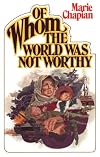
Of Whom the World Was Not Worthy
by Marie Chapian
On This Page
Tags
Recommendations


















Member Reviews
This book's title comes from the “great faith chapter” in Hebrews, which starts with these words: Now faith is the substance of things hoped for, the evidence of things not seen. Beginning with Abel, the chapter lists the heroes of the Old Testament and the things their faith enabled them to do. The list ends with the unnamed and countless men and women who were destitute, homeless, tortured, imprisoned, and murdered for their faith, and it testifies of their character that the world was not worthy of them. To this number, author Marie Chapian adds Slovenian Christians who suffered greatly during World War II and the post-war years.
The central figure in Chapian's story is Jozeca , the wife of Baptist evangelist Jakob Kovac (not show more their real names). Chapian writes of the courtship and marriage of this unlikely couple who, despite the 35-year difference in their ages, were drawn together by their shared faith. Although Jakob often worked in the coal mines, evangelism was his primary calling. He traveled throughout Yugoslavia to preach to groups of Christians, who often met in homes. Jozeca became known as the praying woman, and people in trouble called her to come and pray for them when they had no where else to turn.
The war years were difficult in Slovenia. Some Slovenes sided with the Germans, while others formed partisan groups loosely organized under Tito. Control of villages passed from side to side, often ending with the massacre of entire populations in retaliation for assistance provided to the previous occupiers of the villages. Families were split apart by imprisonment or conscription into partisan military activities. Food and shelter were scarce, and work was difficult to find. Things didn't improve much after the war, as jobs, food, and shelter were still in short supply. Jakob and Jozeca's faith sustained them through their years of suffering.
Jozeca prayed about the great problems she faced, and she never forgot to thank God for answering her prayers. Jozeca's example reminds me to be grateful for the small blessings each day brings. Her story is recommended for readers of Christian biography, particularly those with an interest in Baptist missions. show less
The central figure in Chapian's story is Jozeca , the wife of Baptist evangelist Jakob Kovac (not show more their real names). Chapian writes of the courtship and marriage of this unlikely couple who, despite the 35-year difference in their ages, were drawn together by their shared faith. Although Jakob often worked in the coal mines, evangelism was his primary calling. He traveled throughout Yugoslavia to preach to groups of Christians, who often met in homes. Jozeca became known as the praying woman, and people in trouble called her to come and pray for them when they had no where else to turn.
The war years were difficult in Slovenia. Some Slovenes sided with the Germans, while others formed partisan groups loosely organized under Tito. Control of villages passed from side to side, often ending with the massacre of entire populations in retaliation for assistance provided to the previous occupiers of the villages. Families were split apart by imprisonment or conscription into partisan military activities. Food and shelter were scarce, and work was difficult to find. Things didn't improve much after the war, as jobs, food, and shelter were still in short supply. Jakob and Jozeca's faith sustained them through their years of suffering.
Jozeca prayed about the great problems she faced, and she never forgot to thank God for answering her prayers. Jozeca's example reminds me to be grateful for the small blessings each day brings. Her story is recommended for readers of Christian biography, particularly those with an interest in Baptist missions. show less
The Yugoslavians fought back to the German army. Their war cry was "Better grave than slave!" In the midst of living hell Jakob, Joseca & other believers clung to God and prayed for both friend & foe. Their enemies could burn their cities & towns but they could not destroy their souls or quench their indomitable spirits. Marie went to Yugoslavia & interviewed these people to learn how the Christian's faith was sustained thru those terrible years of war, famine & cold. This is their story.
According to the back of the book, the author traveled to what was then Yugoslavia to interview Christians whose faith had been challenged during the oppressive times of World War II. The resulting book is the story of Jakob and Jozeca and their children. Their story took place in what is now the country of Slovenia, although it was then just a part of Yugoslavia. We learn of his commitment to preaching the gospel and of Jozeca's conversion from Catholicism to Protestantism. We see Hitler and Mussolini, and the horrors wrought by their regime. We see the fear under which even those who were doing no wrong lived. It was quite easy to be imprisoned and tortured for one's faith and to be seen as aiding the enemy by unknowingly giving show more housing to someone who might have been working for the other side. We see the economic problems of the time, which were at least, in part, due to the war. We also see the power of prayer. Perhaps the saddest thing for me is the manner in which she was treated by the German missionary who took her husband's place in the church upon his death. I am thankful that her faith was stronger than the persecution she faced so we could hear her story. show less
Ratings
Members
- Recently Added By
Author Information

50+ Works 1,876 Members
Marie Chapian is a certified Christian life and fulfillment coach and the New York Times bestselling author and coauthor of more than thirty books, including Telling Yourself the Truth. Winner of numerous awards, including Campus Life's Best Book of the Year and the Gold Medallion Book Award, she holds a doctorate in counseling and an MFA in show more creative writing. She lives in southern California. Learn more at www.mariechapian.com. show less
Common Knowledge
- Canonical title
- Of Whom the World Was Not Worthy
- Original publication date
- 1978
- Important places
- Slovenia; Yugoslavia
- Important events
- World War II
- First words
- [Preface] Heroes of the past as well as now are people like you and me - not extraordinary supermen and superwomen, but people, as the Bible puts it, who "are made strong in weakness."
[Introduction] This is a true story.
All around, silent linden trees were buried in snow. - Last words
- (Click to show. Warning: May contain spoilers.)And she believed that.
- Canonical DDC/MDS
- 248.4
Classifications
- Genres
- Religion & Spirituality, Nonfiction, Biography & Memoir
- DDC/MDS
- 248.4 — Religion Christian practice & observance Christian experience, practice, life Christian Living
- LCC
- BV4501.2 .C4758 — Philosophy, Psychology and Religion Practical Theology Practical Theology Practical religion. The Christian life
Statistics
- Members
- 192
- Popularity
- 169,923
- Reviews
- 3
- Rating
- (3.75)
- Languages
- English, Finnish, Swedish
- Media
- Paper
- ISBNs
- 5
- ASINs
- 1