On This Page
Description
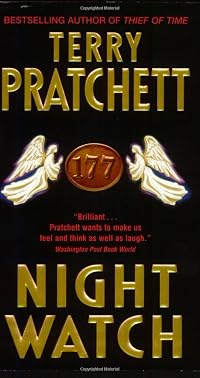
One moment, Sir Sam Vimes is in his old patrolman form, chasing a sweet-talking psychopath across the rooftops of Ankh-Morpork. The next, he's lying naked in the street, having been sent back thirty years courtesy of a group of time-manipulating monks who won't leave well enough alone. This Discworld is a darker place that Vimes remembers too well, three decades before his title, fortune, beloved wife, and impending first child. Worse still, the murderer he's pursuing has been transported show more back also. Worst of all, it's the eve of a fabled street rebellion that needlessly destroyed more than a few good (and not so good) men. Sam Vimes knows his duty, and by changing history he might just save some worthwhile necks-though it could cost him his own personal future. Plus there's a chance to steer a novice watchman straight and teach him a valuable thing or three about policing, an impressionable young copper named Sam Vimes. show lessTags
Recommendations





Member Reviews
One of my favourite Discworlds, the premise here is fantastic. Vimes is sent back in time accidentally, and he has to Not Change Anything Important whilst preventing a Baddy from changing Important Things. Of course, by not changing anything, he is allowing all sorts of terribleness to happen, not least his own moral failures and descent into alcoholism. This obviously poses a series of moral problems for Vimes, as well as the very material problems caused by the existence of his own younger self wandering around being vulnerable! It is this being-pulled-in-all-directions that creates the dramatic tension in Night Watch. Also, the politics of liberal revolution are entertainingly, though nihilistically, dissected here.
Further thoughts show more inspired by Night Watch:
Pratchett is often described as being a humanist, an every life counts sort of guy. But like a lot of liberals his humanism is faux-nihilistic. He implies that nothing can change, that things are bad because people are bad, and that people who want to change things are as bad, if not worse, than the bad people at the top. His answer, like all liberals, is that we should all be nice to each other . but the structures are never critiqued. in his world capitalism is a force of human nature, not a set of decisions. it is often cut-throat, but this can be dealt with by the expediency of killing people. yet anyone else whose official policy is killing bad people is treating with suspicion or outright hostility - they are monsters, i am merely righting historic wrongs.
i did note something in this readthrough that i had missed before - on the night that SV is dropped into the past, Sybil is having their first child. She is locked in her room with Mrs Comfort the midwife. When he returns half-an hour later in their time, there are complications and the stupid midwife is blamed, SV summons a Proper Man Doctor who resolved the issue and there is celebration throughout the land. But I have read Sylvia Federici since last reading Night Watch, and so instead of a plot device i see represented the transition from women's knowledge and ownership of the means of production to men's claim of professionalism and ownership of the means of production, which took place during the time period roughly represented during the City Watch-Industrial cycles of Discworld. Rather than being presented critically we see actually the liberal triumph of 'reason', which was used as excuse first to burn thousands of women to death and then to exclude women from social hierarchies. So scratch a liberal and what do we find?
Finally the role of Vetinari in this. As a trainee assassin, and the Best Assassin Ever, he is tasked with killing the old patrician during the liberal revolution. But when it comes to it, the patrician has a heart attack. Thus like old comics code, Vetinari's hands remain clean! Why is this? has he ever killed anyone on screen, so to speak? i can't remember. he tells Vimes in the now that he killed 4 people that day, but we don't see it. is it so a beloved character can remain clean? or was it a reference to something else that i don't know about? show less
Further thoughts show more inspired by Night Watch:
Pratchett is often described as being a humanist, an every life counts sort of guy. But like a lot of liberals his humanism is faux-nihilistic. He implies that nothing can change, that things are bad because people are bad, and that people who want to change things are as bad, if not worse, than the bad people at the top. His answer, like all liberals, is that we should all be nice to each other . but the structures are never critiqued. in his world capitalism is a force of human nature, not a set of decisions. it is often cut-throat, but this can be dealt with by the expediency of killing people. yet anyone else whose official policy is killing bad people is treating with suspicion or outright hostility - they are monsters, i am merely righting historic wrongs.
i did note something in this readthrough that i had missed before - on the night that SV is dropped into the past, Sybil is having their first child. She is locked in her room with Mrs Comfort the midwife. When he returns half-an hour later in their time, there are complications and the stupid midwife is blamed, SV summons a Proper Man Doctor who resolved the issue and there is celebration throughout the land. But I have read Sylvia Federici since last reading Night Watch, and so instead of a plot device i see represented the transition from women's knowledge and ownership of the means of production to men's claim of professionalism and ownership of the means of production, which took place during the time period roughly represented during the City Watch-Industrial cycles of Discworld. Rather than being presented critically we see actually the liberal triumph of 'reason', which was used as excuse first to burn thousands of women to death and then to exclude women from social hierarchies. So scratch a liberal and what do we find?
Finally the role of Vetinari in this. As a trainee assassin, and the Best Assassin Ever, he is tasked with killing the old patrician during the liberal revolution. But when it comes to it, the patrician has a heart attack. Thus like old comics code, Vetinari's hands remain clean! Why is this? has he ever killed anyone on screen, so to speak? i can't remember. he tells Vimes in the now that he killed 4 people that day, but we don't see it. is it so a beloved character can remain clean? or was it a reference to something else that i don't know about? show less
Reread 2026: That was an enjoyable read. I think I keep saying this about these books but it sure is a poignant read with everything going on in Round World right now. Pratchett sure knew human nature. He is dearly missed. Original review below.
---------------
Night Watch is the 29th novel in Terry Pratchett's Discworld series and the 6th of the City Watch sub-series. Sam Vimes goes on a timey-wimey adventure into Ankh-Morpork and the City Watch's past landing in the middle of major historical events in the city.
"And so the children of the revolution were faced with the age-old problem: it wasn’t that you had the wrong kind of government, which was obvious, but that you had the wrong kind of people.
As soon as you saw people as things show more to be measured, they didn’t measure up."
Time travel is one of my least favorite tropes in fantasy. Thankfully that is not the focus of the story, though there is plenty of fretting over changing the future by altering the past. Instead it is the story of the events that shaped young Sam Vimes into the old Sam Vimes we've grown to love over five previous books by, err, himself. Or something. There's definitely a time loop involved.
That bit of head scratching logic aside, this is a surprisingly poignant read and not the story I was expecting for a Watch novel. Pratchett has some insightful things to say about society, policing, government and duty that feels extremely relevant in these trying times. I don't know how Pratchett does it. This story is both disturbing in how real it is and comforting for the hope it provides. show less
---------------
Night Watch is the 29th novel in Terry Pratchett's Discworld series and the 6th of the City Watch sub-series. Sam Vimes goes on a timey-wimey adventure into Ankh-Morpork and the City Watch's past landing in the middle of major historical events in the city.
"And so the children of the revolution were faced with the age-old problem: it wasn’t that you had the wrong kind of government, which was obvious, but that you had the wrong kind of people.
As soon as you saw people as things show more to be measured, they didn’t measure up."
Time travel is one of my least favorite tropes in fantasy. Thankfully that is not the focus of the story, though there is plenty of fretting over changing the future by altering the past. Instead it is the story of the events that shaped young Sam Vimes into the old Sam Vimes we've grown to love over five previous books by, err, himself. Or something. There's definitely a time loop involved.
That bit of head scratching logic aside, this is a surprisingly poignant read and not the story I was expecting for a Watch novel. Pratchett has some insightful things to say about society, policing, government and duty that feels extremely relevant in these trying times. I don't know how Pratchett does it. This story is both disturbing in how real it is and comforting for the hope it provides. show less
My intermittent re-reading of Pratchett's City Watch books continues with Night Watch. In this one, Commander Vimes is flung back in time while chasing a psychopathic murderer and finds himself fighting in a revolution he already lived through once, but seems destined not to live through this time.
This is often named as possibly the best of Pratchett's Discworld books (a category with a heck of a lot of competition). I'm not sure it's my own personal favorite, but it is damned, damned good. Pratchett's writing often features some extremely insightful reflections on what we might call the human condition -- much more so than you'd expect from what purports to be a fun, humorous fantasy series -- and that is very much in evidence here. show more Pratchett looks full-on at the often uncaring messiness of the world and its depressing cycles of repeating history, but tempers that with some affecting examples of the hope that community ties and the integrity and humanity of individuals can provide in the face of faceless oppression. It may have left me with a bit of a lump in my throat at the end. And, of course, it once again provides an excellent showcase for one of Pratchett's best characters, and comes with a generous helping of Pratchett's trademark wit.
Also, I'm not saying that Mad Lord Snapcase -- who is raised to power by people desperate for change largely on the basis that he pretends to pay attention to them as he waves from his fancy carriage, only to immediately prove to be a self-centered and terrible ruler -- well, I'm not saying he makes me think of anybody in particular. I'll just say that none of these books seems to have gotten any less timely and relevant-feeling since the day they were published. show less
This is often named as possibly the best of Pratchett's Discworld books (a category with a heck of a lot of competition). I'm not sure it's my own personal favorite, but it is damned, damned good. Pratchett's writing often features some extremely insightful reflections on what we might call the human condition -- much more so than you'd expect from what purports to be a fun, humorous fantasy series -- and that is very much in evidence here. show more Pratchett looks full-on at the often uncaring messiness of the world and its depressing cycles of repeating history, but tempers that with some affecting examples of the hope that community ties and the integrity and humanity of individuals can provide in the face of faceless oppression. It may have left me with a bit of a lump in my throat at the end. And, of course, it once again provides an excellent showcase for one of Pratchett's best characters, and comes with a generous helping of Pratchett's trademark wit.
Also, I'm not saying that Mad Lord Snapcase -- who is raised to power by people desperate for change largely on the basis that he pretends to pay attention to them as he waves from his fancy carriage, only to immediately prove to be a self-centered and terrible ruler -- well, I'm not saying he makes me think of anybody in particular. I'll just say that none of these books seems to have gotten any less timely and relevant-feeling since the day they were published. show less
In one timeline, I read this in 2015 and it was a total miss even though I had an affection for the character of Sam Vines. It quite possibly had to do with an attempt I was making to understand Pratchett and appreciate him as much as his fans do by reading the series in order.
In another timeline, 2021 to be exact, I started re-reading with an enthusiastic book buddy, trading off a hyper-Pratchett-esque indy book that was exhausting me with Three Stooges antics and fourth wall-breaking asides.
In the second timeline, a mere six chronological years, one pandemic, and approximately four hundred emotional decades later, I realized what a lovely--yes, you read that right, I called Pratchett 'lovely'--meditation on aging, responsibility, show more consequences, and history this was. It is very much a swan song of a book, an ode to prior characters who often make brief but important appearances, whether in their young or aged selves. It is a book that will no doubt land better with the aged reader who can viscerally feel Vimes' perspective:
"You’re not me, he thought. I don’t think I was ever as young as you. If you’re going to be me, it’s going to take a lot of work. Thirty damn years of being hammered on the anvil of life, you poor bastard. You’ve got it all to come."
I realized as I was reading Pratchett that my earlier book was so focused on being funny that it failed to contrast or highlight with an emotional counter-point. Here, Pratchett has the occasional extreme such as farcical bragging or ridiculous incompetence, but also contains all these other emotional notes and sad histories.
Surprisingly, there's also quite a bit about political unrest and revolutions, particularly unsettling in its accuracy to a tumultuous 2020.
“No. The *protest* was over the price of bread, said Vimes’s inner voice. The riot was what happens when you have panicking people trapped between idiots on horseback and other idiots shouting “yeah, right!” and trying to push forward, and the whole thing in the charge of a fool advised by a maniac with a steel rule.”
Bringing to mind all the protests of 2020.
"People said things like “Quite possibly we shall never know the truth” which meant, in Vimes’s personal lexicon, “I know, or think I know what the truth is, and hope like hell it doesn’t come out, because things are all smoothed over now.”
Bringing to mind the lack of accountability post insurrection.
But the most insightful commentary on politics was yet to come:
“Vimes had spent his life on the streets and had met decent men, and fools, and people who’d steal a penny from a blind beggar, and people who performed silent miracles or desperate crimes every day behind the grubby windows of little houses, but he’d never met The People.
People on the side of The People always ended up disappointed, in any case. They found that The People tended not to be grateful or appreciative or forward-thinking or obedient. The People tended to be small-minded and conservative and not very clever and were even distrustful of cleverness. And so, the children of the revolution were faced with the age-old problem: it wasn’t that you had the wrong kind of government, which was obvious, but that you had the wrong kind of people.
As soon as you saw people as things to be measured, they didn’t measure up.”
If that doesn't say something about all groups, than you didn't read it very well.
A quite excellent, if occasionally melancholic re-read, at least from the 2021 timeline perspective. May we all return to the timeline where there's someone we love (but I'll pass on the baby).
Many, many thanks to Nataliya, her enthusiasm and her insights!
The first timeline review: (spoiler for length, not actual spoilers.
Thud! Thud!
In one timeline, that’s the name of another Pratchett Discworld novel (the 34th, apparently).
[b:Thud!|62530|Thud! (Discworld, #34; City Watch #7)|Terry Pratchett|https://i.gr-assets.com/images/S/compressed.photo.goodreads.com/books/1320495268l/62530._SY75_.jpg|819104]
In another, that’s the sound of me marching to my own drum.
In yet another, that’s the sound the vegetables thrown by my book-loving friends make when they hit my hard head.
Because, honestly, this was in between the “okay” and ‘liked it” kind of read for me. Given my GR friend average rating of 4.52, I’m missing something. Most likely, it is books one through five in the Night Watch sub-series of Discworld. I did read at least two Vines books, Men at Arms, and possibly Feet of Clay. Or maybe it was that other timeline, because it was a really, really long time ago, and Vines was almost all I remembered (remember, I told you: “I often have only foggy details stored.”)
Night Watch: A Discworld novel in which guardsman Sam Vines learns that Time Travel is Confusing. Currently a Baron, with time occupied more by meetings than by feeling the city stones beneath his feet, Sam Vines is thrown back into history as he attempts to catch a serial killer. In an unusual twist, Vines will have to play mentor to young Sam. Certainly interesting, at times philosophical, it definitely has a feel-good aspect that helps it go down easily. The trouble is, much of the story has to do with the history of the city of Ankh-Morpork and the various politicking of the rulers and those propping them up, and the Night Watch’s own role in keeping the peace. Certainly a worthwhile topic, particularly at this time in American history (I can’t speak to other countries), but the message is incompletely rendered to those unfamiliar with Discworld’s intricacies.
The upshot?
Don’t listen to me, unless you haven’t read any of the Discworld books.
Thud!
In another timeline, 2021 to be exact, I started re-reading with an enthusiastic book buddy, trading off a hyper-Pratchett-esque indy book that was exhausting me with Three Stooges antics and fourth wall-breaking asides.
In the second timeline, a mere six chronological years, one pandemic, and approximately four hundred emotional decades later, I realized what a lovely--yes, you read that right, I called Pratchett 'lovely'--meditation on aging, responsibility, show more consequences, and history this was. It is very much a swan song of a book, an ode to prior characters who often make brief but important appearances, whether in their young or aged selves. It is a book that will no doubt land better with the aged reader who can viscerally feel Vimes' perspective:
"You’re not me, he thought. I don’t think I was ever as young as you. If you’re going to be me, it’s going to take a lot of work. Thirty damn years of being hammered on the anvil of life, you poor bastard. You’ve got it all to come."
I realized as I was reading Pratchett that my earlier book was so focused on being funny that it failed to contrast or highlight with an emotional counter-point. Here, Pratchett has the occasional extreme such as farcical bragging or ridiculous incompetence, but also contains all these other emotional notes and sad histories.
Surprisingly, there's also quite a bit about political unrest and revolutions, particularly unsettling in its accuracy to a tumultuous 2020.
“No. The *protest* was over the price of bread, said Vimes’s inner voice. The riot was what happens when you have panicking people trapped between idiots on horseback and other idiots shouting “yeah, right!” and trying to push forward, and the whole thing in the charge of a fool advised by a maniac with a steel rule.”
Bringing to mind all the protests of 2020.
"People said things like “Quite possibly we shall never know the truth” which meant, in Vimes’s personal lexicon, “I know, or think I know what the truth is, and hope like hell it doesn’t come out, because things are all smoothed over now.”
Bringing to mind the lack of accountability post insurrection.
But the most insightful commentary on politics was yet to come:
“Vimes had spent his life on the streets and had met decent men, and fools, and people who’d steal a penny from a blind beggar, and people who performed silent miracles or desperate crimes every day behind the grubby windows of little houses, but he’d never met The People.
People on the side of The People always ended up disappointed, in any case. They found that The People tended not to be grateful or appreciative or forward-thinking or obedient. The People tended to be small-minded and conservative and not very clever and were even distrustful of cleverness. And so, the children of the revolution were faced with the age-old problem: it wasn’t that you had the wrong kind of government, which was obvious, but that you had the wrong kind of people.
As soon as you saw people as things to be measured, they didn’t measure up.”
If that doesn't say something about all groups, than you didn't read it very well.
A quite excellent, if occasionally melancholic re-read, at least from the 2021 timeline perspective. May we all return to the timeline where there's someone we love (but I'll pass on the baby).
Many, many thanks to Nataliya, her enthusiasm and her insights!
The first timeline review: (spoiler for length, not actual spoilers.
Thud! Thud!
In one timeline, that’s the name of another Pratchett Discworld novel (the 34th, apparently).
[b:Thud!|62530|Thud! (Discworld, #34; City Watch #7)|Terry Pratchett|https://i.gr-assets.com/images/S/compressed.photo.goodreads.com/books/1320495268l/62530._SY75_.jpg|819104]
In another, that’s the sound of me marching to my own drum.
In yet another, that’s the sound the vegetables thrown by my book-loving friends make when they hit my hard head.
Because, honestly, this was in between the “okay” and ‘liked it” kind of read for me. Given my GR friend average rating of 4.52, I’m missing something. Most likely, it is books one through five in the Night Watch sub-series of Discworld. I did read at least two Vines books, Men at Arms, and possibly Feet of Clay. Or maybe it was that other timeline, because it was a really, really long time ago, and Vines was almost all I remembered (remember, I told you: “I often have only foggy details stored.”)
Night Watch: A Discworld novel in which guardsman Sam Vines learns that Time Travel is Confusing. Currently a Baron, with time occupied more by meetings than by feeling the city stones beneath his feet, Sam Vines is thrown back into history as he attempts to catch a serial killer. In an unusual twist, Vines will have to play mentor to young Sam. Certainly interesting, at times philosophical, it definitely has a feel-good aspect that helps it go down easily. The trouble is, much of the story has to do with the history of the city of Ankh-Morpork and the various politicking of the rulers and those propping them up, and the Night Watch’s own role in keeping the peace. Certainly a worthwhile topic, particularly at this time in American history (I can’t speak to other countries), but the message is incompletely rendered to those unfamiliar with Discworld’s intricacies.
The upshot?
Don’t listen to me, unless you haven’t read any of the Discworld books.
Thud!
2005 October 9
Sam Vimes is a most excellent policeman, the platonic ideal that is possible in a work of fantasy. Pratchett plays around with the idea of the past, both our own, and our society's, and dabbles with fate and bootstraps. Meanwhile, there is a psychopath to stop, and an insurrection to deal with, and the governing bodies of the past are worthless or deranged... I can't even throw all those words into a review and come up with anything funny, let alone, insightful, which is what Pratchett can do, and why he's such a good writer. I think Pratchett is a very good treatment for misanthropy. Yes, of course, people are stupid and unthinkingly evil, but they're still kind to their mothers or kittens or something. He's a bit like show more Jane Austen there, because he seems to think that no matter how hopeless people are most of the time, a thoughtful individual can steer them, or at least, reduce the harm.
Personal copy show less
Sam Vimes is a most excellent policeman, the platonic ideal that is possible in a work of fantasy. Pratchett plays around with the idea of the past, both our own, and our society's, and dabbles with fate and bootstraps. Meanwhile, there is a psychopath to stop, and an insurrection to deal with, and the governing bodies of the past are worthless or deranged... I can't even throw all those words into a review and come up with anything funny, let alone, insightful, which is what Pratchett can do, and why he's such a good writer. I think Pratchett is a very good treatment for misanthropy. Yes, of course, people are stupid and unthinkingly evil, but they're still kind to their mothers or kittens or something. He's a bit like show more Jane Austen there, because he seems to think that no matter how hopeless people are most of the time, a thoughtful individual can steer them, or at least, reduce the harm.
Personal copy show less
Somehow I managed to miss this in my collection - it's not new, but I had not yet read it. It's pretty fantastic.
I really like Sam Vimes as a character, and this is all about him - not just his adventures, but his internal life. He struggles with his own violence and wrestles with his often-rigid conception of his duty as he relives - literally - one of the formative periods of his life. It's also a formative moment in the history of Ankh-Mopork, and the glimpses of young Vetinari are fantastic. This actually gives Snuff a lot more background - they are very similar books. (And I adored Snuff.)
Glad I found it!
I really like Sam Vimes as a character, and this is all about him - not just his adventures, but his internal life. He struggles with his own violence and wrestles with his often-rigid conception of his duty as he relives - literally - one of the formative periods of his life. It's also a formative moment in the history of Ankh-Mopork, and the glimpses of young Vetinari are fantastic. This actually gives Snuff a lot more background - they are very similar books. (And I adored Snuff.)
Glad I found it!
Huh, go figure. Just as the 28th book in this long-running series took a (what I believe to be terrible) left turn, this very next one also took an unexpected turn, and is a darker and more violent book than any of the previous 28.
And it's also an extremely good one. Probably top five in the series so far. The laughs are still there, the humour as biting and witty as ever, but there's this whole other level of depth that Pratchett delivers this time around.
I will say I was actually reluctant to read the next one in the series because of how much I disliked [b:The Amazing Maurice and His Educated Rodents|34534|The Amazing Maurice and His Educated Rodents (Discworld, #28)|Terry show more Pratchett|https://i.gr-assets.com/images/S/compressed.photo.goodreads.com/books/1168566225l/34534._SY75_.jpg|1179689], but this one completely restored my faith. show less
And it's also an extremely good one. Probably top five in the series so far. The laughs are still there, the humour as biting and witty as ever, but there's this whole other level of depth that Pratchett delivers this time around.
I will say I was actually reluctant to read the next one in the series because of how much I disliked [b:The Amazing Maurice and His Educated Rodents|34534|The Amazing Maurice and His Educated Rodents (Discworld, #28)|Terry show more Pratchett|https://i.gr-assets.com/images/S/compressed.photo.goodreads.com/books/1168566225l/34534._SY75_.jpg|1179689], but this one completely restored my faith. show less
Members
- Recently Added By
Published Reviews
ThingScore 94
A fine place to start reading Pratchett if you don't mind a few ''in'' jokes, ''Night Watch'' transcends standard genre fare with its sheer schoolboy humor and characters who reject their own stereotypes.
added by Shortride
What makes the book intriguing is Pratchett's Chestertonian common-sense morality. While his blunt logic doesn't always equip him to deal with the niceties (at one point, he seems to argue against any controls on gun ownership), it allows him to break through liberal confusions and conservative certainties.
added by melmore
Not a side-splitter this time, though broadly amusing and bubbling with wit and wisdom: both an excellent story and a tribute to beat cops everywhere, doing their hair-raising jobs with quiet courage and determination.
added by melmore
Lists

Best Fantasy Novels
821 works; 357 members

BBC Big Read
191 works; 46 members

Top-Rated Books on LibraryThing
272 works; 116 members
Best of British Literature
226 works; 41 members

Recommend the 20 best books you've read in the last five years
2,168 works; 601 members

Top Five Books of 2013
1,562 works; 721 members

Best Satire
188 works; 29 members

Books I've Read More Than Once
602 works; 49 members

Best Time Travel Novels
165 works; 123 members
Favourite Books
1,817 works; 308 members
Literature About Social Class
134 works; 19 members

The Guardian's 100 best books of the 21st century
100 works; 21 members

Best Urban Fantasy
632 works; 77 members

Best time travel books
56 works; 22 members

Favourite Fantasy Books of the 21st Century
51 works; 6 members

Books tagged favorites
390 works; 30 members
Five star books
1,755 works; 108 members

2000s (the decade, not the century)
184 works; 11 members

One Book, Many Authors
441 works; 40 members

Genre Benders: Comic Fantasy
97 works; 16 members

Top Five Books of 2016
795 works; 229 members

Top Five Books of 2015
811 works; 241 members

Mind Expanding Books by hackerkid
581 works; 8 members

Allie's Favourite 150 Books
145 works; 3 members

Funny Novels Post-1960
11 works; 4 members

Books Read in 2020
4,379 works; 124 members

Books Read in 2023
5,547 works; 145 members
Speculative Fiction to Read
706 works; 32 members

Books Read in 2016
4,666 works; 199 members

Quirky Characters
24 works; 7 members

Favorite Books from the 2000s
35 works; 3 members

Over-used titles
6 works; 1 member
Books Read in 2015
3,299 works; 126 members

Books Read in 2022
5,166 works; 114 members
Huxley's reading log 2017
45 works; 1 member

Books Read in 2017
4,249 works; 130 members
Books We Love to Reread
688 works; 296 members

Books Read in 2025
4,091 works; 97 members
Books That Made Us Cry
278 works; 145 members

Books Read in 2021
5,361 works; 114 members
Our Favorite Comfort Reads
334 works; 200 members
Book Worlds We'd Like To Visit
322 works; 158 members
Books We Couldn't Put Down
443 works; 197 members
Books We Want To Read Again For The First Time
384 works; 160 members

Books Read in 2026
1,891 works; 66 members
Best Audiobooks
240 works; 114 members

Old Baggages Book Club
18 works; 1 member
Time Travel Stories
64 works; 6 members

DWI Members Recommendations
25 works; 1 member

Books Read in 2010
631 works; 11 members

Genre Benders: Fantasy + Mystery
108 works; 16 members

Books With Time Words in the Title
160 works; 4 members
Funny Books
33 works; 2 members

Books Read in 2019
4,052 works; 110 members

KayStJ's to-read list
1,616 works; 11 members

Books Read in 2013
1,630 works; 51 members

Libertarian Books
102 works; 18 members

Unread books
1,063 works; 86 members

Best Science Fiction Novels
816 works; 430 members
Author Information

424+ Works 579,895 Members
Terry Pratchett was on born April 28, 1948 in Beaconsfield, United Kingdom. He left school at the age of 17 to work on his local paper, the Bucks Free Press. While with the Press, he took the National Council for the Training of Journalists proficiency class. He also worked for the Western Daily Press and the Bath Chronicle. He produced a series show more of cartoons for the monthly journal, Psychic Researcher, describing the goings-on at the government's fictional paranormal research establishment, Warlock Hall. In 1980, he was appointed publicity officer for the Central Electricity Generating Board with responsibility for three nuclear power stations. His first novel, The Carpet People, was published in 1971. His first Discworld novel, The Colour of Magic, was published in 1983. He became a full-time author in 1987. He wrote more than 70 books during his lifetime including The Dark Side of the Sun, Strata, The Light Fantastic, Equal Rites, Mort, Sourcery, Truckers, Diggers, Wings, Dodger, Raising Steam, Dragons at Crumbling Castle: And Other Tales, and The Shephard's Crown. He was diagnosis with early onset Alzheimer's disease in 2007. He was knighted for services to literature in 2009 and received the World Fantasy award for life achievement in 2010. He died on March 12, 2015 at the age of 66. (Bowker Author Biography) show less
Some Editions
Awards and Honors
Awards
Distinctions
Notable Lists
Series


Belongs to Publisher Series
Work Relationships
Is contained in
Has the adaptation
Is abridged in
Was inspired by
Common Knowledge
- Canonical title*
- Die Nachtwächter
- Original title
- Night Watch
- Original publication date
- 2002-11
- People/Characters
- Sandra Battye; Carcer Dun; Fred Colon; Cecil 'Snouty' Clapman (Night Watch); Ned Coates (Night Watch); Detritus (show all 28); Dai Dickins (Night Watch); Cut Me Own Throat 'C.M.O.T.' Dibbler; Doctor Follett (Master of Assassins); Mossy Lawn; Lu-Tze (Sweeper); Horace Nancyball; Nobby Nobbs; Rosemary Palm (Rosie); Qu; Quirke [Discworld]; Sadie - Agony Aunt; Reg Shoe; Mr. Slant; Lord Snapcase; Findthee Swing (Captain of the Unmentionables); Havelock Vetinari; Sam Vimes (Commander); Lady Sybil Ramkin Vimes; Jocasta Wiggs; Billy Wiglet (Night Watch); Willikins; Lord Winder
- Important places
- Ankh-Morpork, Discworld; The Glorious People's Republic of Treacle Mine Road; City Watch Headquarters, Ankh-Morpork, Discworld
- Dedication*
- Noční hlídka (o ní pro ni)
- First words
- Sam Vimes sighed when he heard the scream, but he finished shaving before he did anything about it.
- Quotations
- "When Mister Safety Catch Is Not On, Mister Crossbow Is Not Your Friend."
-- Detritus learns about weapons safety (Terry Pratchett, Night Watch)
"Don't put your trust in revolutions. They always come around again. That's why they're called revolutions. People die, and nothing changes."
-- (Terry Pratchett, Night Watch)
'It's not me, you understand,' said Vimes, 'but if I went back
and showed my captain this piece of paper and he said to me,
Vi- Keel, how d'you know he's Henry the Hamster, well, I'd be a
bit... flummoxed. Maybe even... (show all) perplexed.'
-- (Terry Pratchett, Night Watch)
Maybe the best way to build a bright new world is to peel some spuds in this one.
'One's got a lot of holes in his feet, one dropped through the privy roof and has got a twisted leg, and one's dead.'
'I don't think I can do much about the dead one' said the doctor. 'How do you know he's dead? I real... (show all)ize I might regret asking that question.'
'He's got a broken neck from falling off a roof and I reckon he fell off because he got a steel crossbow bolt in his brain.'
'Ah. That sounds like dead, if you want my medical opinion.'
(Terry Pratchett, Night Watch) - Last words
- (Click to show. Warning: May contain spoilers.)And the world turned toward morning.
- Blurbers*
- Hook, Fiona
- Original language
- English
*Some information comes from Common Knowledge in other languages. Click "Edit" for more information.
Classifications
Statistics
- Members
- 12,397
- Popularity
- 678
- Reviews
- 183
- Rating
- (4.39)
- Languages
- 11 — Czech, Dutch, English, Estonian, Finnish, French, German, Hungarian, Polish, Spanish, Turkish
- Media
- Paper, Audiobook, Ebook
- ISBNs
- 53
- ASINs
- 34