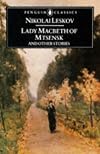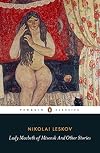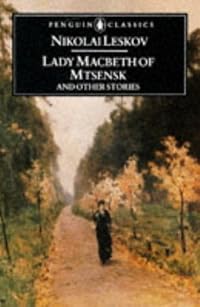
Lady Macbeth of Mtsensk and Other Stories
by Nikolai Leskov
On This Page
Description
Five great stories from one of the most quintessentially Russian of writers, Nikolai Leskov.In the best of Leskov's stories, as in almost no others apart from those of Gogol, we can hear the voice of nineteenth-century Russia. An outsider by birth and instinct, Leskov is one of the most undeservedly neglected figures in Russian literature. He combined a profoundly religious spirit with a fascination for crime, an occasionally lurid imagination and a great love for the Russian vernacular. show more This volume includes five of his greatest stories, including the masterful Lady Macbeth of Mtsensk.Nikolai Semyonovich Leskov was born in 1831 in Gorokhovo, Oryol Province and was orphaned early. In 1860 he became a journalist and moved to Petersburg where he published his first story. He subsequently wrote a number of folk legends and Christmas tales, along with a few anti-nihilistic novels which resulted in isolation from the literary circles of his day. He died in 1895.David McDuff is a translator of Russian and Nordic literature. His translations of nineteenth and twentieth century Russian prose classics (including works by Dostoyevsky,Tolstoy, Bely and Babel) are published by Penguin. show lessTags
Recommendations
















Member Reviews
“In these parts one occasionally comes across individuals of such character that, no matter how many years may have passed since one’s last encounter with them, one can never recall them without experiencing an inward tremor. An example of this type was Katerina Lvovna Izmailova, a merchant’s wife who once enacted a drama so awesome that the members of our local gentry, taking their lead from someone’s light-hearted remark, took to calling her ‘Lady Macbeth of Mtsensk.’”
—"Lady Macbeth of Mtsensk” by Nikolai Leskov
Wow. The opening did not fail the story and this story did not fail the collection. I’m not sure how I’ve made it nearly forty-four years without reading Leskov, but I’m grateful to discover yet another show more Russian author’s oeuvre I can dig into over the next years that I hope to be graced with (although, it would be a perfectly Russian literary ending to die part-way through the next novel). His work smacks more of Gogol than anyone else I’ve read: its experimentation (he’d invented a type of Russian to mimic Greek for “Pamphalon the Entertainer”—untranslatable, of course), its varied use of style and form (philosophical and suspenseful and absurd and epic and . . . ), its believable psychology within stories that could be too fantastic in less capable hands. It also has shadows of Chekhov in the faithful representation of Russian peoples from nearly every class.
“Lady Macbeth of Mtsensk” is thrilling and unsettling and has a whopper of an ending that makes me absolutely itch for the film adaption. “Pamphalon the Entertainer” rivals Hesse’s “Siddhartha” philosophically, and maybe supersedes it emotionally. I was moved by the stylite’s interaction with a humble yet flamboyant (somehow it doesn’t seem like a contradiction) citizen of Damascus, and yet have lost any real compulsion toward the religious myself—at the very least, religious redemption expounded in Christian theology. Yes, like Michael Stipe (Stylite?), I’ve also lost my . . . and that leads me to another story about isographers (essentially, icon-painters): “The Sealed Angel”. Its methodical description of the different styles of sacred art with technical details so exacting that it warranted over three pages of endnotes somehow didn’t detract, but in fact heightened the theft of the “angel” of the story and its subsequent restoration and ultimate forgery. I was impelled to interrupt the wife’s nighttime reading with a page and a half of painstaking depiction of that reparation and she didn’t seem annoyed. Score for Leskov!
I own another work of the author’s that I hadn’t known was his. Man, those Russians are the kings of concealment, waiting on shelves, wedged between more brightly jacketed books, lying in that nondescript Penguin Classics black with white font, and then . . . BOOM! They pop out from nowhere. Balaclavas and Kalashnikovs and heavy cassocks and cyberattacks blaring. Another score for Leskov!
From this volume’s introduction I learned that Leskov was riffing on Turgenev’s “Hamlet of the Shchigrovsky District” which was riffing on Shakespeare, as was Leskov, and then Turgenev publishes “King Lear of the Steppes” riffing on . . . himself? I’m kind of lost, but enjoying the music nonetheless. It’s all Graeco-Russian to me. show less
—"Lady Macbeth of Mtsensk” by Nikolai Leskov
Wow. The opening did not fail the story and this story did not fail the collection. I’m not sure how I’ve made it nearly forty-four years without reading Leskov, but I’m grateful to discover yet another show more Russian author’s oeuvre I can dig into over the next years that I hope to be graced with (although, it would be a perfectly Russian literary ending to die part-way through the next novel). His work smacks more of Gogol than anyone else I’ve read: its experimentation (he’d invented a type of Russian to mimic Greek for “Pamphalon the Entertainer”—untranslatable, of course), its varied use of style and form (philosophical and suspenseful and absurd and epic and . . . ), its believable psychology within stories that could be too fantastic in less capable hands. It also has shadows of Chekhov in the faithful representation of Russian peoples from nearly every class.
“Lady Macbeth of Mtsensk” is thrilling and unsettling and has a whopper of an ending that makes me absolutely itch for the film adaption. “Pamphalon the Entertainer” rivals Hesse’s “Siddhartha” philosophically, and maybe supersedes it emotionally. I was moved by the stylite’s interaction with a humble yet flamboyant (somehow it doesn’t seem like a contradiction) citizen of Damascus, and yet have lost any real compulsion toward the religious myself—at the very least, religious redemption expounded in Christian theology. Yes, like Michael Stipe (Stylite?), I’ve also lost my . . . and that leads me to another story about isographers (essentially, icon-painters): “The Sealed Angel”. Its methodical description of the different styles of sacred art with technical details so exacting that it warranted over three pages of endnotes somehow didn’t detract, but in fact heightened the theft of the “angel” of the story and its subsequent restoration and ultimate forgery. I was impelled to interrupt the wife’s nighttime reading with a page and a half of painstaking depiction of that reparation and she didn’t seem annoyed. Score for Leskov!
I own another work of the author’s that I hadn’t known was his. Man, those Russians are the kings of concealment, waiting on shelves, wedged between more brightly jacketed books, lying in that nondescript Penguin Classics black with white font, and then . . . BOOM! They pop out from nowhere. Balaclavas and Kalashnikovs and heavy cassocks and cyberattacks blaring. Another score for Leskov!
From this volume’s introduction I learned that Leskov was riffing on Turgenev’s “Hamlet of the Shchigrovsky District” which was riffing on Shakespeare, as was Leskov, and then Turgenev publishes “King Lear of the Steppes” riffing on . . . himself? I’m kind of lost, but enjoying the music nonetheless. It’s all Graeco-Russian to me. show less
Ratings
Members
- Recently Added By
Author Information

336+ Works 2,972 Members
Series
Belongs to Publisher Series
Work Relationships
Common Knowledge
- Canonical title
- Lady Macbeth of Mtsensk and Other Stories
- Original publication date
- 2015-10-13
- People/Characters
- Katerina Lvovna Ismailova; Zinovy Borisovich Ismailov; Boris Timofeyevich Ismailov
- Important places
- Mtsensk, Oryol Oblast, Russia
- First words
- The name of the great nineteenth-century Russian prose writer Nikolai Leskov is possibly less familiar to readers of English than those of his illustrious contemporaries, Turgenev, Tolstoy and Dostoevsky. The reasons for this... (show all) being so are various: not the least of them is the fact that, unlike the other three writers mentioned, Leskov was, even to his fellow-Russians, an outsider - neither a radical nor a conservative, neither a member of the aristocracy nor a representative of the literary and cultural establishment. -Introduction
When I first made Vasily Petrovich's acquaintance, he was already known as 'Musk Ox'. People had given him this sobriquet because he really did look uncommonly like the musk-ox that is to be seen in the illustrated treatise o... (show all)n zoology by Yulian Simashko. -Musk-Ox - Canonical DDC/MDS
- 891.733
- Canonical LCC
- PG3337.L5 A254
Classifications
- Genres
- Fiction and Literature, General Fiction
- DDC/MDS
- 891.733 — Literature & rhetoric Asian Literature East Indo-European and Celtic literatures Russian and East Slavic languages Russian fiction 1800–1917
- LCC
- PG3337 .L5 .A254 — Language and Literature Slavic languages and literatures. Baltic languages. Albanian language Slavic. Baltic. Albanian Russian literature Individual authors and works 1800-1870
- BISAC
Statistics
- Members
- 157
- Popularity
- 207,906
- Reviews
- 2
- Rating
- (4.03)
- Languages
- English, German, Russian, Spanish
- Media
- Paper, Ebook
- ISBNs
- 7
- ASINs
- 3