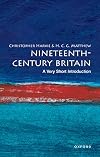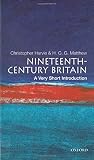
Nineteenth-Century Britain: A Very Short Introduction
by Christopher Harvie, H. C. G. Matthew
Very Short Introductions (23)
On This Page
Description
This is a sharp but subtle account of remarkable economic and social change, and an even more remarkable political stability as 19th century Britain moved from being rural, agrarian and multilingual to being largely urban and English.Tags
Recommendations


















Member Reviews
Chronologically confusing, following themes rather than a reign by reign or government by government approach.
My overall impression of this British history series is that they work better as refresher courses rather than introductions, despite the titles.
My overall impression of this British history series is that they work better as refresher courses rather than introductions, despite the titles.
An excellent Very Short Introduction to the history of Britain in the Nineteenth Century. A lot of things I recall from grammar school in the 1960s but much more I do not recall being taught at all - poverty, taxation, women, trades unions, the Left and the rise of what became the Labour Party, agriculture ...
This appears to be a CliffNotes version of a longer textbook. It requires a fair amount of knowledge of English history background, the subject is so vast that names, events and places are not explained by assumed to be understood. It's sort of the worst of all worlds, a text loaded with dry statistics and no central "big picture", then condensed. Parts are good, worth skimming through and picking out the sections and chapters of interest and for the recent bibliography.
--Review by Stephen Balbach, via CoolReading (c) 2008 cc-by-nd
--Review by Stephen Balbach, via CoolReading (c) 2008 cc-by-nd
Really short into to the Nineteenth Century in Britain. Short, but informative.
A Very Short Introduction to Nineteenth-Century Britain is a sharp but subtle account of remarkable economic and social change and an even more remarkable political stability. Britain in 1789 was overwhelmingly rural, agrarian, multilingual, and almost half Celtic. By 1914, when it faced its greatest test since the defeat of Napoleon, it was largely urban and English. Christopher Harvie and Colin Matthew show the forces behind Britain's rise to its imperial zenith, and the continuing tensions within the nations and classes of the 'union state'.
Christopher Harvie and Colin Matthew were both brought up and educated in Edinburgh. Harvie went via the Open University to become Professor of British and Irish Studies at Tubingen in Germany, show more becoming a historian of modern Scotland and North Sea oil; from Oxford, Matthew edited the Gladstone Diaries, wrote an award-winning life of the Victorian statesman, and became Editor of the New Dictionary of National Biography in 1992. Colin Matthew died in 1999. show less
Christopher Harvie and Colin Matthew were both brought up and educated in Edinburgh. Harvie went via the Open University to become Professor of British and Irish Studies at Tubingen in Germany, show more becoming a historian of modern Scotland and North Sea oil; from Oxford, Matthew edited the Gladstone Diaries, wrote an award-winning life of the Victorian statesman, and became Editor of the New Dictionary of National Biography in 1992. Colin Matthew died in 1999. show less
Ratings
Members
- Recently Added By
Lists

Greatest Books
40 works; 3 members
Author Information
27+ Works 539 Members
Christopher Harvie, Professor of British and Irish Studies at the University of Tbingen, has written extensively on UK and Scottish history. A founder-historian at the Open University, 1969-80, he is the author of over sixteen books, including A Floating Commonwealth (2008), Scotland: A Short History (2014) and the historical novel Dalriada show more (2015). He was a Member of the Scottish Parliament, 2007-11. show less
13+ Works 516 Members
Series

Work Relationships
Is contained in
Common Knowledge
- Canonical title
- Nineteenth-Century Britain: A Very Short Introduction
- Important places
- Great Britain
- First words
- In 1881 the young Oxford historian Arnold Toynbee delivered his Lectures on the Industrial Revolution, and in so doing made it as distinct a 'period' of British history as the Wars of the Roses.
- Last words
- (Click to show. Warning: May contain spoilers.)Tuesday 4 August 1914 brought that experiment to an abrupt halt.
- Original language
- English
Classifications
- Genres
- History, Nonfiction, General Nonfiction
- DDC/MDS
- 941.081 — History & geography History of Europe British Isles Historical periods of British Isles 1837- Period of Victoria and House of Windsor Victoria 1837-1901
- LCC
- DA530 .H4465 — History of Europe, Asia, Africa and Oceania Great Britain History of Great Britain England History By period Modern, 1485-
- BISAC
Statistics
- Members
- 273
- Popularity
- 116,448
- Reviews
- 5
- Rating
- (3.47)
- Languages
- English
- Media
- Paper, Ebook
- ISBNs
- 4
- ASINs
- 3