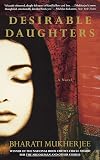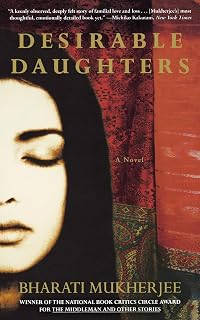
Desirable Daughters
by Bharati Mukherjee
On This Page
Description
Chronicles the journeys of three Brahmin women as they follow divergent paths from their home in Calcutta and a rigid Indian society to seek new lives for themselves on two separate continents.Tags
Recommendations









Member Reviews
This beautifully written, even if somewhat meandering, novel explores the lives of three very different sisters from the point-of-view of the youngest sister. Tara Bhattarcharjee Chatterjee, a divorced mother trying to find her identity as an East Indian in suburban California, is shocked when a stranger shows up at her home claiming to be the nephew she never knew she had. Feeling like the slighted youngest sister kept out of family secrets, Tara re-examines her relationship with her two older sisters. Meanwhile, she is also dealing with her relationships with her teenaged son, ex-husband, and live-in lover as well as her love-hate relationships with her country of origin (India) and country of residence (America). Interwoven with all show more this is family history going back several generations. With so many threads, not every one can be fully developed to its greatest potential, which is one fault in this book (the other being that it took a little while to get in to). Overall, the book is an interesting exploration of how complicated people (and families) are, written in high literary form, with a detailed look at another culture to boot. show less
The plot here is slap-dash but Mukherjee's knowing interest and description of the people of India's diaspora to the U.S. shines and commands attention. Unlike many modern novels about India the focus is with the upper class. The relationship of the three sisters and their families is a wild surprising far ranging ride. The clash of the past with present is an important element as is being a Brahman.
Quotes: pages 33-34) “Bengali culture trains one to claim the father's birthplace, sight unseen, as his or her desh, her home. Although she has never seen it, my mother's desh is Dhaka, by way of Mishtigun, the village even few East Bengalis have ever seen. When I speak of this to my American friends---the iron-clad identifiers of region, show more language, caste, and subcaste---they call me 'overdetermined' and of course they are right. When I tell them they should be thankful for their identity crisis and feelings of alienation, I of course am right. When everyone knows your business and every name declares your identity, where no landscape fails to contain a plethora of human figures, even a damaged consciousness, even loneliness, become privileged commodities.”
(page 198) “Window-shopping, however, is never a pleasure in Jackson Heights. For the Indian immigrants I know in New York---professional people, friends of Bish---Jackson Heights is tack, faintly embarrassing. It is the commercial center of Indian life in America (if Indian life in America or anywhere can ever be said to have a center), just as Silicon Valley is its scientific and professional heart, but the shops of Jackson Heights are not slanted to the elite. The gold stores of Calcutta and the sari and fabric shops of Bombay are better stocked, more selective, and far more welcoming.”
(pages 214-215) “...according to Daddy, all Sinhis were sharpies, a shade more ruthless than Marwaris, who a least had been making their home in Calcutta for nearly a century while bleeding us dry and shipping their profits back to their ancestral villages in the deserts of Rajasthan. Marwaris, at least, were fiercely observant, vegetarian, ascetic, temple-building Hindus. Sindhis were always a little suspect, a minority Hindu community lost in the vast Muslim sea around Karachi. Even their language was written in Arabic script, like Urdu, and their Hinduism seemed to us negotiable. They'd arrived in Bombay as Partition refugees, more midnight's children, stripped of their wealth, and within five years had out hustled and outschemed the Parsis and Gujaratis who historically dominated Bombay capitalism.
No wonder we hated them. We disapproved of anyone who sullied himself with the exclusive pursuit of money and anyone who lacked culture as we defined it. Anyone who worked harder and became wealthy.”
(pages 265-266) “He was intent on delivering a self-lacerating scrutiny of his failure. He was a man in pain.
'Bish, please, it was my fault, my head was turned. I was so naive, I had too much time, and not enough to do---' the whole silly mantra. He wouldn't listen. He would not permit collective guilt. Marriage is man's manifest dharma, his test, his duty, the outer sign of his inner strength and harmony,” show less
Quotes: pages 33-34) “Bengali culture trains one to claim the father's birthplace, sight unseen, as his or her desh, her home. Although she has never seen it, my mother's desh is Dhaka, by way of Mishtigun, the village even few East Bengalis have ever seen. When I speak of this to my American friends---the iron-clad identifiers of region, show more language, caste, and subcaste---they call me 'overdetermined' and of course they are right. When I tell them they should be thankful for their identity crisis and feelings of alienation, I of course am right. When everyone knows your business and every name declares your identity, where no landscape fails to contain a plethora of human figures, even a damaged consciousness, even loneliness, become privileged commodities.”
(page 198) “Window-shopping, however, is never a pleasure in Jackson Heights. For the Indian immigrants I know in New York---professional people, friends of Bish---Jackson Heights is tack, faintly embarrassing. It is the commercial center of Indian life in America (if Indian life in America or anywhere can ever be said to have a center), just as Silicon Valley is its scientific and professional heart, but the shops of Jackson Heights are not slanted to the elite. The gold stores of Calcutta and the sari and fabric shops of Bombay are better stocked, more selective, and far more welcoming.”
(pages 214-215) “...according to Daddy, all Sinhis were sharpies, a shade more ruthless than Marwaris, who a least had been making their home in Calcutta for nearly a century while bleeding us dry and shipping their profits back to their ancestral villages in the deserts of Rajasthan. Marwaris, at least, were fiercely observant, vegetarian, ascetic, temple-building Hindus. Sindhis were always a little suspect, a minority Hindu community lost in the vast Muslim sea around Karachi. Even their language was written in Arabic script, like Urdu, and their Hinduism seemed to us negotiable. They'd arrived in Bombay as Partition refugees, more midnight's children, stripped of their wealth, and within five years had out hustled and outschemed the Parsis and Gujaratis who historically dominated Bombay capitalism.
No wonder we hated them. We disapproved of anyone who sullied himself with the exclusive pursuit of money and anyone who lacked culture as we defined it. Anyone who worked harder and became wealthy.”
(pages 265-266) “He was intent on delivering a self-lacerating scrutiny of his failure. He was a man in pain.
'Bish, please, it was my fault, my head was turned. I was so naive, I had too much time, and not enough to do---' the whole silly mantra. He wouldn't listen. He would not permit collective guilt. Marriage is man's manifest dharma, his test, his duty, the outer sign of his inner strength and harmony,” show less
I actually love the concept and am so glad I read this book. I only gave it three stars because the plot focuses so narrowly for so long on the main character, who for most of the book was between interesting things. A hugely interesting thing - her marriage - is so long behind her she displays a kind of resigned fatigue in explaining it. And the most interesting parts of the book - meeting the mysterious stranger and the climactic event of the novel - are told as if they all happened so fast and were so mysterious she doesn't really know many details. The mysterious stranger, the two times we meet him, is fascinating, but most of what we learn about him is through quick exposition.
It's incredible strength is the education this book show more gives you about India's caste system as seen from the top - the Brahmin families that this book is about. It's far from the typical immigrant story of coming to America with nothing after poverty, war or starvation drives you out of your homeland. These characters are at the top of India's culture and America's, as well. show less
It's incredible strength is the education this book show more gives you about India's caste system as seen from the top - the Brahmin families that this book is about. It's far from the typical immigrant story of coming to America with nothing after poverty, war or starvation drives you out of your homeland. These characters are at the top of India's culture and America's, as well. show less
Three daughters were born to a Brahmin family in Calcutta, each exactly three years apart. But although they share the same beautiful features and sharp minds, their lives followed different paths. Transplanted to California, the youngest sister, Tara Chatterjee, alternates between despondency that she did not live up to cultural expectations and a rebellious defensiveness that the present is not the past. When a young man arrives at her door claiming to be the illegitimate son of her eldest sister, Tara Chatterjee quickly learns the past was not what she thought it was. As her investigation turns dangerous, she uncovers not only family secrets but also rediscovers her ex-husband, her son, and herself. Tara’s quest for the truth will show more take her back to India, where she will decide upon a new future writing about the past and Tara Lata, the Tree Bride, for whom she was named. Mukherjee continues Tara’s story in The Tree Bride.
Desirable Daughters.doc show less
Desirable Daughters.doc show less
This book is sorta bizarre with all of its subplots and unconventional characters. Part of me thinks that there was just too much going on, and then another part of me kinda enjoyed that. I started this book expecting it to be another cultural/generational gap, traditional expectations not met kind of book. It definitely has those elements in it, but there's so much more. Bombay gangs and people who may or may not be who they say they are! I guess my only complaint is that , with so much going on, it was not as coherent as it could have been. I looked through a few of the other reviews here, and I'm not sure why some people disliked all of the characters ... it didn't have that effect on me at all. Sure, some of the characters are show more exaggerated in their abilities/good looks/charms, but I got used to that after the first chapter and enjoyed the rest of the story, even sympathizing with a lot of the characters. show less
Three daughters were born to a Brahmin family in Calcutta, each exactly three years apart. But although they share the same beautiful features and sharp minds, their lives followed different paths. Transplanted to California, the youngest sister, Tara Chatterjee, alternates between despondency that she did not live up to cultural expections and a rebellious defensiveness that the present is not the past. When a young man arrives at her door claiming to be the illegitimate son of her eldest sister, Tara Chatterjee quickly learns the past was not what she thought it was. As her investigation turns dangerous, she uncovers not only family secrets but also rediscovers her ex-husband, her son, and herself. Tara’s quest for the truth will show more take her back to India, where she will decide upon a new future writing about the past and Tara Lata, the Tree Bride, for whom she was named. Mukherjee continues Tara’s story in The Tree Bride. show less
A rich and suspenseful novel of the eternal pull of Indian tradition on contemporary life.
Members
- Recently Added By
Lists

Books Set in New Jersey
22 works; 4 members
Author Information

18+ Works 3,169 Members
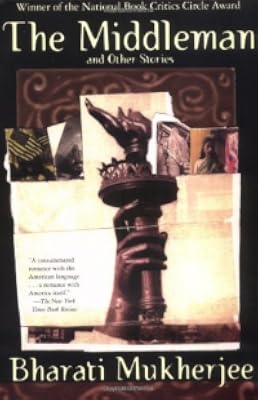
Bharati Mukherjee was born in Calcutta, India on July 27, 1940. She received a bachelor's degree in English from the University of Calcutta in 1959 and a master's degree from the University of Baroda in 1961. After sending six stories to the University of Iowa, she was accepted into the Iowa Writers' Workshop. She received an M.F.A. in 1963 and a show more doctorate in comparative literature in 1969 from the University of Iowa. She married fellow student Clark Blaise, a Canadian author, in 1963. They moved to Montreal in 1966, where she taught English at McGill University. They moved back to the United States in 1980. After teaching creative writing at Columbia University, New York University, and Queens College, she taught postcolonial and world literature at the University of California, Berkeley. She wrote numerous books during her lifetime including The Tiger's Daughter, Wife, Darkness, Jasmine, The Holder of the World, Desirable Daughters, The Tree Bride, and Miss New India. In 1988, The Middleman and Other Stories won the National Book Critics Circle Award for fiction. She died from complications of rheumatoid arthritis and takotsubo cardiomyopathy, a stress-induced heart condition, on January 28, 2017 at the age of 76. (Bowker Author Biography) show less
Work Relationships
Has as a student's study guide
Common Knowledge
- Canonical title
- Desirable Daughters
- Original publication date
- 2002
- People/Characters
- Tara Chatterjee
- Important places
- Calcutta, India
- Epigraph
- No one behind, no one ahead.
The path the ancients cleared has closed.
And the other path, everyone's path,
Easy and wide, goes nowhere.
I am alone and find my way.
-SANSKRIT VERSE ADAPTED BY OCTAVIO... (show all) PAZ AND TRANSLATED BY ELIOT WEINBERGER - Dedication
- To Clark-babu
- First words
- In the mind's eye, a one-way procession of flickering oil lamps sways along the muddy shanko between rice paddies and flooded ponds, and finally disappears into a distant wall of impenetrable jungle.
- Last words
- (Click to show. Warning: May contain spoilers.)"Remember this. It's a miracle."
Classifications
Statistics
- Members
- 493
- Popularity
- 61,288
- Reviews
- 9
- Rating
- (3.45)
- Languages
- English, Indonesian
- Media
- Paper
- ISBNs
- 8
- ASINs
- 2