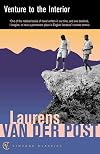
Venture to the Interior
by Laurens Van der Post
On This Page
Description
Summoned to Whitehall in 1949, Laurens van der Post was told that in old British Central Africa there were two large tracts of country that London didn't really know anything about, and could he go in there on foot and take a look, please? Venture to the Interior is the account of that journey, a journey filled with adventure and discovery, flying from London across Europe and Africa, and after days in small aircraft, on foot across the mountains to the two lost worlds of central Africa.Tags
Recommendations

























Member Reviews
I was not far into the first part of this book when I started to feel suspicious. Laurens provides some context for his adventure in the form of family history, and what do you know? It's exciting on both sides. Maybe it's just the jealousy of someone whose pedigree can best be described as "peasants on both sides, all the way back" but this struck me as...possibly exaggerated. So I turned to trusty Google.
Perhaps it's ignorance, but I'd never heard of Laurens van der Post before picking up this book. And as it turns out, the controversy surrounding this man is almost more interesting than the book itself. It's possible that he lied about or exaggerated many of his experiences. His account of his family history on his father's side is show more one of the areas in which he may not have been entirely truthful.
Aside from his questionable honesty, it's not disputed that he treated women awfully. He had multiple affairs, abandoned his first wife and children, and took advantage of a 14 year old girl who was entrusted to his care, fathering a child with her and ruining her budding career as a dancer. Far from the wise and good man he portrays himself as in his writing.
After the questionable family history, almost 100 pages of the book are occupied by his travel by aeroplane from England to Nyasaland (modern day Malawi). More specifically, they are occupied by his crotchety-old-man-complaining about this newfangled means of travel. It's a common problem in books from this era, air travel being so new that the author must spend many pages in excited wonderment or grouchy longing for the good old days of slow travel, each of which tend to confound the modern reader to whom it's simply a normal part of travel.
If you can make your way through the tiresome air travel section, the narrative picks up from there and the book will become much more pleasant to read. Laurens, along with two white companions and an excessive amount of native bearers, explores mountain of Mlanje with its unique ecosystem and unpredictable weather. Here the tell-tale signs of untruth once again rear their head - Laurens in his great wisdom is able to pre-cognitively predict disaster and like Cassandra warns his companions against all mistakes, but alas! They don't listen. Disaster strikes but it is definitely super in no way saintly Laurens's fault!
After Mlanje, Laurens moves on to the Nyika plateau in the north of Nyasaland. Some of his descriptions of the scenery and wildlife are very beautiful and evocative.
The philosophical aspect which is supposed to be a big part of this book fell a bit flat with me. A lot of the philosophical asides seemed frankly nonsensical to me - they sounded deep on the surface but on examination it was impossible to figure out what Laurens was trying to say. One part that was clear, was that Laurens calls for peace and understanding between races, while in the same breath sexualising black people and romanticising their primitive, dark natures. Since the last book I read by a South African from this era was much more virulently racist, I guess Laurens gets a teensy tiny point for being a slightly less ridiculously racist?
To conclude, the latter 200 pages of this book are entertaining, if perhaps not strictly factual. The main value I got from this book was a little more understanding of the history and geography of Africa. show less
Perhaps it's ignorance, but I'd never heard of Laurens van der Post before picking up this book. And as it turns out, the controversy surrounding this man is almost more interesting than the book itself. It's possible that he lied about or exaggerated many of his experiences. His account of his family history on his father's side is show more one of the areas in which he may not have been entirely truthful.
Aside from his questionable honesty, it's not disputed that he treated women awfully. He had multiple affairs, abandoned his first wife and children, and took advantage of a 14 year old girl who was entrusted to his care, fathering a child with her and ruining her budding career as a dancer. Far from the wise and good man he portrays himself as in his writing.
After the questionable family history, almost 100 pages of the book are occupied by his travel by aeroplane from England to Nyasaland (modern day Malawi). More specifically, they are occupied by his crotchety-old-man-complaining about this newfangled means of travel. It's a common problem in books from this era, air travel being so new that the author must spend many pages in excited wonderment or grouchy longing for the good old days of slow travel, each of which tend to confound the modern reader to whom it's simply a normal part of travel.
If you can make your way through the tiresome air travel section, the narrative picks up from there and the book will become much more pleasant to read. Laurens, along with two white companions and an excessive amount of native bearers, explores mountain of Mlanje with its unique ecosystem and unpredictable weather. Here the tell-tale signs of untruth once again rear their head - Laurens in his great wisdom is able to pre-cognitively predict disaster and like Cassandra warns his companions against all mistakes, but alas! They don't listen. Disaster strikes but it is definitely super in no way saintly Laurens's fault!
After Mlanje, Laurens moves on to the Nyika plateau in the north of Nyasaland. Some of his descriptions of the scenery and wildlife are very beautiful and evocative.
The philosophical aspect which is supposed to be a big part of this book fell a bit flat with me. A lot of the philosophical asides seemed frankly nonsensical to me - they sounded deep on the surface but on examination it was impossible to figure out what Laurens was trying to say. One part that was clear, was that Laurens calls for peace and understanding between races, while in the same breath sexualising black people and romanticising their primitive, dark natures. Since the last book I read by a South African from this era was much more virulently racist, I guess Laurens gets a teensy tiny point for being a slightly less ridiculously racist?
To conclude, the latter 200 pages of this book are entertaining, if perhaps not strictly factual. The main value I got from this book was a little more understanding of the history and geography of Africa. show less
I am no fan of Laurens van der Post. I suspect that some of his fame as a writer is due to his taking up the cause of equality among races, and his horific wartime experiences as a prisoner of the Japanese. But his writing - so far - had struck me as polemic and pedestrian; a master of the pedagogic travelogue and no more. But there is a hint in this book of what I have perhaps missed so far. In the middle of this book, which otherwise entirely lives up to my opinion of the author as a very average writer, is a story that stunning, both in the sense of the events and the telling. It could be said that the events described are so extraordinary that no writer could tell it badly, but van der Post's writing here is unsurpassed anywhere, by show more anyone. I can not think of any writer who has ever told of death and grief with such pure white heat. So for that, I recommend this book - very highly - to any reader of stories of Africa in the 1950's, and any reader who wishes to rehabilitate their opinion of the author. show less
Last few chapters a bit airy, but alright.
The most boring and soporific of the textbooks I had to read for the GCE -- a view shared by almost everyone in my class.
Malawi Zambia
Ratings
Members
- Recently Added By
Author Information

53+ Works 3,920 Members
Colonel Laurens Van der Post, a British subject born in South Africa, has "spent most of his adult life with one foot in Africa and one in England." A soldier, explorer, traveler, and philosopher, he fought in World War II in Ethiopia, Syria, and the Far East. Since the war he has worked for the British government on a variety of missions show more throughout Africa. Van der Post's beautifully composed Venture to the Interior (1952) is much more than an account of the planned journey from London to Nyasaland in South Africa, the climbing of Mianje, and the exploration of Nyika. It catches the "unique and indefinable spirit of the ancient continent" and explores the interiors of people's minds. His The Heart of the Hunter (1961) points the way toward a rediscovery of the positive values of the wilderness in our own lives. (Bowker Author Biography) show less
Awards and Honors
Awards
Distinctions
Series
Belongs to Publisher Series
Common Knowledge
Classifications
Statistics
- Members
- 340
- Popularity
- 93,619
- Reviews
- 5
- Rating
- (3.75)
- Languages
- 8 — Danish, English, Estonian, Finnish, German, Norwegian (Bokmål), Norwegian, Swedish
- Media
- Paper, Ebook
- ISBNs
- 14
- ASINs
- 21