On This Page
Description
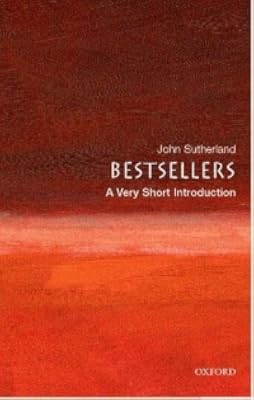
For the last century, the tastes and preferences of readers of fiction have been reflected in the American and British bestseller lists. John Sutherland takes an engaging look through the lists to reveal what we have been reading - and why.Tags
Recommendations





Member Recommendations

Member Reviews
The main strength of the Very Short Introduction series is in giving the “intelligent outsider” a way into a subject that you normally wouldn’t dare to venture into, because of the way it is surrounded by impenetrable-looking fortifications of theory or technical jargon. Popular fiction isn’t like that: by definition, it’s a subject that all of us (with the possible exception of serious literary scholars) know something about, but it defeats our grasp because of its vast geographical, chronological and generic scope. None of us has enough time to read every popular Victorian novel, every pulp detective story, every Western, every Mills & Boon romance, every paperback with a half-naked woman on the cover and the whole canon of show more science-fiction… And, of course, even an author who has written extensively about the history of popular fiction can’t hope to cover all that in just over a hundred pages.
Sutherland gives us a brief overview of the commercial history of publishing in the UK and US and sketches out the difficulty of defining what we mean by “bestseller” — is it the book that has sold most copies in a week or month, or the book with the biggest long-term sales (over a five-hundred-year period, The Pilgrim’s Progress has outsold Dan Brown), or the author with the biggest total sales (Agatha Christie, whose individual titles rarely got into the charts)? Do we sample or count real point-of-sale totals? Do we count children’s books separately or in the same category as mainstream novels? What do we do about utility items like The Highway Code, always a big seller in the UK Market?
Sutherland also takes us on a lightning tour of some of the salient bestsellers of the 20th century in the US and the UK, which is entertaining and occasionally illuminating, but if you’re looking for an analysis of what makes a book a popular success you won’t find it here. Bestsellers are, with hindsight, always in tune with the spirit of the times in which they have their greatest success (occasionally long after their initial publication, as in the case of The Forsyte Saga or Lady Chatterley), but there’s no sure way of knowing in advance what that’s going to be. (Sutherland doesn’t say so, but of course bestsellers themselves are one of the most important cultural elements we look to in defining the “spirit of the times” when we look back.) Even sequels and blatant clones of earlier successes don’t always hit the mark.
A fun read, but less useful than some of the other VSI’s. show less
Sutherland gives us a brief overview of the commercial history of publishing in the UK and US and sketches out the difficulty of defining what we mean by “bestseller” — is it the book that has sold most copies in a week or month, or the book with the biggest long-term sales (over a five-hundred-year period, The Pilgrim’s Progress has outsold Dan Brown), or the author with the biggest total sales (Agatha Christie, whose individual titles rarely got into the charts)? Do we sample or count real point-of-sale totals? Do we count children’s books separately or in the same category as mainstream novels? What do we do about utility items like The Highway Code, always a big seller in the UK Market?
Sutherland also takes us on a lightning tour of some of the salient bestsellers of the 20th century in the US and the UK, which is entertaining and occasionally illuminating, but if you’re looking for an analysis of what makes a book a popular success you won’t find it here. Bestsellers are, with hindsight, always in tune with the spirit of the times in which they have their greatest success (occasionally long after their initial publication, as in the case of The Forsyte Saga or Lady Chatterley), but there’s no sure way of knowing in advance what that’s going to be. (Sutherland doesn’t say so, but of course bestsellers themselves are one of the most important cultural elements we look to in defining the “spirit of the times” when we look back.) Even sequels and blatant clones of earlier successes don’t always hit the mark.
A fun read, but less useful than some of the other VSI’s. show less
The author begins his “very short introduction” with the question, referring to bestsellers: “Why read, or contemplate, with any degree of seriousness, less than ‘good’ books?” He offers an example and short discussion of an early 20th century bestseller (1923, [Black Oxen] by Gertrude Atherton), before stating: great literary works are timeless, but bestsellers are “snapshots: of a particular age.
An interesting beginning, but in the next 10 pages or so, he:
*argues that Huckleberry Finn is not such an American book as it seems as it borrows from other non-American authors (quotes from Dumas, uses some Walter Scott...)
*notes (with charts) that so few translated books have ever made the US lists
*belabors the point that show more Americans very liberally pirated British books during the 19th century prior to an international copyright agreement in 1891 (so so difficult to be sympathetic on that point when, during the same era, Britain is plundering half the world...).
I don’t mind criticism of my country; in fact, I can find it quite enlightening; however, this seemed oddly placed, and I began to wonder who Mr. Sutherland’s intended audience actually was.
The good news is that after this part, Sutherland settles down and presents a well-organized short introduction to “bestsellers.” First he looks at the lists generally. He discusses terminology and whether there are cyclical patterns (he says no, not really, but certain types of books do reoccur on the lists. i.e. “religious bestsellers”). He discusses “literary” bestsellers, “comeback” bestsellers (very rare), the origin of paperback books and bestsellers, sales mania in the modern era, and then crunches some impressive numbers—all these topics liberally illustrated with examples of bestselling books.
Sutherland then offers reasonably long chapters on each of the intriguing histories of the American and UK bestseller lists and book markets, including some prehistory for both, beginning back in the 18th century. As an American (and former bookseller), I knew very little about the history of the UK book market, and perhaps falsely assumed that it has functioned fundamentally like the American market, but they have had very different (and fascintating) histories. Included in each of these two chapters are quick overview by decade or era, and a discussion of genre in both regions (again, the American bestselling genres were familiar, but many of the UK ones were not...the “Saharan romance”?). He brings us up relatively up-to-do before spending a couple of pages on the future of the bestsellers.
Overall I thought the book very good, with many fascinating insights for readers who might enjoy a bit of study on the subject of popular fiction and how they reflect the “fashions and ideologies of the day.” However, I don’t think he ever clearly answers his initial question, though I think he does suggest indirectly that we read popular books because we love looking in the cultural mirror. He never mentions (unless I’ve missed it), the desire many readers have for a common, cultural experience..
note: my husband found an error in Sutherland’s discussion of science fiction where he identified John W. Campbell as the editor of Amazing Stories... show less
An interesting beginning, but in the next 10 pages or so, he:
*argues that Huckleberry Finn is not such an American book as it seems as it borrows from other non-American authors (quotes from Dumas, uses some Walter Scott...)
*notes (with charts) that so few translated books have ever made the US lists
*belabors the point that show more Americans very liberally pirated British books during the 19th century prior to an international copyright agreement in 1891 (so so difficult to be sympathetic on that point when, during the same era, Britain is plundering half the world...).
I don’t mind criticism of my country; in fact, I can find it quite enlightening; however, this seemed oddly placed, and I began to wonder who Mr. Sutherland’s intended audience actually was.
The good news is that after this part, Sutherland settles down and presents a well-organized short introduction to “bestsellers.” First he looks at the lists generally. He discusses terminology and whether there are cyclical patterns (he says no, not really, but certain types of books do reoccur on the lists. i.e. “religious bestsellers”). He discusses “literary” bestsellers, “comeback” bestsellers (very rare), the origin of paperback books and bestsellers, sales mania in the modern era, and then crunches some impressive numbers—all these topics liberally illustrated with examples of bestselling books.
Sutherland then offers reasonably long chapters on each of the intriguing histories of the American and UK bestseller lists and book markets, including some prehistory for both, beginning back in the 18th century. As an American (and former bookseller), I knew very little about the history of the UK book market, and perhaps falsely assumed that it has functioned fundamentally like the American market, but they have had very different (and fascintating) histories. Included in each of these two chapters are quick overview by decade or era, and a discussion of genre in both regions (again, the American bestselling genres were familiar, but many of the UK ones were not...the “Saharan romance”?). He brings us up relatively up-to-do before spending a couple of pages on the future of the bestsellers.
Overall I thought the book very good, with many fascinating insights for readers who might enjoy a bit of study on the subject of popular fiction and how they reflect the “fashions and ideologies of the day.” However, I don’t think he ever clearly answers his initial question, though I think he does suggest indirectly that we read popular books because we love looking in the cultural mirror. He never mentions (unless I’ve missed it), the desire many readers have for a common, cultural experience..
note: my husband found an error in Sutherland’s discussion of science fiction where he identified John W. Campbell as the editor of Amazing Stories... show less
An interesting introduction to the way bestsellers happen and how it reflects the era they're written in rather than, often, any real merit or worth. While some of today's bestsellers may endure, they are also influenced by selling pressure and the way the market works. This is almost a comfort book for some people who write well but don't sell the blockbuster.
A fairly good overview of what a bestseller is, and isn't, and the factors that influence sales. It won't tell you how to write one, nor does it go into any detail on individual books, but if you like books it has some interest.
This title was about bestsellers. Why do certain books become so wildly popular? Are old bestsellers books we still read? No! Are the now read classics bestsellers in their time? Mostly not. And when at the start of the 19th century Americans tend to read British books, hundred years laters it's the other way around.
A nice book that mentioned some titles that made me curious.
http://boekenwijs.blogspot.com/2010/06/bestsellers-very-short-introduction.html
A nice book that mentioned some titles that made me curious.
http://boekenwijs.blogspot.com/2010/06/bestsellers-very-short-introduction.html
A very good introduction, from a British perspective, to the best-seller list.
Erudite, Educative and Entertaining!
Members
- Recently Added By
Lists

Huxley's reading log 2017
45 works; 1 member
Author Information

133+ Works 5,096 Members
John Sutherland was born on October 9, 1938. After graduating from the University of Leicester in 1964, he began his academic career as an assistant lecturer in Edinburgh. He specializes in Victorian fiction, 20th century literature, and the history of publishing. He is Lord Northcliffe Professor Emeritus of Modern English Literature at University show more College, London and is currently teaching at the California Institute of Technology. He writes for The Guardian and is a well-known literary reviewer. He is the author of more than 20 books including Stephen Spender: The Authorized Biography, How to Read a Novel: A User's Guide, The Boy Who Loved Books, Curiosities of Literature, 50 Literature Ideas You Really Need to Know, Lives of the Novelists: A History of Fiction in 294 Lives, and Magic Moments: Life-Changing Encounters with Books, Film, Music. He is also the co-author, with Stephen Fender, of Love, Sex, Death and Words: Tales from a Year in Literature. (Bowker Author Biography) show less
Series

Common Knowledge
- Canonical title
- Bestsellers: A Very Short Introduction
- Original publication date
- 2007-10-11
- First words
- Why read, or contemplate, with any degree of seriousness, less than 'good' (and sometimes downright bad) books — the Deepings of the literary world?
- Last words
- (Click to show. Warning: May contain spoilers.)But within the new wholly digitized regime, the 'bestseller', as it was concocted in the hot-house of American bookselling in the late 19th century and perfected in the 20th century, will probably, at some not too distant point, join the internal combustion engine in the junkyard of history.
Classifications
Statistics
- Members
- 166
- Popularity
- 196,524
- Reviews
- 7
- Rating
- (3.27)
- Languages
- Chinese, English
- Media
- Paper, Ebook
- ISBNs
- 6
- ASINs
- 2