German Existentialism
by Martin Heidegger
40 Members (2.00)
On This Page
Description
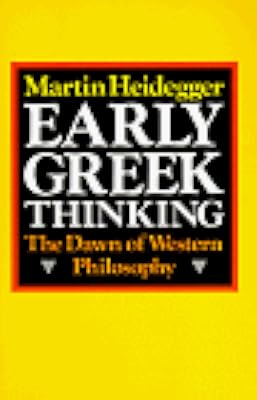
"On the day of German Labor, on the day of the Community of the People, the Rector of Freiburg University, Dr. Martin Heidegger, made his official entry into the National Socialist Party." And so begins one of the most controversial texts available today. Heidegger, a German Nationalist and proud Nazi, thoroughly examines the history, the philosophy, and the rise to power of the Nazi movement in Germany. Martin Heidegger's distinguished Italian colleague, Professor Benedetto Croce, said show more of his German contemporary, "This man dishonors philosophy and that is an evil for politics too." Croce's severe rebuke was not singular at the time when Hitlerism was rampant over Europe. It is true that among the almost one thousand professional philosophers of Germany and Austria only very few actively opposed National Socialism. On the other hand, no one degraded his history profession in the way that Heidegger did, by becoming a spokesman for National socialism and attempting to mold his theories into one pattern with Hitlerism.. show lessTags
Recommendations














































Member Reviews
Members
- Recently Added By
Author Information

462+ Works 23,569 Members
Martin Heidegger was born in Messkirch, Baden, Germany on September 22, 1889. He studied Roman Catholic theology and philosophy at the University of Frieburg before joining the faculty at Frieburg as a teacher in 1915. Eight years later Heidegger took a teaching position at Marburg. He taught there until 1928 and then went back to Frieburg as a show more professor of philosophy. As a philosopher, Heidegger developed existential phenomenology. He is still widely regarded as one of the most original philosophers of the 20th century. Influenced by other philosophers of his time, Heidegger wrote the book, Being in Time, in 1927. In this work, which is considered one of the most important philosophical works of our time, Heidegger asks and answers the question "What is it, to be?" Other books written by Heidegger include Basic Writings, a collection of Heidegger's most popular writings; Nietzsche, an inquiry into the central issues of Friedrich Nietzsche's philosophy; On the Way to Language, Heidegger's central ideas on the origin, nature and significance of language; and What is Called Thinking, a systematic presentation of Heidegger's later philosophy. Since the 1960s, Heidegger's influence has spread beyond continental Europe and into a number of English-speaking countries. Heidegger died in Messkirch on May 26, 1976. (Bowker Author Biography) show less
Classifications
- Genres
- Nonfiction, Philosophy, Politics and Government, Literature Studies and Criticism, History
- DDC/MDS
- 321.6440943 — Society, government, & culture Political science Systems of governments and states Absolute monarchy [formerly : Absolutism] [formerly : Modern dictatorship] [formerly : Fascist-type dictatorship]
- LCC
- B3279 .H47 .E54 — Philosophy, Psychology and Religion Philosophy (General) By period Modern By region or country
- BISAC
Statistics
- Members
- 40
- Popularity
- 732,903
- Rating
- (2.00)
- Languages
- English
- Media
- Paper, Ebook
- ISBNs
- 4
- ASINs
- 3