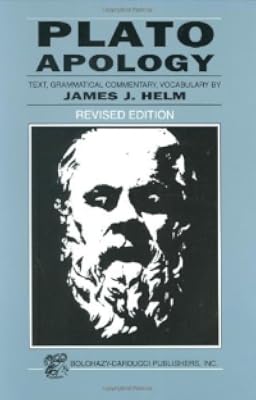
Apology
by Platon
On This Page
Description
This historically renowned oration was presented by Socrates in his own defense after he had been formally accused of corrupting the youth of Athens. It is not an apology in the traditional sense of expressing remorse for one's actions; rather, Socrates' Apology (recorded by his faithful student and protege Plato) is a succinct and compelling defense of the brilliant philosopher's worldview, lifestyle, and teaching methods. A rewarding read for fans of philosophy and supporters of show more intellectual freedom.. show less
Tags
Recommendations











Member Reviews
Probably my favorite of Plato's Socratic dialogues, this apologia (defense) follows the Euthyphro and recounts the courtroom proceedings between Socrates and the indictments of Meletus to a large jury in democratic Athens. In addition to rendering Meletus' charges senseless, Socrates extols his love for wisdom and truth at all costs. He even states that a fear of death would be ignorant because it would be tantamount to purporting to know something one cannot know (here Socrates continues the jabs he takes at the Sophists). My favorite part, however, is his practical response when questioned why people like to spend time in his presence: because they love to see those who think they are wise cross-examined (i.e. exposed as actually show more ignorant). show less
Apology of Socrates, written by Plato, tells the story of the trial of his teacher, Socrates. The book describes how Socrates defends himself in court in Athens after he is accused of corrupting young people and not respecting the city’s gods.
The book reads almost like a courtroom conversation. Socrates explains why he spends his life questioning people and encouraging them to think about truth and wisdom. Instead of trying to make the jury feel sorry for him, he calmly explains his ideas and asks questions that reveal problems in the accusations against him. For example, when he questions his accuser, Meletus, he shows that the claims against him do not make much sense.
One of the most interesting things about Socrates is his way of show more thinking. He believes that true wisdom comes from understanding that we do not know everything. Because of this, he encourages people to question their beliefs and examine their lives. His famous idea that “the unexamined life is not worth living” shows how strongly he believes in thinking deeply about our actions and values.
The story also shows Socrates’ courage and honesty. Even though he is facing a possible death sentence, he refuses to change his beliefs or beg the court for mercy. He believes that searching for truth and encouraging others to think is more important than protecting himself.
Overall, Apology of Socrates is a short but powerful book. It introduces readers to important philosophical ideas about truth, wisdom, and personal responsibility. Through Plato’s writing, Socrates appears not only as a smart thinker but also as a brave person who stayed true to his principles. The book remains important today because it encourages readers to question ideas, think critically, and live thoughtful lives. show less
The book reads almost like a courtroom conversation. Socrates explains why he spends his life questioning people and encouraging them to think about truth and wisdom. Instead of trying to make the jury feel sorry for him, he calmly explains his ideas and asks questions that reveal problems in the accusations against him. For example, when he questions his accuser, Meletus, he shows that the claims against him do not make much sense.
One of the most interesting things about Socrates is his way of show more thinking. He believes that true wisdom comes from understanding that we do not know everything. Because of this, he encourages people to question their beliefs and examine their lives. His famous idea that “the unexamined life is not worth living” shows how strongly he believes in thinking deeply about our actions and values.
The story also shows Socrates’ courage and honesty. Even though he is facing a possible death sentence, he refuses to change his beliefs or beg the court for mercy. He believes that searching for truth and encouraging others to think is more important than protecting himself.
Overall, Apology of Socrates is a short but powerful book. It introduces readers to important philosophical ideas about truth, wisdom, and personal responsibility. Through Plato’s writing, Socrates appears not only as a smart thinker but also as a brave person who stayed true to his principles. The book remains important today because it encourages readers to question ideas, think critically, and live thoughtful lives. show less
Bro is schizophrenic. He had a 3 children and a wife and didn’t think to escape or play nice. Instead went on. A schizophrenia-fuelled rant, called everyone an idiot, got plead guilty, still monologging, got plead to death, still monologging. I can’t tell if this is him chasing his purpose till the last minute or if he had brain damage from the war. Much respect though, definitely worth reading as this is the man who inspired 2000 years of western culture (also he convinced someone that a dog is a philosopher which I can’t get over
This was a little harder to read than Euthyphro. I had to read most pages once or twice, and I also listened to it on audio. The central idea seems to be the exploring the tension between justice and wisdom. It picks up after Euthyphro, with Socrates on trial for "corrupting the youth." But the legal accusations quickly change to Socrates behavior and conversations about God. Socrates essentially makes his defense by trying to show that he is being faithful to God by following a command from an Oracle to pursue wisdom, which manifests as asking questions, including even questioning the Gods themselves. The political tensions are very high as there has been recent wars and overthrowing of government. Socrates maintains that he did show more nothing wrong, and is simply exercising his speech. The Judge/jury vote to put Socrates to death.
Title: Apology
Series: Socratic Dialogue
Order:
Author/Editor: Plato
Note (Accolades):
Genre/Subject: Philosophy, Greek
Pages: 19
Owned/Platform: PDF
Excitement: 7
Rating: 6
How did I hear about it:
Finished: Yes
Read over the course of: A Week
Date Finished: Sun, Apr 6, 2025
Reason Finished:
Reason Dropped:
Expectations: Met
Pacing Feel: Just Right
Style: Academic
Worth My Time: Yes show less
Title: Apology
Series: Socratic Dialogue
Order:
Author/Editor: Plato
Note (Accolades):
Genre/Subject: Philosophy, Greek
Pages: 19
Owned/Platform: PDF
Excitement: 7
Rating: 6
How did I hear about it:
Finished: Yes
Read over the course of: A Week
Date Finished: Sun, Apr 6, 2025
Reason Finished:
Reason Dropped:
Expectations: Met
Pacing Feel: Just Right
Style: Academic
Worth My Time: Yes show less
I do believe that there are gods, and in a far higher sense than that in which any of my accusers believe in them.
Socrates, Apology
Not knowing what has been said before, and exactly what Socrates is being accused of, it takes a little while to get into his apology. But it is a fascinating defense. He certainly was a brave soul.
Socrates, Apology
Not knowing what has been said before, and exactly what Socrates is being accused of, it takes a little while to get into his apology. But it is a fascinating defense. He certainly was a brave soul.
Apología de Sócrates y Critón o el deber del ciudadano son dos diálogos fundamentales de Platón que presentan la figura de Sócrates en momentos cruciales de su vida.
Apología de Sócrates es el discurso de defensa de Sócrates ante el tribunal ateniense que lo acusa de corromper a la juventud y de impiedad. En este diálogo, Sócrates argumenta que su misión es cuestionar la sabiduría convencional y promover el pensamiento crítico, aceptando su condena con dignidad.
Critón muestra a Sócrates en prisión, donde su amigo Critón intenta convencerlo de escapar. Sócrates rechaza la propuesta, defendiendo la obediencia a las leyes y la importancia de actuar con justicia, incluso cuando las normas parecen injustas.
Apología de Sócrates es el discurso de defensa de Sócrates ante el tribunal ateniense que lo acusa de corromper a la juventud y de impiedad. En este diálogo, Sócrates argumenta que su misión es cuestionar la sabiduría convencional y promover el pensamiento crítico, aceptando su condena con dignidad.
Critón muestra a Sócrates en prisión, donde su amigo Critón intenta convencerlo de escapar. Sócrates rechaza la propuesta, defendiendo la obediencia a las leyes y la importancia de actuar con justicia, incluso cuando las normas parecen injustas.
Socrates might just be trolling Athens...
Members
- Recently Added By
Lists

Filosofía - Clásicos
217 works; 1 member

One Book, Many Authors
441 works; 40 members

ENTENDIENDO LA FILOSOFÍA
16 works; 1 member

Recommendations by Peter Kreeft
45 works; 4 members

Recommended Reading : 600 Classics Reviewed, Editors of Salem Press, 2015
634 works; 6 members

1970s
657 works; 23 members

New Lifetime Reading Plan by Fadiman and Major
225 works; 5 members

Books Read in 2010
631 works; 11 members
How to Read a Book's Recommended Reading List
309 works; 10 members

Greatest Books, allegedly
484 works; 9 members

Books Read in 2012
816 works; 34 members

A Reading List
100 works; 3 members

Books Read in 2019
4,052 works; 110 members
Blue Pyramid 1,276 Best Books of All Time
1,248 works; 32 members

CCE 100 Great Books List
145 works; 8 members

Books You Read During High School (For School)
301 works; 53 members

el
1,139 works; 1 member
Author Information

2,751+ Works 101,159 Members
Plato was born c. 427 B.C. in Athens, Greece, to an aristocratic family very much involved in political government. Pericles, famous ruler of Athens during its golden age, was Plato's stepfather. Plato was well educated and studied under Socrates, with whom he developed a close friendship. When Socrates was publically executed in 399 B.C., Plato show more finally distanced himself from a career in Athenian politics, instead becoming one of the greatest philosophers of Western civilization. Plato extended Socrates's inquiries to his students, one of the most famous being Aristotle. Plato's The Republic is an enduring work, discussing justice, the importance of education, and the qualities needed for rulers to succeed. Plato felt governors must be philosophers so they may govern wisely and effectively. Plato founded the Academy, an educational institution dedicated to pursuing philosophic truth. The Academy lasted well into the 6th century A.D., and is the model for all western universities. Its formation is along the lines Plato laid out in The Republic. Many of Plato's essays and writings survive to this day. Plato died in 347 B.C. at the age of 80. (Bowker Author Biography) show less
All Editions
Some Editions
Awards and Honors
Notable Lists
Series
Belongs to Publisher Series
Work Relationships
Is contained in
Platon. Sämtliche Werke Bd. 1: Apologie des Sokrates, Kriton, Ion, Hippias II, Theages, Alkibiades I, Laches, Charmides, Euthyphron, Protagoras, Gorgias, Menon, Hippias I, Euthydemos, Menexenos. Übers. v. Friedrich Schleiermacher. by Plato
Diálogos I by Platón
Four Texts on Socrates: Plato's Euthyphro, Apology, and Crito and Aristophanes' Clouds by Thomas G. West
The Dialogues of Plato: Apology; Crito; Euthyphro; Phædo; Protagoras; Meno; Symposium; Gorgias, Part III by Platon
The Apology, Phaedo and Crito of Plato / The Golden Sayings of Epictetus / The Meditations of Marcus Aurelius by Charles William Eliot (indirect)
Teokset. Ensimmäinen osa : Apologia ; Kriton ; Lakhes ; Hippias (lyhyempi dialogi) ; Ion ; Euthyfron ; Kharmides ; Lysis ; Protagoras / suomentaneet Marja Itkonen-Kaila, Marianna Tyni, Kaarle Hirvonen by Plato
Apology of Socrates and Crito, With Extracts from the Phaedo and Symposium and from Xenophon's Memorabilia by Platon
Has as a study
Has as a student's study guide
Common Knowledge
- Canonical title
- Apology
- Original title
- Απολογία Σωκράτους; The apology of Socrates : the Greek text of Plato, edited, with introductory notes, commentary, and English translation
- Alternate titles*
- Apologie
- Original publication date
- 399 BCE; 1929
- People/Characters
- Adeimantus of Collytus; Socrates (469-399 BC); Anytus; Meletus; Lycon; Plato (show all 13); Critobulus; Lysanias; Antiphon; Nicostratus; Paralus; Aeantodorus; Apollodorus
- Important places
- Ancient Greece; Athens, Greece; Greece
- Important events
- Classical Antiquity; Socrates' Death (399 BCE); 4th century BCE
- Epigraph
- 'Socrates,
Who, firmly good in a corrupted State,
Against the rage of tyrants single stood
Invinclble! calm Reason's holy law, -
That voice of God within the attentive mind, -
Obeying, fearless or in li... (show all)fe or death.'
THOMSON
B.C. 399 : A.D. 1929
I gazed, in thought, upon the crowded space
Where, in the light of that disastrous day,
Stood Socrates to face his enemies.
...
E. H. R. - Dedication
- VIRO DOCTO MONTAGUE JOHN RENDALL, LL.D. COLL: BEATÆ MARIÆ PROPE WINTON: OLIM INFORMATORI IN ARTIBUS INGENIUS PENITUS VERSATO IN OFFICIIS FUNGENDIS ACRI ET STRENUO IN AMICITIA SEMPER FIDELI HOC OPUSCULUM QUALECUNQUE MULTA EI... (show all)US BENEFICIA RECOLENS GRATO ANIMO VELIT DEDICARE EDITOR
- First words
- How you, O Athenians, have been affected by my accusers, I cannot tell; but I know that they almost made me forget who I was—so persuasively did they speak; and yet they have hardly uttered a word of truth.
The present edition of the Apology is not meant to compete with exising editions of that acknowledged masterpiece of the ancient world.
Preface.
Greek Philosophy had its beginnings not on the mainland of Greece, but on the shores of Asia Minor : Ionia was the cradle of free thought and speculation.
Introductory notes.
ΑΠΟΛΟΓΙΑ ΣωΚΡΑΤΟΥΣ.
I. - "ΟΤΙ μέν ύμείς, ϖ ...
BEFORE THE VERDICT (1-24)
CHAPTER 1
What impression has been made on you, men of Athens, by my accusers, I do not know ; at all events they made me well-nigh forget who I was, so plausible... (show all) were they.
Translation. - Quotations
- And now, Athenians, I am not going to argue for my own sake, as you may think, but for yours, that you may not sin against the God by condemning me, who am his gift to you. For if you kill me you will not easily find a succes... (show all)sor to me, who, if I may use such a ludicrous figure of speech, am a sort of gadfly, given to the state by God; and the state is a great and noble steed who is tardy in his motions owing to his very size, and requires to be stirred into life. I am that gadfly which God has attached to the state, and all day long and in all places am always fastening upon you, arousing and persuading and reproaching you. You will not easily find another like me, and therefore I would advise you to spare me.
Some one will say: Yes, Socrates, but cannot you hold your tongue, and then you may go into a foreign city, and no one will interfere with you? Now I have great difficulty in making you understand my answer to this. For if I ... (show all)tell you that to do as you say would be a disobedience to the God, and therefore that I cannot hold my tongue, you will not believe that I am serious; and if I say again that daily to discourse about virtue, and of those other things about which you hear me examining myself and others, is the greatest good of man, and that the unexamined life is not worth living, you are still less likely to believe me. - Last words
- (Click to show. Warning: May contain spoilers.)The hour of departure has arrived, and we go our ways—I to die, and you to live. Which is better God only knows.
(Click to show. Warning: May contain spoilers.)'As many as shall read this book, pardon (I beseech you) if aught I have erred in accent acute and grave, in apostrophe, in breathing soft or aspirate ; and may God save you all! Amen.'
- From a medieval manuscript. - Original language
- Greek; English
- Disambiguation notice
- Please separate and combine only LT works having substantially the same content. For example, this LT work includes one of Plato's dialogues: The Apology (a.k.a. The Defense of Socrates). Thank you.
*Some information comes from Common Knowledge in other languages. Click "Edit" for more information.
Classifications
Statistics
- Members
- 1,710
- Popularity
- 13,038
- Reviews
- 24
- Rating
- (3.98)
- Languages
- 23 — Catalan, Czech, Danish, Dutch, English, Finnish, French, German, Greek (Ancient), Greek, Hungarian, Italian, Lithuanian, Multiple languages, Norwegian (Nynorsk), Norwegian (Bokmål), Norwegian, Polish, Russian, Serbian, Spanish, Turkish, Portuguese (Portugal)
- Media
- Paper, Audiobook, Ebook
- ISBNs
- 193
- ASINs
- 46