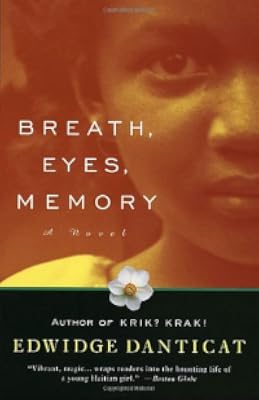
Breath, Eyes, Memory
by Edwidge Danticat
On This Page
Description
At the age of twelve, Sophie Caco is sent from her impoverished village of Croix-des-Rosets to New York, to be reunited with a mother she barely remembers. There she discovers secrets that no child should ever know, and a legacy of shame that can be healed only when she returns to Haiti--to the women who first reared her. What ensues is a passionate journey through a landscape charged with the supernatural and scarred by political violence, in a novel that bears witness to the traditions, show more suffering, and wisdom of an entire people. show lessTags
Recommendations


Member Recommendations
Member Reviews
Ellie (mirrordrum) had recommended I read Breath, Eyes, Memory by Edwidge Danticat, after I'd enjoyed other Danticat books, and that was a good call. This apparently was her debut novel, set in Haiti and New York City.
"I come from a place where breath, eyes and memory are one, a place where you carry your past like the hair on your head,'' says our narrator Sophie Caco. The child of rape by an unknown father, she lives with her Tante Atie in a small town in Haiti while her mother sends back money to help them from NYC. The book revolves around family expectations and how to survive them intact, including that daughters remain virginal. Sophie, her mother and grandmother, and Tante Atie, all experience traumatic practices that have been show more passed down from generation to generation.
At 12 years old, Sophie joins her mother Martine in New York, and both try to reconcile and escape past tragedy. There is sadness in the story, but also beauty, including the bucolic life in Haiti and the struggles of immigrants to make it in New York. Sophie faces many challenges, and is relentlessly observant. Danticat has a graceful, hypnotic prose style, and this is one of her best. show less
"I come from a place where breath, eyes and memory are one, a place where you carry your past like the hair on your head,'' says our narrator Sophie Caco. The child of rape by an unknown father, she lives with her Tante Atie in a small town in Haiti while her mother sends back money to help them from NYC. The book revolves around family expectations and how to survive them intact, including that daughters remain virginal. Sophie, her mother and grandmother, and Tante Atie, all experience traumatic practices that have been show more passed down from generation to generation.
At 12 years old, Sophie joins her mother Martine in New York, and both try to reconcile and escape past tragedy. There is sadness in the story, but also beauty, including the bucolic life in Haiti and the struggles of immigrants to make it in New York. Sophie faces many challenges, and is relentlessly observant. Danticat has a graceful, hypnotic prose style, and this is one of her best. show less
his is Danticat's remarkable first novel, a heavy tale of troubled women coming to terms with life's burdens and losses, inevitably passing the seeds of trauma and dysfunction down through the generations, with the best of intentions. Danticat's prose and style are beautiful, making it almost impossible to draw back from the heartache. There are a number of fine reviews on site, although those that criticize the structure, or speculate on how the story may not "work" for "middle class white readers" are pretty far off the mark. This is a human story, cultural details notwithstanding, that anyone with a beating heart should find moving. I'd love to sit a couple white male politicians down in a room with good lighting and not let 'em out show more 'til they've absorbed every last word. show less
Nightmares Passed on Through Generations
"I come from a place where breath, eyes and memory are one, a place from which you carry your past like the hair on your head."
Much of this book is difficult to read. The pain and horror that the women expierence affect them and their relationships through generations..."and recreate the same unspeakable acts that they themselves lived through."
Sophie's mother experienced horrible violations in her youth, making motherhood unbearable. Once Sophie and her mother reunite, her mother passed on nightmares "like heirlooms".
In the end, compassion helps Sophie realize that her mother was as b"brave as stars at dawn".
"I come from a place where breath, eyes and memory are one, a place from which you carry your past like the hair on your head."
Much of this book is difficult to read. The pain and horror that the women expierence affect them and their relationships through generations..."and recreate the same unspeakable acts that they themselves lived through."
Sophie's mother experienced horrible violations in her youth, making motherhood unbearable. Once Sophie and her mother reunite, her mother passed on nightmares "like heirlooms".
In the end, compassion helps Sophie realize that her mother was as b"brave as stars at dawn".
There's a certain kind of reader that prefers novels about the interpersonal problems of couples who live in New York City or London. There's a certain kind of reader who likes books that contain characters that they can describe as "relatable." "Breath, Eyes, Memory" is not a book for those kind of readers. Like Chinua Achebe's "Things Fall Apart", it's a novel that's filled with characters who love to tell stories but may never have picked up a novel in their lives. Split between rural Haiti and the grimy, dangerous parts of New York, there probably isn't much that middle-class native English speakers will be able to directly relate to here. During the scenes set in Haiti, its characters speak in a folk dialect so dense with metaphor show more and allusion that they might as well be reciting poetry to one another. The figurative language here is often extremely beautiful, but, as it seems awkawrdly translated from Creole or French, it often sits rather uncomfortably on the page, which is, I'd wager, exactly the effect the author sought to create. I liked it, but I imagine that some readers will find it too strange, others almost quaint. The scenes set in Reagan-era New York are, in contrast, enormously blunt about the pain and disorientation of the immigrant experience: the mental trauma that its characters feel is often so great that they often seem hardly able to fully acknowledge, never mind express, their confusion. While the parts of the book set in Haiti show how tight-knit Haitian families and rural communities can be, this human connection doesn't often seem to offer much comfort to anyone: the author is not at all interested in sparing the reader the details the place's overwhelming poverty. In "Breath, Eyes, Memory," life is, above all, hard and unforgiving, and involves one loss or disappointment after another.
Things do get better, though. The main character's family somehow manages to edge up into the American middle class. She meets a love interest so enormously likable that you wonder what he's doing in the novel at all, though her problems don't exactly disappear as soon as he makes his entrance. Her voice grows and matures as she does, and her and the reader's understanding of the books other characters also grows as the book moves forward, even as their pain lingers. But "Breath, Eyes, Memory" never quite stops seeming like an attempt -- if a fairly successful one -- to use the novelistic form to describe a sort of human experience that has, historically, been almost completely foreign to it. This, too, may or may not please its readers, and will probably lose some completely. Danticat, to her credit, doesn't seem much inclined to put any of her first world readers on familiar ground: "Breath, Eyes, Memory" feels like it's told on her terms.
Men are largely absent from the book, and there are times where it seems that the author is deliberately trying to portray life in this Haitian family as centered on communal, specifically female experience. There are times when the main character and her mother seem to strike a hard-fought balance between the culture that produced them and their later experiences. But it's never easy, and, as good as this novel can be, it's seldom a reassuring or comfortable read. It's an often poetic novel about the hard realities of survival in tough places. It's unlike most novels I've ever read, and won't be everybody's cup of tea. Even so, I'd recommend it to everyone but the readers mentioned at the beginning of my review. show less
Things do get better, though. The main character's family somehow manages to edge up into the American middle class. She meets a love interest so enormously likable that you wonder what he's doing in the novel at all, though her problems don't exactly disappear as soon as he makes his entrance. Her voice grows and matures as she does, and her and the reader's understanding of the books other characters also grows as the book moves forward, even as their pain lingers. But "Breath, Eyes, Memory" never quite stops seeming like an attempt -- if a fairly successful one -- to use the novelistic form to describe a sort of human experience that has, historically, been almost completely foreign to it. This, too, may or may not please its readers, and will probably lose some completely. Danticat, to her credit, doesn't seem much inclined to put any of her first world readers on familiar ground: "Breath, Eyes, Memory" feels like it's told on her terms.
Men are largely absent from the book, and there are times where it seems that the author is deliberately trying to portray life in this Haitian family as centered on communal, specifically female experience. There are times when the main character and her mother seem to strike a hard-fought balance between the culture that produced them and their later experiences. But it's never easy, and, as good as this novel can be, it's seldom a reassuring or comfortable read. It's an often poetic novel about the hard realities of survival in tough places. It's unlike most novels I've ever read, and won't be everybody's cup of tea. Even so, I'd recommend it to everyone but the readers mentioned at the beginning of my review. show less
An extraordinarily well written novel. There is so much going on in this novel, sometimes just beneath the surface—the crushing oppression of societal poverty, the richness of cultural tradition, the peril of cultural expectations, sexual violence, mental illness, immigration & assimilation, etc., etc. But Danticat tells the story with a sensitivity and subtlety that keeps the narrative itself always alive & compelling.
Sophie Caco lives with her Tante Atie in Haiti, while her mother Martine is in New York. At the age of twelve, Sophie goes to New York to live with her mother and learns a dark secret that affects her relationship with her mother.
This is a harrowing book. While the Caco women - Sophie, Martine, Atie, and Ife (Sophie's grandmother) - are all strong, they all have heartbreak and hurt, and hurt each other. Sophie's first-person narration means you see the world through her eyes, and don't always realize the perspectives of the other characters until Sophie herself does. Danticat's writing is poetic and evocative. It's a well-crafted story that I would have enjoyed writing about as an English major, but it's so heartrending that I couldn't show more enjoy it. show less
This is a harrowing book. While the Caco women - Sophie, Martine, Atie, and Ife (Sophie's grandmother) - are all strong, they all have heartbreak and hurt, and hurt each other. Sophie's first-person narration means you see the world through her eyes, and don't always realize the perspectives of the other characters until Sophie herself does. Danticat's writing is poetic and evocative. It's a well-crafted story that I would have enjoyed writing about as an English major, but it's so heartrending that I couldn't show more enjoy it. show less
in contrast to the book i had just finished (la bastarda) this book absolutely saturates the reader in haitian culture and feeling, through the characters and what they experience. this is such an excellent example of how to both tell a compelling story while also showing people what life for some people in a different culture/country is like. beautifully done and the language is wonderful.
it's not perfect, though, and the introduction of bulimia was handled awkwardly without enough followup and exposition. (this was the main thing that bothered me about the book, and that cost it a star or more.) it was perfectly believable but i think needed to be handled differently, and more in depth, especially for how late it was introduced. the show more last quarter or so fell off for me, partially because of this, which is too bad because the resolution of the story is excellent and the writing fantastic. still overall very well done. show less
it's not perfect, though, and the introduction of bulimia was handled awkwardly without enough followup and exposition. (this was the main thing that bothered me about the book, and that cost it a star or more.) it was perfectly believable but i think needed to be handled differently, and more in depth, especially for how late it was introduced. the show more last quarter or so fell off for me, partially because of this, which is too bad because the resolution of the story is excellent and the writing fantastic. still overall very well done. show less
Members
- Recently Added By
Lists

Oprah's Book Club (original and 2.0)
91 works; 21 members

100 books to read in a lifetime
102 works; 37 members

Best African American Literature
53 works; 9 members
Black Authors
384 works; 32 members

The Immigrant's Stories
74 works; 19 members

Top Five Books of 2021
604 works; 181 members

This is the Canon: Decolonize Your Bookshelf in 50 Books
51 works; 5 members

africa diaspora novels
10 works; 1 member
50 Books by Women Authors
50 works; 10 members

Best African and African diaspora books
111 works; 4 members

First Novels
373 works; 17 members

Books Read in 2008
336 works; 8 members

Books With Body Parts in the Title
153 works; 9 members

Books Read in 2021
5,361 works; 114 members
Books by Black Authors: Potential Reads
12 works; 1 member

AP Lit
363 works; 6 members
Author Information

44+ Works 12,836 Members
Edwidge Danticat was born in Haiti in 1969 and came to America at age twelve to live with her parents in Brooklyn. She studied French literature at Barnard College and received her M.F.A. from Brown University. Her work has achieved both popular and critical acclaim. Breath, Eyes, Memory (1994), her first novel and master's thesis, garnered show more Danticat a Granta Regional Award for Best Young American Novelist and was chosen as an Oprah Book Club selection, a singular honor. Her collection of short stories Krik? Krak! (1995) was nominated for the National Book Award. Along with awards for fiction from Seventeen and Essence and the 1995 Pushcart Short Story Prize, Danticat was chosen by Harper's Bazaar as "one of 20 people in their twenties who will make a difference," and by the New York Times Magazine as one of "30 Under 30" people to watch. Her second novel, The Farming of Bones (1998), concerns a massacre in Haiti in 1937. (Bowker Author Biography) show less
Awards and Honors
Awards
Distinctions
Notable Lists
Work Relationships
Has as a student's study guide
Common Knowledge
- Canonical title
- Breath, Eyes, Memory
- Original publication date
- 1994
- People/Characters
- Sophie; Tante Atie; Martine; Joseph; Bridgitte; Grandmother (show all 7); Marc
- Important places
- Caribbean Region; USA; Haiti; Hispaniola; New York, New York, USA; Providence, Rhode Island, USA (show all 7); Port-au-Prince, Haïti
- Dedication
- To the brave women of Haiti,
grandmothers, mothers, aunts,
sisters, cousins, daughters, and friends,
on this shore and other shores.
We have stumbled but we will not fall. - First words
- A flattened and drying daffodil was dangling off the little card that I had made my aunt Atie for Mother's Day.
- Last words
- (Click to show. Warning: May contain spoilers.)"Now, she said, you will know how to answer."
Classifications
Statistics
- Members
- 3,188
- Popularity
- 5,448
- Reviews
- 72
- Rating
- (3.77)
- Languages
- 9 — Dutch, English, Finnish, French, German, Italian, Norwegian (Bokmål), Spanish, Swedish
- Media
- Paper, Audiobook, Ebook
- ISBNs
- 37
- ASINs
- 15