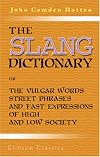
The Slang Dictionary
by John Camden Hotten
34 Members (5.00)
On This Page
Description
"All ridiculous words make their first entry into a language by familiar phrases; I dare not answer for these that they will not in time be looked upon as a part of our tongue."SPECTATOR."Rabble-charming words, which carry so much wild fire wrapt up in them."SOUTH."Slang derivations are generally indirect, turning upon metaphor and fanciful allusions, and other than direct etymological connexion. Such allusions and fancies are essentially temporary or local; they rapidly pass out of the show more public mind: the word remains, while the key to its origin is lost.""Many of these [slang] words and phrases are but serving their apprenticeship, and will eventually become the active strength of our language."H. T. BUCKLE. show lessTags
Recommendations


















Member Reviews
Members
- Recently Added By
Published Reviews
Hotten is the first slang lexicographer to come up with a considered treatment of the history of slang and indeed of cant, or criminal slang. He also offers a history of back slang and rhyming slang. His is a substantial bibliography, which no one had done before him. No-one had ever written about slang in the way that Hotten did.
added by a.book.collector
Author Information
Common Knowledge
- Canonical title
- The Slang Dictionary
- Original publication date
- 1859
- Important places
- United Kingdom
- Original language
- English UK
Classifications
- Genres
- Reference, Nonfiction, History
- DDC/MDS
- 427.09 — Language English & Old English languages Historical and geographic variations, modern nongeographic variations of English standard subdivisions, and by time period [formerly: Modern slang]
- LCC
- PE3721 .H7 — Language and Literature English language English Slang. Argot, etc.
- BISAC
Statistics
- Members
- 34
- Popularity
- 815,883
- Rating
- (5.00)
- Languages
- English
- Media
- Paper, Ebook
- ISBNs
- 10
- ASINs
- 7