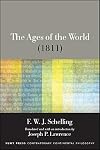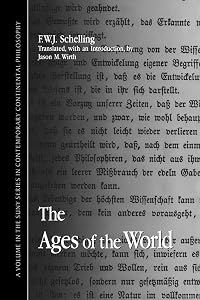
The Ages of the World: (Fragment) from the Handwritten Remains
by Friedrich Wilhelm Joseph von Schelling
On This Page
Description
"In 1810, after establishing a reputation as Europe's most prolific philosopher, F. W. J. Schelling embarked on his most ambitious project, The Ages of the World. For over a decade he produced multiple drafts of the work before finally conceding its failure, a "failure" in which Heidegger, Jaspers, Voegelin, and many others have discerned a pivotal moment in the history of philosophy. Slavoj Zizek calls this text the "vanishing mediator," the project that, even while withheld and concealed show more from view, connects the epoch of classical metaphysics that stretches from Plato to Hegel with the post-metaphysical thinking that began with Marx and Kierkegaard. Although drafts of the second and third versions from 1813 and 1815 have long been available in English, this translation by Joseph P. Lawrence is the first of the initial 1811 text. In his introductory essay, Lawrence argues for the importance of this first version of the work as the one that reveals the full sweep of Schelling's intended project, and he explains its significance for concerns in modern science, history, and religion"-- show lessTags
Recommendations








Member Reviews
Along with The Philosophy Of Mythology, this has been the most engaging book I've read by Schelling; and with his essay on human freedom, those three works mark Schelling at his most mature and most original. He hasn't lost all of his dependence on Fichte but it isn't as prominent as it was in earlier works. Here, as with the essay on human freedom, Schelling shows a little more dependence on Jacob Boehme, the Gorlitz mystic. While I do like Boehme to a degree, I have some misgivings regarding some of his ideas; and specifically the ones Schelling here uses. These issues do not take up a lot of the book, so it's not enough to affect my rating. His dependence on Boehme isn't all encompassing. It's noticeable in various places, but it's show more clear that Schelling isn't simply regurgitating Boehme's theosophy. He definitely has some unique ideas here. I don't know if Schelling may be dependent on Franz von Baader in some of his thought. Baader has yet to be translated into English, apart from brief extracts, so I have not been able to research him adequately. It is known, however, that Schelling was influenced by Baader, so some dependence is probably a safe bet.
This work does fit rather well with the lectures that make up his Philosophy of Mythology, which I was quite impressed with. In that work, Schelling investigated the philosophical continuity of revelation through religion and mythology up through Judaism and Christianity. In this work, he more or less investigates theosophy (not in the Blavatskian sense, of course). This book really strikes me as being strongly Neo-Platonist. There is an undercurrent of pantheism, or, at least, panentheism. It's not that I support either, but the investigation I thought was so intriguing I cannot give the book any less than the highest rating. It is clear to me why the Russian philosopher Vladimir Solovyov (who I am well acquainted with) was a follower of Schelling and this work in particular. This work does seem to be at least partially what the system of sophiology was based on. At least in the case of Solovyov. Bulgakov seems to have been more circumspect in regards to Schelling; but I think Berdyaev probably was influenced by this work.
This concludes my reading of Schelling for the time being. Very good book to end with. I would have to say that even though Fichte was the true originator of German Idealism, Schelling certainly applied it in ways that I think were often more interesting. show less
This work does fit rather well with the lectures that make up his Philosophy of Mythology, which I was quite impressed with. In that work, Schelling investigated the philosophical continuity of revelation through religion and mythology up through Judaism and Christianity. In this work, he more or less investigates theosophy (not in the Blavatskian sense, of course). This book really strikes me as being strongly Neo-Platonist. There is an undercurrent of pantheism, or, at least, panentheism. It's not that I support either, but the investigation I thought was so intriguing I cannot give the book any less than the highest rating. It is clear to me why the Russian philosopher Vladimir Solovyov (who I am well acquainted with) was a follower of Schelling and this work in particular. This work does seem to be at least partially what the system of sophiology was based on. At least in the case of Solovyov. Bulgakov seems to have been more circumspect in regards to Schelling; but I think Berdyaev probably was influenced by this work.
This concludes my reading of Schelling for the time being. Very good book to end with. I would have to say that even though Fichte was the true originator of German Idealism, Schelling certainly applied it in ways that I think were often more interesting. show less
Ratings
Members
- Recently Added By
Author Information

143+ Works 1,424 Members
Series
Belongs to Publisher Series
Common Knowledge
- Canonical title
- The Ages of the World: (Fragment) from the Handwritten Remains (Fragment)
Classifications
Statistics
- Members
- 85
- Popularity
- 374,408
- Reviews
- 1
- Rating
- (4.50)
- Languages
- English, French, German, Italian
- Media
- Paper, Ebook
- ISBNs
- 11
- ASINs
- 1