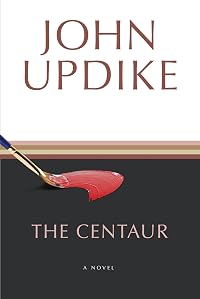
The Centaur
by John Updike
On This Page
Description
In a small Pennsylvania town in the late 1940s, schoolteacher George Caldwell yearns to find some meaning in his life. Alone with his teenage son for three days in a blizzard, Caldwell sees his son grow and change as he himself begins to lose touch with his life. Interwoven with the myth of Chiron, the noblest centaur, and his own relationship to Prometheus, The Centaur is one of John Updike's most brilliant and unusual novels, blending the worlds of modern youth and ancient mythology.Tags
Recommendations















Member Reviews
This is a sad little book where men want to talk about their feelings but can't for 222 pages and, as a result, nothing happens. I had a hard time believing John Updike had ever met a woman when I read "This sense of danger, of dreadful things he has seen, excites her. Her breasts seem to float on her ribs warmly; she suppresses an instinct to bring her hands to them" (177) but I finished the godforsaken packet of tinder and got to the index, which the author says his wife suggested. This begs the incredible question of what sane woman would decide not only to repeatedly see a man like this but to marry him.
Some may contest my claims of nothing happening in the book with the instances where father and son get stuck in the snow, where show more they get stuck in a city, where they get stuck in the house of the Hummels, where they get stuck in (literally any other location mentioned in the book). Updike does nothing but create elevator after elevator for his poor characters who, despite being given nothing but opportunities, never come to crisis. Instead of a novel, this is more a list of their individual failures.
While reading this, I read "There’s a New 'It’s Not You, It’s Me' and It’s Still Terrible" by an accident of social media, and found that the author Cat Zhang perfectly stated what is so exhausting in Caldwell's character when she described a dirtbag variety of boyfriend in the late 20teens:
This sounds so familiar, a Centaur reader might think to herself. It's Caldwell's refrain, said on pg. 71 to a hitchhiker he and Peter pick up on the way to school: "If ever a kid deserved a break, it's this kid here. My wad is shot. Time to trade in on a new old man; I'm a walking junk heap." This inability to move past personal fault and comparison is what keeps Caldwell from growing during the book; it's his out of each crisis, whether social or emotional. Instead of solving problems, he apologizes. As a result, the reactions of those around him are constantly the same; his stagnation prevents the maturation of his teenage son and any confrontation with his coworkers or students.
The book has enough atypical structure that it may have been innovative at the time. The first chapter, which I read for a class years ago, is decidedly the strongest; Updike blends a literal interpretation of myth with the physical reality of the school. Unfortunately he quickly drops this, the interesting conceit of the book, in favor of exploring new ways for Caldwell to fail, new situations for him to avoid any type of progress or development. The non-chronological structure functions as scaffold for more peering at the deepest disappointments middle age can provide. And the last chapter, an exercise in how to weave misogyny and racism as an undercurrent in narration, is icing on the cake.
So, what did Updike do well? In all the time he saves by not having anything happen, he's able to cultivate a pretty excellent repertoire of setting descriptions. I'd be pleased to visit the towns in this book, but only if I could be guaranteed no one remotely like these characters would be there. show less
Some may contest my claims of nothing happening in the book with the instances where father and son get stuck in the snow, where show more they get stuck in a city, where they get stuck in the house of the Hummels, where they get stuck in (literally any other location mentioned in the book). Updike does nothing but create elevator after elevator for his poor characters who, despite being given nothing but opportunities, never come to crisis. Instead of a novel, this is more a list of their individual failures.
While reading this, I read "There’s a New 'It’s Not You, It’s Me' and It’s Still Terrible" by an accident of social media, and found that the author Cat Zhang perfectly stated what is so exhausting in Caldwell's character when she described a dirtbag variety of boyfriend in the late 20teens:
“I can’t be what you need” (ICBWYN, for short, and for fun) seems to function as an emergency brake for panicked individuals in search of an out. It allows them to shrug off relationships before they mean anything. ... When we use ICBWYN against others, we also deny ourselves the ways in which we’re growing; we bar ourselves from the tender possibilities of becoming someone they could need.
This sounds so familiar, a Centaur reader might think to herself. It's Caldwell's refrain, said on pg. 71 to a hitchhiker he and Peter pick up on the way to school: "If ever a kid deserved a break, it's this kid here. My wad is shot. Time to trade in on a new old man; I'm a walking junk heap." This inability to move past personal fault and comparison is what keeps Caldwell from growing during the book; it's his out of each crisis, whether social or emotional. Instead of solving problems, he apologizes. As a result, the reactions of those around him are constantly the same; his stagnation prevents the maturation of his teenage son and any confrontation with his coworkers or students.
The book has enough atypical structure that it may have been innovative at the time. The first chapter, which I read for a class years ago, is decidedly the strongest; Updike blends a literal interpretation of myth with the physical reality of the school. Unfortunately he quickly drops this, the interesting conceit of the book, in favor of exploring new ways for Caldwell to fail, new situations for him to avoid any type of progress or development. The non-chronological structure functions as scaffold for more peering at the deepest disappointments middle age can provide. And the last chapter, an exercise in how to weave misogyny and racism as an undercurrent in narration, is icing on the cake.
So, what did Updike do well? In all the time he saves by not having anything happen, he's able to cultivate a pretty excellent repertoire of setting descriptions. I'd be pleased to visit the towns in this book, but only if I could be guaranteed no one remotely like these characters would be there. show less
Utterly beautiful, fabulous, CLEVER writing. I couldn't put it down.
Set in small-town America in the late 40s, this is the tale of a father (the hapless George Caldwell; teacher, bit of a failure, derided by students and the principal, loved- but sometimes exasperating to- his teenage son). And of his son- a student at the same school, concerned with his first girlfriend, his psoriasis, his family...)
Set over three days one January, there are ongoing issues with the clapped out family car getting stuck in snowdrifts. Meanwhile George is having tests for what he suspects may be cancer...
And then Updike weaves a strand of Greek mythology into the narrative. The reader may pick up on some- I noted Hephaesteus in Mr Hubble, a lame but show more highly proficient engineer with a faithless wife. And the eponymous Centaur, where the narrative on George suddenly transforms him into such a beast. It was massively clever (although I thought Updike's index at the back, informing the reader of all the mythological allusions may have been a bit OTT.) I didnt see too many similarities between Caldwell and a Centaur - but representing the teacher in this guise DOES allow Updike to wonderfully describe a certain event towards the end in - I think - a still more moving way than if he'd just baldly written of the teacher.
The best book I've read this year- I'm off to order some more Updike books of Ebay. Masterly writing. show less
Set in small-town America in the late 40s, this is the tale of a father (the hapless George Caldwell; teacher, bit of a failure, derided by students and the principal, loved- but sometimes exasperating to- his teenage son). And of his son- a student at the same school, concerned with his first girlfriend, his psoriasis, his family...)
Set over three days one January, there are ongoing issues with the clapped out family car getting stuck in snowdrifts. Meanwhile George is having tests for what he suspects may be cancer...
And then Updike weaves a strand of Greek mythology into the narrative. The reader may pick up on some- I noted Hephaesteus in Mr Hubble, a lame but show more highly proficient engineer with a faithless wife. And the eponymous Centaur, where the narrative on George suddenly transforms him into such a beast. It was massively clever (although I thought Updike's index at the back, informing the reader of all the mythological allusions may have been a bit OTT.) I didnt see too many similarities between Caldwell and a Centaur - but representing the teacher in this guise DOES allow Updike to wonderfully describe a certain event towards the end in - I think - a still more moving way than if he'd just baldly written of the teacher.
The best book I've read this year- I'm off to order some more Updike books of Ebay. Masterly writing. show less
Published in 1963, when the author was 31, The Centaur emerges, like an early flowering, from John Updike’s singular genius. This award-winning novel, set in 1947, chronicles several days in the life of 50-year-old George Caldwell, a teacher of general science at a small-town Pennsylvania school, and his 15-year-old son Peter. George is convinced, despite assurances to the contrary, that he is dying, and more than once maintains that he was never meant to reach such an advanced age. It is not so much that he imagines he’s suffering from a specific illness or ailment. Rather, a prevailing sense that he has failed repeatedly on numerous fronts, has outlived his usefulness and is no good at anything pervades his waking hours, colours show more his perception of the world and his place in it, and thereby shapes his character. Peter is trapped in the wake of his father’s overwhelming despair. Tormented by psoriasis, the marks of which he strives to keep hidden, he seems to exist in a state of constant shame and intense emotional vulnerability brought on, at least in part, by his father’s unrelenting self-criticisms and declarations of failure and ineptitude, and by his own struggle to not regard his father as ridiculous. The action of the novel follows George and Peter on their difficult travels between their isolated home in the rural countryside to Olinger High School, where George teaches and Peter is a student, and their attendance at several school-related athletic events. In this novel Updike employs Greek myth to illuminate his characters’ actions, passions and motivations. George is Chiron, reputedly the wisest of the centaurs who, gravely wounded, sacrificed his immortality to save Prometheus. Peter is Prometheus, the deity who stole fire and gave it to humans, and who was punished by being chained to a rock. The story of George and Peter, their often querulous interactions and their exchanges with other characters, is certainly engaging and more than simply entertaining, and the novel’s success is due largely to the astounding richness and fluidity of Updike’s language, which explodes from the page, lending each and every scene pinpoint clarity, endowing even mundane gestures and observations with the quality of a miracle. Updike’s third novel, constructed around themes of redemption and sacrifice, is wise and frank, funny and moving. If the Greek myth motif comes across as somewhat heavy handed, it does not detract from a work that is widely regarded as a landmark in 20-Century American fiction and a major achievement by one of the most gifted writers of his generation. show less
Updike's prose is so artful, this story is gorgeously told, and there are scenes that will stay with me for some time. Yet, for whatever reason, this book existed as a sort of gray area for me--I wanted more myth or less, and firmer footing in one realm or another. Because although the movement between viewpoints added to the book, there was something about the emotional context and characterizations that kept me at such a distance from the story, I never quite got the impact that I've gotten from Updike's other works.
I may read this again, when my mind has more bandwidth for the complexity, and I'm sure I'll recommend it to particular readers, but this isn't the Updike work I'd start with if you're new to his prose.
I may read this again, when my mind has more bandwidth for the complexity, and I'm sure I'll recommend it to particular readers, but this isn't the Updike work I'd start with if you're new to his prose.
This early novel by John Updike remains my favorite. The opening page is as good as any he's written, and the handling of myth and realism is balanced and not too strained. This is not a University Novel, to be taught, but a Public Novel, to be read.
Updike is at his best, as far as I can tell, in short story form. That being said, this novel from the early '60s still impresses, and will, I suspect, continue to impress long after his dozens of later, more popular fictions, fade from memory.
Updike is at his best, as far as I can tell, in short story form. That being said, this novel from the early '60s still impresses, and will, I suspect, continue to impress long after his dozens of later, more popular fictions, fade from memory.
John Updike has such a gift with language and storytelling that I almost always find myself enmeshed, sometimes against my own will. The Centaur was one of those books wherein I was far more interested with the premise and the sentences than the overall structure. Still, Updike is always entertaining, so I cannot help but rate him a little higher than I would anyone else.
Well, it's Updike, so at least it doesn't suck stylistically... but this novel was a failure. In one sense it's the cap to his earliest 'Olinger' material (Olinger Stories, Poorhouse Fair, Of the Farm) but it's also a failed experiment, an attempt to wed a mythic subtext to a modern story, like Joyce or Barth; but he just doesn't pull it off. The mythic material isn't well-integrated, the modern family dynamics are underdeveloped. I was expecting to enjoy this, so I was very disappointed -- had to force myself to finish it.
Members
- Recently Added By
Published Reviews
ThingScore 50
Purports to tell the story of the evolution of a father's relationship with his son in a small town in modern Pennsylvania. At least this is how the average dopey reader would undertand the story, until, that is, he is confronted with an index ... having belatedly realised that the modren-dress story is a retelling of the legends of classical Greece.
added by KayCliff
Above all there is that beautiful Updikean wordplay, here manifested in attributive metaphors. Half the sentences in this book could be studied for Updike’s uncanny ability to lay visual markers on unrelated nouns, embedding man-made objects into natural surroundings by modifying the images of the artificial with those of the natural.
added by Shortride
This is a poor novel irritatingly marred by good features. The title, grindingly reinforced by the tasteful Hellenic fragment on the cover, sounds the warning note of “significance” and the severe intention is further signaled by a dark quotation from Karl Barth on the title page: something about man being “a creature on the boundary between heaven and earth.” As if one were not tuned show more by this time to the “universal” wave length, there follows on the next page, before our story really begins, a précis of the myth of Chiron, the weary centaur who sacrifices his immortality as an atonement for Prometheus. Then, lest we forget, the author has appended, at the suggestion of his wife, an index of the mythical references which crop up throughout the text...
The fact is that Updike does himself a great disservice by enameling his tale with the elaborate reference. At the center of all that wearisome pedantry he has a neglected germ of literary imagination. The father is carefully and sympathetically observed with a shambling heroism, fatigued and gullible, which is nicely set off against the irritable fondness of his son. He has chosen however to inflate this compact moral set-up, blowing it up into a volume which is out of proportion to its weight. It finally becomes flounderingly portentous and pompously intoned, like Hemingway’s Old Man and the Sea. show less
The fact is that Updike does himself a great disservice by enameling his tale with the elaborate reference. At the center of all that wearisome pedantry he has a neglected germ of literary imagination. The father is carefully and sympathetically observed with a shambling heroism, fatigued and gullible, which is nicely set off against the irritable fondness of his son. He has chosen however to inflate this compact moral set-up, blowing it up into a volume which is out of proportion to its weight. It finally becomes flounderingly portentous and pompously intoned, like Hemingway’s Old Man and the Sea. show less
added by SnootyBaronet
Lists

Magic Realism
371 works; 52 members

20th Century Literature
1,161 works; 55 members

Favourite Books
1,820 works; 316 members

National Book Award - Fiction
78 works; 10 members

Five star books
1,767 works; 109 members

Books Read in 2013
1,630 works; 51 members

Lucy's Long List
69 works; 1 member
Author Information

342+ Works 53,815 Members
American novelist, poet, and critic John Updike was born in Reading, Pennsylvania on March 18, 1932. He received an A.B. degree from Harvard University, which he attended on a scholarship, in 1954. After graduation, he accepted a one-year fellowship to study painting at the Ruskin School of Drawing and Fine Art in Oxford, England. After returning show more from England in 1955, he worked for two years on the staff of The New Yorker. This marked the beginning of a long relationship with the magazine, during which he has contributed numerous short stories, poems, and book reviews. Although Updike's first published book was a collection of verse, The Carpentered Hen and Other Tame Creatures (1958), his renown as a writer is based on his fiction, beginning with The Poorhouse Fair (1959). During his lifetime, he wrote more than 50 books and primarily focused on middle-class America and their major concerns---marriage, divorce, religion, materialism, and sex. Among his best-known works are the Rabbit tetrology---Rabbit, Run (1960), Rabbit Redux (1971), Rabbit Is Rich (1981), and Rabbit at Rest (1988). Rabbit, Run introduces Harry "Rabbit" Angstrom as a 26-year-old salesman of dime-store gadgets trapped in an unhappy marriage in a dismal Pennsylvania town, looking back wistfully on his days as a high school basketball star. Rabbit Redux takes up the story 10 years later, and Rabbit's relationship with representative figures of the 1960s enables Updike to provide social commentary in a story marked by mellow wisdom and compassion in spite of some shocking jolts. In Rabbit Is Rich, Harry is comfortably middle-aged and complacent, and much of the book seems to satirize the country-club set and the swinging sexual/social life of Rabbit and his friends. Finally, in Rabbit at Rest, Harry arrives at the age where he must confront his mortality. Updike won the Pulitzer Prize for both Rabbit Is Rich and Rabbit at Rest. Updike's other novels range widely in subject and locale, from The Poorhouse Fair, about a home for the aged that seems to be a microcosm for society as a whole, through The Court (1978), about a revolution in Africa, to The Witches of Eastwick (1984), in which Updike tries to write from inside the sensibilities of three witches in contemporary New England. The Centaur (1963) is a subtle, complicated allegorical novel that won Updike the National Book Award in 1964. In addition to his novels, Updike also has written short stories, poems, critical essays, and reviews. Self-Consciousness (1989) is a memoir of his early life, his thoughts on issues such as the Vietnam War, and his attitude toward religion. He was elected to the American Academy of Arts and Letters in 1977. He died of lung cancer on January 27, 2009 at the age of 76. (Bowker Author Biography) John Updike was born in 1932, in Shillington, Pennsylvania. Since 1957 he has lived in Massachusetts. His novels have won the Pulitzer Prize, the National Book Award, the National Book Critics Circle Award, & the Howells Medal. (Publisher Provided) John Updike was born in 1932 and attended Harvard College and the Ruskin School of Drawing and Fine Art in Oxford, England. Form 1955 to 1957 he was a staff member of The New Yorker, which he contributed numerous writings. Updike's art criticism has appeared in publications including Arts and Antiques, The New Republic, The New York Times Book Review, and Realites, among many others. He is the author of such best-selling novels as Rabbit Run and Rabbit is Rich. His many works of fiction, poetry and criticism have been awarded the Pulitzer Prize, the National Book Award, the American Book Award, and the National Book Critics Circle Award. For the past 40 years he has lived in Massachusetts. (Publisher Provided) John Updike is the author of some 50 books, including collections of short stories, poems, & criticism. His novels have won the Pulitzer Prize, the National Book Award, the National Book Critics Circle Award, & the Howells Medal. Born in Shillington, Pennsylvania, in 1932, he has lived in Massachusetts since 1957. (Publisher Provided) show less
Awards and Honors
Awards
Distinctions
Series
Belongs to Publisher Series
Work Relationships
Common Knowledge
- Canonical title
- The Centaur
- Original title
- The Centaur
- Original publication date
- 1963-02-04
- People/Characters
- Geoorge Caldwell; Peter Caldwell; Catherine Caldwell ('Cassie', né | e Kramer); Penny
- Important places
- Alton, Pennsylvania, USA; Pennsylvania, USA
- Epigraph
- "Heaven is the creation inconceivable to man, earth the creation conceivable to him. He himself is the creature on the boundary between heaven and earth. "
KARL BARTH
But it was still needful that a life should be given to expiate that ancient sin, -- the theft of fire. It happened that Chiron, noblest of all the Centaurs (who are half horses and half men), was wandering the world in agon... (show all)y from a wound he had received by strange mischance. For, at a certain wedding-feast among the Lapithae of Thessaly, one of the turbulent Centaurs had attempted to steal away the bride. A fierce struggle followed, and in the general confusion, Chiron, blameless as he was, had been wounded by a poisoned arrow. Ever tormented with the hurt and never to be healed, the immortal Centaur longed for death, and begged that he might be accepted as an atonement for Prometheus. The gods heard his prayer and took away his pain and his immortality. He died like any wearied man, and Zeus set him as a shining archer among the stars.
--Old Greek Folk Tales Told Anew
BY JOSEPHINE PRESTON PEABODY, 1897. - First words
- Caldwell turned and as he turned his ankle received an arrow.
- Quotations
- "The Devil and me, Pop," my father said. "I love lies. I tell 'em all day. I'm paid to tell 'em." (Knopf, 1990, p. 49)
- Last words
- (Click to show. Warning: May contain spoilers.)Here, in the Zodiac, now above, now below the horizon, he assists in the regulation of our destinies, though in this latter time few living mortals cast their eyes respectfully toward Heaven, and fewer still sit as students to the stars.
- Publisher's editor
- Jones, Judith
- Original language*
- Englisch
*Some information comes from Common Knowledge in other languages. Click "Edit" for more information.
Classifications
Statistics
- Members
- 1,273
- Popularity
- 19,269
- Reviews
- 26
- Rating
- (3.48)
- Languages
- 12 — Czech, Dutch, English, French, German, Hungarian, Italian, Farsi/Persian, Polish, Russian, Spanish, Ukrainian
- Media
- Paper, Audiobook, Ebook
- ISBNs
- 42
- ASINs
- 28