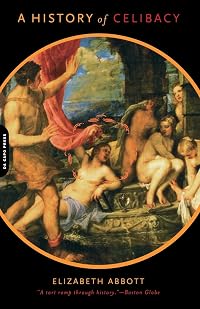
A History of Celibacy
by Elizabeth Abbott
On This Page
Description
"Elizabeth Abbott's spirited and provocative exploration of celibacy debunks the traditionally held notion that celibacy is a predominantly religious concept of little concern to the secular world. With myriad examples, Abbott's history reveals insights not only about our religious practices but also about our sexual desires and changing attitudes toward gender and physical health." "From the vestal virgins of ancient Rome, who were entombed alive if they broke their vows, to contemporary show more athletes, who "conserve semen" to enhance their game, from celibacy as a guarantee for marriage to involuntary celibacy among prisoners, eunuchs, and young women cloistered against their will, Abbott puts a human face on celibacy, capturing the anguish of the castrated boy destined for an operatic career, the ecstasy of the woman whose celibacy is rewarded by visions of Christ, and the anger of the bachelor doomed by the surplus of males in contemporary China."--Jacket. show lessTags
Recommendations




















Member Reviews
Abbott’s survey of celibacy throughout the ages and across the globe is a feminist take on the ways that celibacy has empowered some and crushed others. The first few chapters look at the celibacy from the Greeks and Romans through early and later Christianity. The book does tend to focus rather more on the West, but the author clearly made an effort to look at other cultures and religions. After a chapter examining other major religions, the book divides its look at celibacy by topic – celibacy to preserve semen, empower women, as a duty, for a cause, coerced etc. The last chapter picks up the more linear historical look at the 20th century. It’s a survey so sometimes there’s jumping around and each individual section is short show more – it would be easy to find more in-depth information about, for example, Elizabeth I and Florence Nightingale. However, the analysis of the benefits and drawbacks of celibacy is good and the nuanced situating of various forms of celibacy in context makes the book well worth reading.
Abbott is at her best in her vivid descriptions of the lives of strong, unconventional women – early Christians (real or apocryphal) who could be reformed prostitutes, desert-dwelling virgins or rebellious daughters; the Beguines, a loose spiritual community of women who did good deeds; Catherine of Siena – her extravagant asceticism gave her a power she could never have had in a conventional life but is also somewhat disturbing; powerful virgin priestesses – the Roman vestal virgins and the Incan acllas; Joan of Arc and the Crow warrior Woman Chief; artistic women in Boston marriages. For women who voluntarily chose to become celibate, the rewards could be immense – equal or superior status to men, control of their bodies and future, freedom from drudgery and childbirth. But of course many women were forced to remain chaste in some way – forced into a convent, victims of the double standard in multiple ways. Men who chose to be celibate often saw women as, at best, a distraction and at worst a sinful inferior being. Abbott is clearly writing from a feminist perspective. For the most part, she seems sympathetic to or at least gives a very good description of the power of the draw of celibacy. However, it is clear that patriarchal society and the church hierarchy are often the villains in her summaries. She notes “I seek spirituality in my religion, Christianity, but exploring its roots as I researched this book left me instead struggling to retain my religious faith.” Her contempt in some of the sections – on the role of Hindu widows, Chinese foot binding, female genital mutilation, American slaveholders and 19th c. English attitudes towards prostitution – comes through.
This being a history of celibacy, there are some queasily memorable bits – Abbott’s description of actual chastity belts, the horrifying-sounding impotence tests in pre-Revolutionary France, the multiple methods of castration that were described. Overall very interesting. show less
Abbott is at her best in her vivid descriptions of the lives of strong, unconventional women – early Christians (real or apocryphal) who could be reformed prostitutes, desert-dwelling virgins or rebellious daughters; the Beguines, a loose spiritual community of women who did good deeds; Catherine of Siena – her extravagant asceticism gave her a power she could never have had in a conventional life but is also somewhat disturbing; powerful virgin priestesses – the Roman vestal virgins and the Incan acllas; Joan of Arc and the Crow warrior Woman Chief; artistic women in Boston marriages. For women who voluntarily chose to become celibate, the rewards could be immense – equal or superior status to men, control of their bodies and future, freedom from drudgery and childbirth. But of course many women were forced to remain chaste in some way – forced into a convent, victims of the double standard in multiple ways. Men who chose to be celibate often saw women as, at best, a distraction and at worst a sinful inferior being. Abbott is clearly writing from a feminist perspective. For the most part, she seems sympathetic to or at least gives a very good description of the power of the draw of celibacy. However, it is clear that patriarchal society and the church hierarchy are often the villains in her summaries. She notes “I seek spirituality in my religion, Christianity, but exploring its roots as I researched this book left me instead struggling to retain my religious faith.” Her contempt in some of the sections – on the role of Hindu widows, Chinese foot binding, female genital mutilation, American slaveholders and 19th c. English attitudes towards prostitution – comes through.
This being a history of celibacy, there are some queasily memorable bits – Abbott’s description of actual chastity belts, the horrifying-sounding impotence tests in pre-Revolutionary France, the multiple methods of castration that were described. Overall very interesting. show less
A brilliant and poignant story of human deprivation. This is a surprisingly deep study that shows celibacy to be debilitating, neurotic, and at times empowering.
Abbott’s treatise on all manners and varieties of celibacy throughout history is wide-ranging but not all-encompassing. Any such attempt would make the work doubly thick but not doubly rich. While some of her assertions cannot be entirely substantiated, they do not detract from the overall scholarship. An excellent start into this subject area.
Not Read
Ratings
Members
- Recently Added By
Author Information

9 Works 986 Members
Elizabeth Abbott is Dean of Women at Trinity College, University of Toronto.
Some Editions
Awards and Honors
Common Knowledge
- Original publication date
- 1999; 2003
- People/Characters
- Mohandas Gandhi
- Dedication
- To Yves Pierre-Louis
For his gift of precious friendship
Through the best of times and the worst of times
To the memory of my aunt
Margaret Abbott Cameron,
Canada's first female race car driver - First words
- Two incidents inspired me to launch a wide-ranging exploration of celibacy.
I grew up knowing about mistresses because my great-grandfather Stephen Adelbert Griggs, an affluent Detroit brewer and municipal politician, maintained what my mother scornfully referred to as a "love nest" occupied by a ser... (show all)ies of "fancy" women. - Last words
- (Click to show. Warning: May contain spoilers.)Either way, the element of choice is crucial.
(Click to show. Warning: May contain spoilers.)Yet despite these liberated and liberating possibilities, too many mistresses still cast themselves in the ancient mold, with all its sacrifices and sadness, measuring themselves against the marital model, and finding themselves wanting. - Publisher's editor
- Langlois, Nicole; Blake, Gillian
- Blurbers
- Kingswell, Mark; Fraser, John
Classifications
Statistics
- Members
- 328
- Popularity
- 96,857
- Reviews
- 5
- Rating
- (3.92)
- Languages
- 6 — Chinese, English, French, Hungarian, Italian, Croatian
- Media
- Paper, Ebook
- ISBNs
- 14
- UPCs
- 1
- ASINs
- 1